Short Answer
Key Formula / Key Facts Box
Basic bearing life equation (L10)
L10 = (C / P)3 × 10⁶ revolutions
| Symbol | Meaning | US Unit | SI Unit | Plain‑English |
|---|---|---|---|---|
| C | Dynamic load rating | lbf | N | Maximum load the bearing can sustain indefinitely |
| P | Equivalent dynamic bearing load | lbf | N | Actual load transmitted to the bearing |
| L10 | Basic rating life (90 % reliability) | rev | rev | Number of revolutions 90 % of bearings will reach |
| n | Rotational speed | rpm | r/min | Speed of pump shaft |
| Lh | Life in operating hours | h | h | Convert revolutions to hours: Lh = L10/(60·n) |
Overview — What It Is and Why It Matters
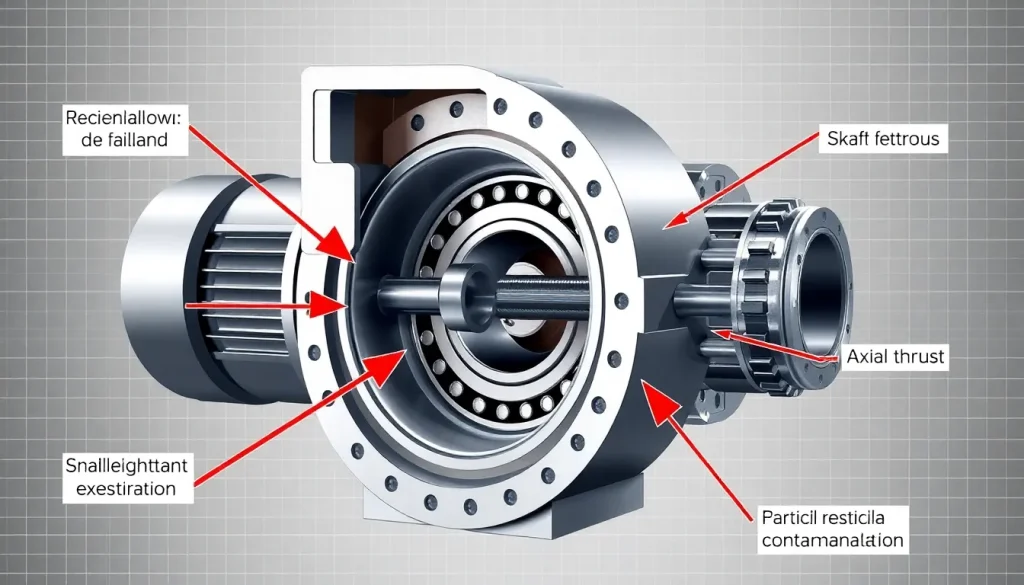
In a centrifugal or positive‑displacement pump, the shaft is supported by rolling‑element bearings that carry radial, axial, and sometimes tilting loads. When a bearing fails before its design life, the pump can seize, vibrate excessively, or leak, leading to costly unscheduled maintenance and production loss. Premature bearing failure is seldom random; it is usually the symptom of a systemic problem such as mis‑alignment, inadequate lubrication, overload, contamination, or operating conditions that exceed the bearing’s dynamic rating.
Understanding the root causes is essential because the bearing is the mechanical link between the motor and the impeller. A compromised bearing not only reduces pump efficiency but also accelerates wear on seals, couplings, and the impeller itself. The engineering relevance lies in the ability to predict bearing life, select the proper bearing class, and implement preventive measures that keep the pump on‑spec for its intended service life.
The Method — Derivation and Variants
The classic L10 life equation originates from the ISO 281 standard (formerly ISO 76) and is derived from fatigue theory for rolling‑element contacts. The derivation assumes a constant equivalent dynamic load, P, applied over a large number of stress cycles. The fatigue limit is expressed as a dynamic load rating, C, which is experimentally determined for each bearing type.
In US‑customary form the equation is written exactly as shown in the box above. In SI units the same relationship holds, but the numerical value of C is expressed in newtons rather than pounds‑force. When the operating speed, n, is known, the life in hours is obtained by dividing the total revolutions by 60 n.
Two common variants are used in practice:
- Adjusted life (Lna): incorporates a reliability factor, a1, to move from 90 % (L10) to the desired reliability (e.g., 95 %). Lna = a1·L10 where a1 = (ln(1‑R)/ln(0.1))1/3 and R is the target reliability.
- Modified life (Lnm): accounts for operating conditions such as temperature, lubrication viscosity, and contamination using multipliers a2 (temperature), a3 (lubrication), and a4 (contamination). Lnm = a2·a3·a4·L10.
Worked Example
Example 1 – US Customary Units
Design a 5‑in. ANSI‑B16.5 double‑row ball bearing for a centrifugal pump that runs at 3 800 rpm and carries a radial load of 2 800 lbf. The selected bearing has a dynamic rating C = 28 000 lbf. Compute the basic rating life in hours.
- Calculate the load ratio: (C/P) = 28 000 / 2 800 = 10.
- Apply the L10 formula: L10 = 10³ × 10⁶ = 1 000 × 10⁶ = 1 ×10⁹ revolutions.
- Convert to hours: Lh = L10 / (60 × n) = 1 ×10⁹ / (60 × 3 800) ≈ 4 386 h ≈ 182 days of continuous operation.
Result: The bearing should survive roughly 4 400 hours before 10 % of a statistically identical batch would be expected to fail.
Example 2 – SI Units
A 30 mm bore, deep‑groove ball bearing (C = 210 kN) is used in a water pump rotating at 1 500 r/min with an equivalent dynamic load of 30 kN. Determine the life in hours.
- Load ratio: C/P = 210 kN / 30 kN = 7.
- L10 = 7³ × 10⁶ = 343 × 10⁶ = 3.43 ×10⁸ revolutions.
- Lh = 3.43 ×10⁸ / (60 × 1 500) ≈ 3 810 h.
Result: The bearing is expected to last about 3 800 hours (≈ 158 days) at the given conditions.
Calculator
For quick on‑site checks, use an online bearing‑life calculator such as PumpCalcs Bearing Life Calculator.
Reference Values & Typical Ranges
- Dynamic load rating (C) for standard deep‑groove ball bearings: 5 kN – 250 kN (1 000 lbf – 56 000 lbf).
- Acceptable bearing life for most process pumps: 10 000 – 30 000 h (L10 basis).
- Lubrication temperature limit for mineral oil: 80 °C (176 °F); synthetic blends may allow up to 120 °C (248 °F).
- Maximum permissible axial load for most radial‑only bearings: 0.2 C.
- Vibration amplitude limit (ISO 10816‑3) for pump bearings: 0.28 mm (0.011 in) RMS at the bearing housing.
Application Guidance
When specifying bearings for a pump, follow these steps:
- Determine the worst‑case radial and axial loads using pump performance curves and system pressure drops.
- Select a bearing whose C exceeds the calculated P by at least a factor of 2 for safety‑critical services.
- Match the bearing speed rating (Cr) to the pump’s maximum rpm; stay below 70 % of the rated speed to limit heat buildup.
- Choose a lubrication scheme (oil bath, grease, or forced oil) that maintains viscosity within ±10 % of the manufacturer’s recommendation across the operating temperature range.
- Incorporate shaft alignment tolerances (≤0.001 in per inch of shaft length) and verify with laser alignment tools during installation.
- Implement a condition‑monitoring plan: vibration analysis, temperature sensors, and oil analysis at intervals defined by ISO 20815.
Field‑judgment adjustments are common. For example, a pump handling abrasive slurry may require a bearing with a higher C rating or a ceramic‑element bearing, even if the calculated load ratio suggests a lower rating would suffice.
Common Mistakes, Limits & Safety Notes
- Mixing US and SI units in the L10 equation. The ratio C/P must be dimensionless; using mismatched units yields nonsensical life predictions.
- Ignoring the effect of temperature on C. Bearing dynamic rating decreases roughly 1 % per 10 °C rise above the reference temperature (25 °C).
- Assuming constant load. Real pumps experience load spikes during start‑up, cavitation, or flow‑rate changes; apply a load factor (Kf) of 1.2‑1.5 for variable‑load applications.
- Under‑lubricating or using the wrong viscosity. Insufficient film thickness leads to metal‑to‑metal contact and rapid fatigue.
- Neglecting shaft misalignment. Even a 0.002 in offset per inch of shaft length can increase P by 10‑20 %.
- Exceeding the bearing’s speed limit (Cr). High speed raises centrifugal forces and temperature, dramatically shortening life.
- Failing to account for contamination. Particles larger than 10 µm can create pitting; use filtered oil reservoirs or sealed bearings.
- Over‑reliance on the L10 figure alone. L10 is a statistical value; a single bearing may fail earlier due to manufacturing defects or installation damage.
- Safety note: A seized bearing can cause shaft breakage, leading to catastrophic pump and motor damage. Always shut down and lock out the pump before bearing inspection.
FAQ
What are the most common causes of premature bearing failure in a pump?
The leading causes are excess radial or axial load, inadequate lubrication (wrong type, low viscosity, or contamination), shaft misalignment, operating temperature above the bearing’s rating, and vibration from resonance or cavitation. Each factor increases the equivalent dynamic load, P, and reduces the calculated L10 life.
How can I tell if a bearing is failing before it seizes?
Early warning signs include a steady rise in bearing housing temperature, increased vibration amplitude at bearing‑critical frequencies, audible grinding or squeaking, oil analysis showing metal particles, and a drop in pump efficiency. Installing temperature probes and a vibration sensor on the bearing housing provides real‑time detection.
Is the L10 life equation applicable to tapered roller bearings?
Yes. The same L10 relationship (L10 = (C/P)^3·10⁶ rev) applies to all rolling‑element bearings, but the dynamic load rating C is specific to the bearing type. Tapered rollers have separate radial and axial ratings, so P must be calculated using the combined load equation from ISO 281.
Can I increase bearing life simply by adding more oil?
Adding oil improves film thickness only up to a point. Over‑filling can cause aeration, increased drag, and heat. The correct approach is to use the lubricant grade recommended for the bearing’s speed and temperature, and to keep the oil clean and at the proper level.
How does cavitation affect pump bearings?
Cavitation creates pressure pulsations that translate into fluctuating radial loads on the shaft. These load spikes raise the equivalent dynamic load P, shortening bearing life. Prevent cavitation by maintaining Net Positive Suction Head (NPSH) above the pump’s required value and by avoiding sudden flow restrictions.
Should I replace both bearings when one fails?
Best practice is to replace both bearings as a matched set. Even if one bearing appears healthy, it has experienced the same operating environment and may be close to its own failure point. Replacing both ensures balanced load distribution and avoids future unscheduled downtime.
What reliability level does L10 represent?
L10 corresponds to a 90 % reliability level – 90 % of a large population of identical bearings will reach at least the calculated life, while 10 % may fail earlier. For higher reliability, apply the reliability multiplier a1 to obtain Lna (e.g., L95).
Is it safe to run a pump at a speed higher than the bearing’s rated speed if I monitor temperature?
Operating above the bearing’s rated speed (C_r) is not recommended even with temperature monitoring. High speed accelerates fatigue, generates more heat, and can exceed the lubricant’s viscosity limits, leading to rapid wear and possible catastrophic failure.
Leave a Reply