Short Answer
Key Formula / Key Facts Box
| Parameter | Typical US Range | Typical SI Range | Comments |
|---|---|---|---|
| Operating Pressure | 0–5,000 psi | 0–35 MPa | Mechanical seals handle higher pressures; packing limited to ~2,000 psi. |
| Maximum Temperature | –20 °F to 500 °F | –29 °C to 260 °C | Carbon‑graphite seals >600 °F; packing usually <400 °F. |
| Leakage Rate (per hour) | ≤ 0.001 gal/hr | ≤ 0.0038 L/hr | Mechanical seals achieve near‑zero leakage; packing typically 10‑100 × higher. |
| Maintenance Interval | 12–24 months (or 10,000 hrs) | 12–24 months (or 9,000 hrs) | Seals require less frequent overhaul; packing needs periodic re‑packing. |
| Cost (initial) | $300–$2,500 | €250–€2,200 | Packing is cheapest; seals cost more but save downtime. |
Overview — What It Is and Why It Matters
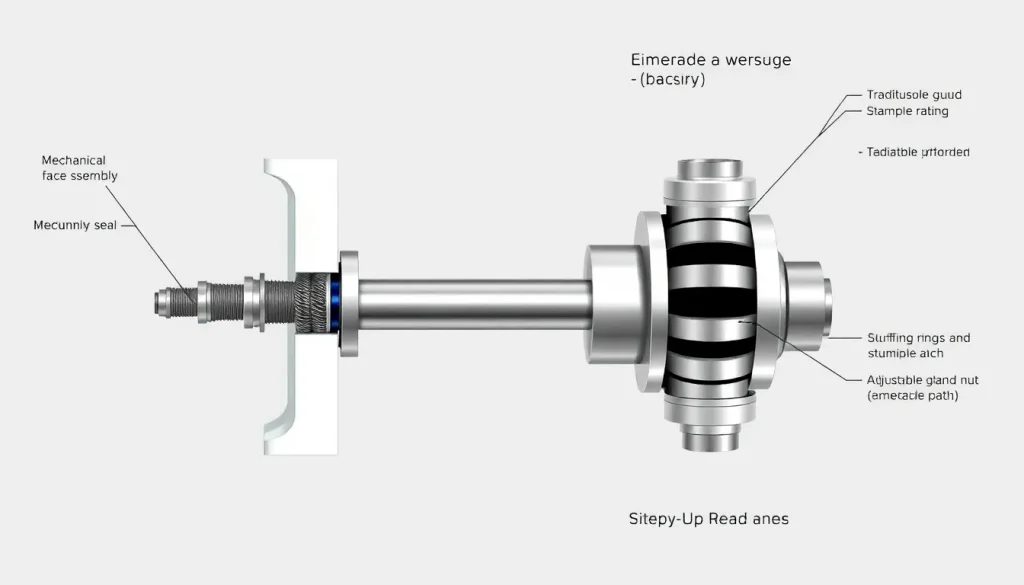
In any rotating equipment, the shaft must pass through the pump housing while keeping the process fluid sealed from the atmosphere and lubricating oil. Two classic solutions dominate the market: mechanical seals and gland packing. Both perform the same fundamental task—preventing fluid escape—but they differ dramatically in design philosophy, performance limits, and life‑cycle cost.
Choosing the wrong sealing method can lead to excessive leakage, premature wear, overheating, or catastrophic failure. In high‑pressure chemical service, a leaking packing can pollute the environment and create safety hazards. Conversely, over‑specifying a mechanical seal for a low‑budget water‑circulation pump can inflate capital cost without tangible benefit.
The Method — Derivation and Variants
There is no single governing equation for sealing performance; instead, designers evaluate a set of criteria derived from fluid mechanics and material science. The most common quantitative metric is the **leakage rate (QL)**, expressed as:
QL = C · A · √(2ΔP/ρ)
where:
- C = discharge coefficient (dimensionless, depends on seal geometry)
- A = effective leakage area (in² or mm²)
- ΔP = pressure differential across the seal (psi or Pa)
- ρ = fluid density (lb/ft³ or kg/m³)
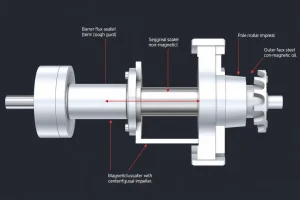
For gland packing the effective area A is a function of the packing material’s compressibility and the amount of stuffing pressure applied. For a mechanical seal, A is the micro‑gap between the seal faces, which is controlled by the spring force and face wear.
**Variants**
- Single‑Spring Mechanical Seal – the most common, uses a single spring to bias the rotating and stationary faces.
- Dual‑Spring (or “double‑seal”) Mechanical Seal – provides redundancy for hazardous or high‑pressure service.
- Graphite/Carbon Packing – traditional fiber‑based material, compatible with many oils and water.
- PTFE‑Based Packing – low‑friction, suitable for corrosive chemicals, but may require higher stuffing pressure.
US‑customary and SI forms of the leakage equation are identical; only the units change. The constant C is typically 0.6–0.8 for packed glands and 0.2–0.4 for well‑aligned mechanical seals.
Worked Example
Example 1 – US Units (Mechanical Seal)
A 10‑in centrifugal pump is handling water at 150 °F (ρ = 62.4 lb/ft³). The design pressure is 250 psi and the selected single‑spring seal has a measured discharge coefficient C = 0.30. The face‑to‑face clearance yields an effective leakage area A = 0.0005 in².
- Convert ΔP to consistent units: 250 psi (already in psi).
- Apply the leakage equation:
QL = 0.30 × 0.0005 × √(2×250 / 62.4)
√(2×250 / 62.4) = √(500 / 62.4) = √8.0128 ≈ 2.83
QL = 0.30 × 0.0005 × 2.83 = 0.000425 gal/min ≈ 0.0255 gal/hr.
Result: Leakage is well below the typical 0.001 gal/hr limit for a sealed water‑service pump.
Example 2 – SI Units (Gland Packing)
A 250 mm (≈10‑in) pump moves a 30 % glycerin‑water solution (ρ = 1080 kg/m³) at 2 MPa (≈290 psi). The packing material is PTFE with C = 0.70 and a calculated leakage area A = 0.3 mm².
- ΔP = 2 MPa = 2,000,000 Pa.
- Insert values (convert A to m²: 0.3 mm² = 3.0×10⁻⁷ m²):
QL = 0.70 × 3.0×10⁻⁷ × √(2×2,000,000 / 1080)
√(4,000,000 / 1080) = √3703.7 ≈ 60.86
QL = 0.70 × 3.0×10⁻⁷ × 60.86 ≈ 1.28×10⁻⁵ m³/s = 0.046 L/min ≈ 2.8 L/hr.
Result: Leakage is higher than typical mechanical‑seal performance but acceptable for many low‑hazard water‑based services.
Calculator
For quick on‑line leakage calculations, visit PumpCalcs Leakage Rate Calculator.
Reference Values & Typical Ranges
- Maximum allowable shaft speed for most mechanical seals: 12,000 rpm (≈125 m/s peripheral speed).
- Typical stuffing box pressure: 30–80 psi (0.2–0.55 MPa).
- Seal face wear rate: 0.001–0.010 in³ per 1,000 hrs (≈1.6×10⁻⁵–1.6×10⁻⁴ cm³/hr).
- Recommended seal replacement interval (based on wear): 10,000–30,000 hrs for water, 5,000–15,000 hrs for abrasive slurries.
- Typical packing life: 1,000–5,000 hrs before re‑packing is needed.
Sources: API 682, ISO 2146, and “Pump Handbook” (Karassik et al., 2020).
Application Guidance
When deciding between a mechanical seal and gland packing, follow this decision flow:
- Assess Process Conditions: pressure, temperature, fluid toxicity, and abrasiveness.
- Determine Leakage Tolerance: environmental regulations often dictate < 0.001 gal/hr for hazardous chemicals.
- Evaluate Maintenance Strategy: If planned‑maintenance intervals are long, a mechanical seal reduces downtime.
- Cost‑Benefit Analysis: Include initial purchase, installation labor, spare‑part inventory, and expected outage cost.
- Check Compatibility with Pump Design: Some older pump housings lack the machined recess needed for a seal cartridge.
Field‑judgment adjustments are common. For example, a pump operating at 1,500 psi with a mildly corrosive fluid may still use a high‑performance packing if the budget is constrained, provided a secondary containment system is in place.
Common Mistakes, Limits & Safety Notes
- Undersizing the Packing Compression – leads to excessive leakage and premature wear.
- Over‑compressing Packing – generates heat, can melt PTFE or cause seal face damage.
- Mixing Units – applying a US‑based C value to an SI calculation (or vice‑versa) yields a 3‑4× error.
- Ignoring Thermal Expansion – seals made of carbon‑graphite expand differently than steel; failure to accommodate this can cause face‑to‑face contact.
- Skipping Pre‑Run Alignment – mis‑aligned shafts increase seal face wear dramatically.
- Using Packing on High‑Speed (>10 k rpm) Pumps – centrifugal forces exceed packing’s ability to stay in place, causing rapid leakage.
- Neglecting Safety Reliefs – sealed pumps can develop internal pressure spikes; pressure relief valves are mandatory for >2 MPa service.
- Improper Lubrication of Packing – using the wrong oil or insufficient amount leads to dry‑run heating.
Always consult the pump manufacturer’s sealing recommendation and the relevant standards (API 682, ISO 2146) before final selection.
FAQ
When should I choose gland packing over a mechanical seal?
Gland packing is appropriate for low‑pressure (<2,000 psi), low‑temperature (<400 °F) services where the process fluid is non‑hazardous, the budget is tight, and the pump operates at moderate speed (<5,000 rpm). It also works well when frequent maintenance is acceptable.
Can I retrofit a mechanical seal onto an older pump that originally used packing?
Yes, provided the pump housing has a machined seal recess or can be modified to accept a seal cartridge. You must also verify that shaft alignment, bearing preload, and lubrication pathways meet the seal manufacturer’s specifications.
What causes premature mechanical seal failure?
Common causes include mis‑alignment, excessive shaft runout, operating temperature beyond the seal’s rating, abrasive particles in the fluid, and inadequate cooling or lubrication of the seal faces.
How do I determine the correct stuffing box pressure for packing?
Start with the manufacturer's recommended pressure (typically 30–80 psi). Adjust in small increments while monitoring leakage; the optimal pressure balances low leakage with acceptable packing temperature (usually <250 °F).
Is it safe to operate a pump with a leaking mechanical seal?
A small, steady leak may be permissible if it is below the allowable limit defined by environmental and safety regulations. However, any sudden increase in leakage should trigger an immediate shutdown to avoid fluid loss, equipment damage, or safety hazards.
What are the environmental advantages of mechanical seals?
Mechanical seals dramatically reduce fugitive emissions, especially for volatile organic compounds (VOCs) and hazardous chemicals. Their near‑zero leakage helps plants meet stricter EPA and OSHA discharge limits.
Do I need a secondary containment system if I use packing?
For hazardous or regulated fluids, secondary containment is advisable regardless of sealing method. Packing typically leaks more, so containment is critical to prevent environmental release.
How often should I inspect packing for wear?
Inspect packing at each scheduled maintenance interval—usually every 2,000 hrs or quarterly for critical service. Look for signs of extrusion, hardening, or excessive heating.
Leave a Reply