
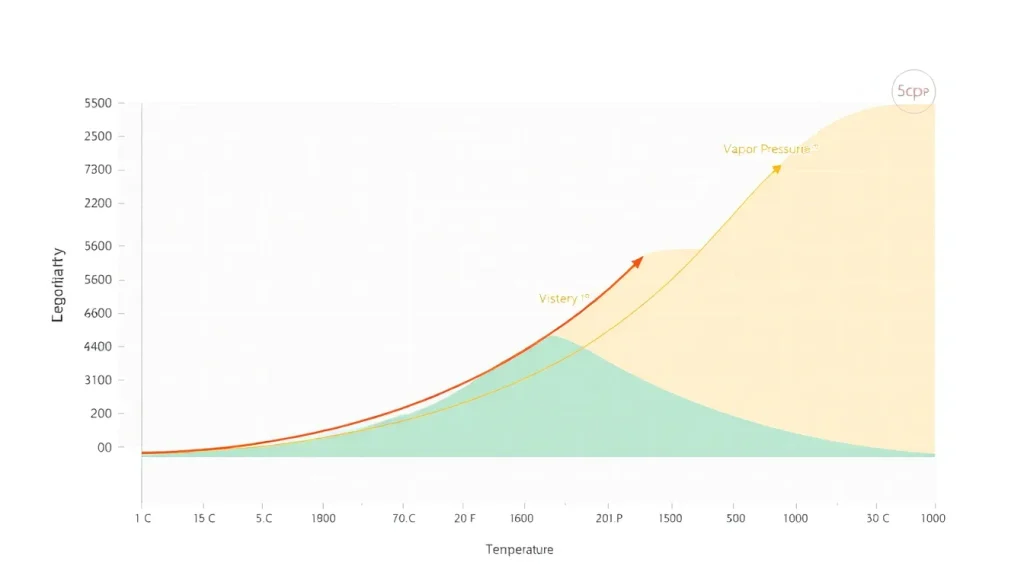
Short Answer
Key Formula / Key Facts Box
| Property | Symbol | US Unit | SI Unit | Typical Equation / Note |
|---|---|---|---|---|
| Density | ρ | lb/ft³ | kg/m³ | ρ≈ρ₀[1‑β(T‑T₀)] (≈ linear up to 100 °C) |
| Vapor Pressure | P_v | psi | kPa | log₁₀P_v = A‑B/(T+ C) (Antoine) |
| Dynamic Viscosity | μ | cP (mPa·s) | Pa·s | μ = μ₀·exp[ E/(T‑T₀) ] (Arrhenius) |
| Kinematic Viscosity | ν | cSt (mm²/s) | mm²/s | ν = μ/ρ |
| Temperature | T | °F | °C | Reference temperature for tables |
Overview — What It Is and Why It Matters
Water is the most common working fluid in centrifugal and positive‑displacement pump systems. Its density, vapor pressure, and viscosity change markedly with temperature, directly influencing head generation, NPSH (Net Positive Suction Head) calculations, power consumption, and seal design. An inaccurate property value can lead to cavitation, oversized motors, or premature seal failure, all of which increase life‑cycle cost and downtime.
The Method — Derivation and Variants
Density. For liquid water below 100 °C the density variation can be expressed as a first‑order Taylor expansion about a reference temperature T₀ (typically 4 °C where ρ is maximum):
ρ = ρ₀[1‑β(T‑T₀)]
where β is the volumetric expansion coefficient (≈2.07×10⁻⁴ °C⁻¹). In US units, ρ₀ = 62.4 lb/ft³ at 4 °C.
Vapor Pressure. The Antoine equation provides an empirical fit for saturated‑steam pressure:
log₁₀(P_v) = A‑B/(T+ C)
Constants A, B, C differ for temperature ranges; for 1 °C‑100 °C (water) the SI constants are A=8.07131, B=1730.63, C=233.426 (P_v in mm Hg, T in °C). Converting to kPa or psi is straightforward.
Viscosity. Water’s dynamic viscosity follows an Arrhenius‑type relationship:
μ = μ₀·exp[ E/(T‑T₀) ]
with μ₀ ≈ 1.002 mPa·s at 20 °C, E ≈ 1,800 K, and T in Kelvin. The kinematic viscosity ν is simply μ divided by density.
US‑customary forms replace SI units (Pa·s → cP, kPa → psi, °C → °F) and use the same functional forms with temperature converted accordingly.
Worked Example
Example 1 – US Units. A centrifugal pump is to be installed in a cooling‑water loop operating at 68 °F (20 °C). Determine the water density and dynamic viscosity needed for the pump‑selection software.
- Convert temperature to °C if using SI‑based correlations: 20 °C.
- Density: ρ = ρ₀[1‑β(T‑T₀)] with ρ₀ = 62.4 lb/ft³, β = 2.07×10⁻⁴ °F⁻¹ (≈1.15×10⁻⁴ °C⁻¹). Using the US‑customary linear fit ρ ≈ 62.4 lb/ft³ – 0.00018 lb/ft³·(68‑39.2) ≈ 62.0 lb/ft³.
- Dynamic viscosity: μ₀ = 1.002 cP at 20 °C; conversion 1 cP = 0.001 lb/ft·s, so μ ≈ 0.00100 lb/ft·s.
- Result: ρ ≈ 62.0 lb/ft³, μ ≈ 0.00100 lb/ft·s (≈1.00 cP).
Example 2 – SI Units. A high‑temperature process requires water at 80 °C. Compute the saturated vapor pressure to verify NPSH margin.
- Use Antoine constants for 1‑100 °C: A=8.07131, B=1730.63, C=233.426.
- Insert T=80 °C: log₁₀(P_v) = 8.07131‑1730.63/(80+233.426) = 8.07131‑1730.63/313.426 ≈ 8.07131‑5.525 ≈ 2.546.
- P_v (mm Hg) = 10^2.546 ≈ 352 mm Hg.
- Convert to kPa: 1 mm Hg = 0.133322 kPa → P_v ≈ 46.9 kPa (≈6.8 psi).
Calculator
For quick conversions and property look‑ups, visit Water Properties Calculator.
Reference Values & Typical Ranges
| Temp (°C) | Temp (°F) | Density (kg/m³) | Density (lb/ft³) | Vapor P (kPa) | Vapor P (psi) | μ (cP) | ν (mm²/s) |
|---|---|---|---|---|---|---|---|
| 0 | 32 | 999.8 | 62.4 | 0.006 | 0.001 | 1.79 | 1.80 |
| 20 | 68 | 998.2 | 62.3 | 2.34 | 0.34 | 1.00 | 1.00 |
| 40 | 104 | 992.2 | 62.0 | 7.38 | 1.07 | 0.653 | 0.66 |
| 60 | 140 | 983.2 | 61.4 | 19.9 | 2.89 | 0.466 | 0.47 |
| 80 | 176 | 971.8 | 60.6 | 47.3 | 6.86 | 0.355 | 0.37 |
| 100 | 212 | 958.4 | 59.8 | 101.3 | 14.7 | 0.282 | 0.30 |
Application Guidance
- Always use the property values that correspond to the actual bulk temperature of the fluid, not the ambient temperature.
- For cavitation‑prone applications, compare the calculated vapor pressure to the suction absolute pressure; maintain an NPSH margin of at least 1 m (3 ft) for centrifugal pumps.
- Viscosity influences the pump’s hydraulic efficiency; a 10 % increase in μ typically reduces efficiency by 2‑3 %.
- When water is heated above 70 °C, consider using a high‑temperature seal material and verify that the pump’s shaft‑seal rating exceeds the measured vapor pressure.
- In multi‑stage or high‑head designs, the density change (≈0.5 % between 20 °C and 80 °C) can affect the required impeller diameter; adjust impeller size or speed accordingly.
Common Mistakes, Limits & Safety Notes
- Mixing °C and °F in the Antoine equation – always convert to the unit set used for the constants.
- Neglecting vapor pressure at temperatures >60 °C, which can cause cavitation even when NPSH calculations appear adequate.
- Using the density of ice (≈917 kg/m³) for water at sub‑zero temperatures; water remains liquid down to –0.5 °C under pressure.
- Applying the linear density correlation above 100 °C; water’s compressibility becomes significant near the critical point.
- Ignoring the temperature rise due to pump inefficiency; the fluid temperature at the discharge can be 5‑15 °C higher than inlet, altering property values.
- Failing to convert viscosity units correctly (cP ↔ Pa·s ↔ lb/ft·s) leads to motor‑size errors.
FAQ
Why does water density decrease with temperature, and how does it affect pump sizing?
Water expands as it warms, reducing density by about 0.5 % per 10 °C. Lower density means the same volumetric flow requires less mass flow, reducing shaft power but also decreasing head generated by a given impeller speed, so designers may increase impeller diameter or speed to meet head requirements.
Can I use the same water property table for seawater?
No. Seawater has higher density (~1025 kg/m³) and viscosity, and its vapor pressure is slightly lower due to dissolved salts. Use a dedicated seawater property chart or correction factors for accurate pump selection.
How critical is vapor pressure for low‑head cooling‑water pumps?
Even low‑head systems can suffer cavitation if suction pressure approaches the water’s vapor pressure. At 60 °C the vapor pressure is ~20 kPa; ensure suction absolute pressure stays at least 30 kPa above this to maintain a safe NPSH margin.
What unit conversion should I use for viscosity when working in US customary units?
1 cP = 0.001 lb/ft·s = 0.001 Pa·s. Many US pump software packages accept viscosity in centipoise (cP) directly, but always verify the internal conversion to avoid a factor‑1000 error.
Do I need to adjust density for water under high pressure in boiler feed lines?
At pressures below 10 MPa, water’s compressibility changes density by less than 0.2 %. For most pump calculations this is negligible, but for high‑pressure boiler feed pumps, use the IAPWS‑IF97 formulation for accurate density.
Is the Antoine equation valid up to the critical point of water?
No. The Antoine equation is empirical and accurate only up to ~100 °C (373 K). Near the critical point (374 °C, 22 MPa) you must use the IAPWS‑95 formulation or steam tables.
How often should I re‑measure water temperature in a pump system?
Measure inlet temperature at least quarterly for systems with variable load or heat‑exchange. For high‑precision applications, continuous temperature monitoring with a PT100 sensor is recommended.
Leave a Reply