Short Answer
Key Formula / Key Facts Box
Joukowsky Equation (Surge Pressure)
ΔP = ρ·a·ΔV
| Symbol | Meaning | US Unit | SI Unit |
|---|---|---|---|
| ΔP | Surge pressure rise | psi (or lb/ft²) | Pa (or MPa) |
| ρ | Fluid density | slug/ft³ (or lb·s²/ft⁴) | kg/m³ |
| a | Pressure‑wave speed in the pipe | ft/s | m/s |
| ΔV | Change in fluid velocity (typically V₁‑V₂) | ft/s | m/s |
In plain English: the pressure spike generated by a sudden stop or start of flow equals the fluid’s mass per volume multiplied by how fast a pressure wave travels in the pipe and by how much the flow velocity changes.
Overview — What It Is and Why It Matters
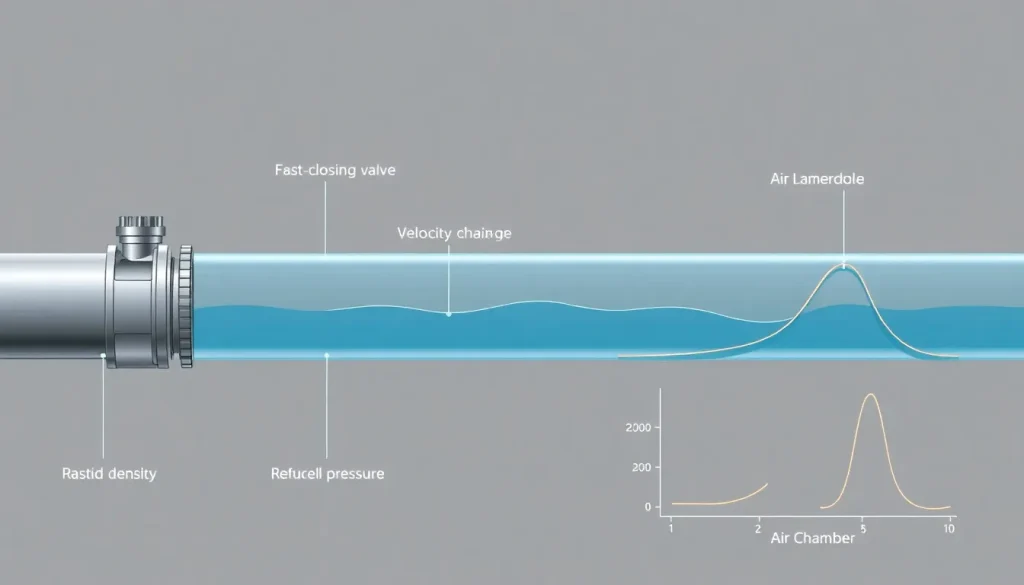
Water hammer, also known as hydraulic shock, occurs when a fluid in a closed conduit experiences an abrupt change in velocity—most commonly from a fast‑closing valve, pump start‑up, or sudden pipe blockage. The kinetic energy of the moving fluid is instantaneously converted into a pressure wave that travels at the speed of sound in the fluid‑pipe system. If the resulting surge pressure exceeds the pipe’s design limit, it can cause pipe deformation, joint separation, equipment damage, or even catastrophic rupture.
Engineers must predict the magnitude of this pressure spike (surge pressure) to size relief devices, select appropriate pipe material, and design mitigation measures such as surge tanks, air chambers, or slow‑closing valves. Under‑estimating water hammer can lead to costly downtime, safety hazards, and non‑compliance with codes such as ASME B31.3 or API 521.
The Method — Derivation and Variants
The Joukowsky equation is derived from the conservation of momentum applied to an infinitesimal fluid element. Assuming an incompressible fluid and a sudden velocity change, the pressure rise ΔP is:
ΔP = ρ·a·ΔV
where the wave speed a depends on the pipe’s elasticity and the fluid’s bulk modulus:
a = frac{1}{sqrt{frac{1}{K}+frac{D}{E·t}}}
- K – Fluid bulk modulus (Pa or psi)
- D – Pipe inner diameter (m or ft)
- E – Pipe wall Young’s modulus (Pa or psi)
- t – Pipe wall thickness (m or ft)
Both SI and US‑customary versions of the Joukowsky equation are used in practice. The core relationship remains identical; only unit conversion factors change.
| System | Surge Pressure Formula | Conversion Factor |
|---|---|---|
| SI | ΔP (Pa) = ρ (kg/m³) × a (m/s) × ΔV (m/s) | None – direct |
| US‑customary | ΔP (psi) = 0.00102 × ρ (lb·s²/ft⁴) × a (ft/s) × ΔV (ft/s) | 0.00102 = 1/ (144 × g) where g = 32.174 ft/s² |
When the fluid density is expressed as specific weight γ (lb/ft³) rather than mass density, the US form can also be written as:
ΔP (psi) = 0.433 × γ (lb/ft³) × a (ft/s) × ΔV (ft/s)
Choose the variant that matches the data you have on hand. The SI form is most common in international projects; the US form is prevalent in North‑American design manuals.
Worked Example
Example 1 – US Units
- Pipe: 8‑in. schedule 40 steel, inner diameter D = 7.981 in = 0.665 ft, wall thickness t = 0.322 in = 0.0268 ft.
- Water specific weight γ = 62.4 lb/ft³ → mass density ρ = γ / g = 62.4 / 32.174 = 1.94 slug/ft³.
- Bulk modulus of water K ≈ 2.2×10⁶ psi.
- Young’s modulus for steel E ≈ 30×10⁶ psi.
- Wave speed: a = 1 / √(1/K + D/(E·t)) = 1 / √(1/2.2e6 + 0.665/(30e6·0.0268)) ≈ 1,200 ft/s.
- Valve closes instantly: initial velocity V₁ = 10 ft/s, final velocity V₂ = 0 ⇒ ΔV = 10 ft/s.
- Surge pressure: ΔP = ρ·a·ΔV = 1.94 × 1,200 × 10 = 23,280 lb/ft².
- Convert to psi: ΔP = 23,280 / 144 = 161.7 psi.
The sudden stop generates a 162‑psi pressure spike, well above typical municipal pipe design limits (≈ 80‑100 psi), indicating a need for mitigation.
Example 2 – SI Units
- Pipe: DN 150 (6‑in.) carbon steel, inner diameter D = 0.150 m, wall thickness t = 0.0085 m.
- Water density ρ = 998 kg/m³, bulk modulus K = 2.2×10⁹ Pa, steel E = 210×10⁹ Pa.
- Wave speed: a = 1 / √(1/K + D/(E·t)) = 1 / √(1/2.2e9 + 0.150/(210e9·0.0085)) ≈ 1,400 m/s.
- Pump stops abruptly: V₁ = 3 m/s → ΔV = 3 m/s.
- Surge pressure: ΔP = ρ·a·ΔV = 998 × 1,400 × 3 = 4,191,600 Pa.
- Convert: 4,191,600 Pa = 4.19 MPa = 607 psi.
Even with a modest velocity change, the high wave speed of steel pipe produces a multi‑megapascal surge, emphasizing the importance of proper control measures.
Calculator
For quick on‑line calculations, use the free tool at PumpCalcs – Surge Pressure Calculator. It accepts both US and SI inputs and automatically converts units.
Reference Values & Typical Ranges
- Water wave speed in steel pipe: 1,200‑1,500 ft/s (≈ 360‑460 m/s).
- Typical valve closure time to avoid severe hammer: t_c ≥ 2·L / a, where L is pipe length downstream of the valve.
- Acceptable surge pressure for residential water mains: ≤ 80 psi (≈ 0.55 MPa).
- Industrial high‑pressure systems often design for surge pressures up to 300 psi (≈ 2.1 MPa) with relief devices.
- Air chamber volume guideline: V_air ≈ 0.02 × D³ × L (in consistent units) to attenuate a single pressure wave.
Sources: ASME B31.3, API 521, Wylie & Streeter “Hydraulic Transients”.
Application Guidance
When evaluating a new piping layout, follow these steps:
- Determine the maximum expected flow velocity and identify any fast‑acting valves or pumps.
- Calculate the pipe’s wave speed using the elasticity formula. For flexible pipe (e.g., HDPE) the wave speed may drop to 400‑800 ft/s, reducing surge pressure.
- Apply the Joukowsky equation to estimate ΔP for worst‑case instantaneous closure.
- Compare the result with the pipe’s allowable stress (often given as a design pressure plus a safety factor).
- If ΔP exceeds limits, select mitigation: slower‑closing valve (actuation time ≥ 2·L/a), surge tank, air‑chamber, or a pressure‑relief valve sized per API 521.
- Validate the design with a transient simulation (e.g., EPANET, AFT Impulse) for complex networks.
Field‑judgment adjustments are common: temperature effects on modulus, water quality (air entrainment), and existing residual stresses can all shift the real surge pressure.
Common Mistakes, Limits & Safety Notes
- Unit mix‑up: Using density in lb/ft³ directly in the SI form or forgetting the 144 in²/ft² conversion when reporting psi.
- Assuming incompressible fluid: For high‑pressure gases the bulk modulus changes dramatically; the Joukowsky equation must be modified.
- Neglecting pipe elasticity: Treating steel as perfectly rigid underestimates wave speed; use the elasticity term.
- Instantaneous closure assumption: Real valves have a finite closure time; using the worst‑case ΔV = V₁ may over‑design if the valve closes slowly.
- Ignoring reflected waves: In branched systems, reflected pressure waves can amplify the initial surge; transient analysis is required.
- Exceeding material fatigue limits: Repeated hammer events can cause fatigue cracking even when each individual ΔP is below the ultimate strength.
- Safety oversight: Failing to install pressure‑relief devices can lead to pipe rupture, water damage, and personal injury. Always conform to ASME B31.3 safety factors.
FAQ
What causes water hammer in a pump system?
Water hammer is generated when a pump or valve changes the fluid velocity abruptly, converting kinetic energy into a high‑pressure shock wave that travels through the piping.
Can a slow‑closing valve eliminate water hammer?
A valve that closes slower than the critical time (t_c ≥ 2·L/a) will reduce the ΔV during closure, often preventing a pressure spike large enough to cause damage.
How do I calculate the wave speed for a plastic pipe?
Use a = 1/√(1/K + D/(E·t)). For PVC, E ≈ 3 × 10⁶ psi, giving wave speeds of 400‑800 ft/s, significantly lower than steel, which reduces surge pressure.
Is water hammer the same as cavitation?
No. Water hammer is a pressure surge caused by rapid velocity change, while cavitation is the formation and collapse of vapor bubbles due to local low pressure.
What safety devices are recommended for water hammer protection?
Common devices include surge tanks, air chambers, pressure‑relief valves, and slow‑acting control valves, all sized according to the predicted ΔP and code requirements.
Why do I need to consider reflected waves?
When a pressure wave reaches a pipe end or junction, it reflects and can constructively interfere with incoming waves, potentially amplifying the surge pressure beyond the initial calculation.
Can I use the Joukowsky equation for gas pipelines?
The basic form applies, but gases have much lower bulk modulus and are compressible; you must use the appropriate gas bulk modulus and often a modified formulation that includes temperature effects.
How often should water hammer analysis be performed?
Perform it during initial design, when modifying valve or pump operation, and after any significant change in pipe material, diameter, or system pressure.



Leave a Reply