Short Answer
Key Formula / Key Facts Box
| Item | Symbol / Code | Meaning | US Unit | SI Unit |
|---|---|---|---|---|
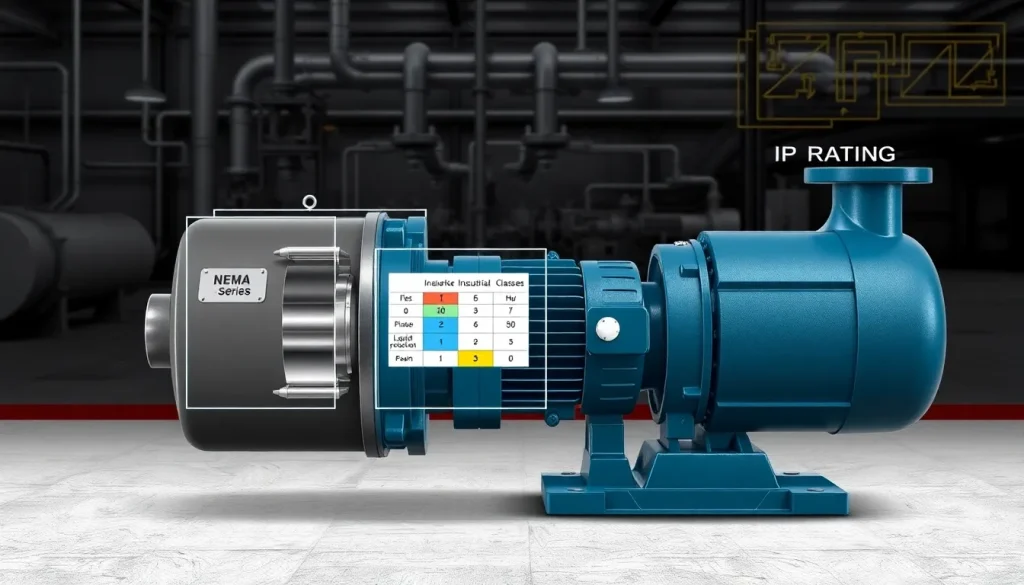
| Motor enclosure type | NEMA Series | Standardized mechanical protection | – | – |
| Insulation class | Class B/F/H | Maximum continuous operating temperature | °F | °C |
| IP first digit | IP‑X | Solid particle protection (0–6) | – | – |
| IP second digit | IP‑Y | Liquid ingress protection (0–9K) | – | – |
| Typical temperature range | ΔT | Ambient to motor hot spot | °F | °C |
| Hazardous‑area rating | Ex d, Ex e | Explosion‑proof or increased safety | – | – |
Overview — What It Is and Why It Matters
In pump installations the electric motor is often the most vulnerable component because it is exposed to the same environment that the pump sees: dusty process rooms, corrosive chemicals, high humidity, or explosive atmospheres. The motor enclosure, its insulation class, and its Ingress Protection (IP) rating together define how well the motor can survive those conditions while delivering the torque required for the pump.
Motor enclosures are defined by standards such as NEMA MG‑1 (U.S.) and IEC 60034‑4 (international). They describe the physical barriers—metal housings, gaskets, fans, and cooling passages—that keep contaminants out and keep heat in or out as needed. Insulation class (e.g., Class B, F, H) specifies the maximum temperature the motor windings can tolerate continuously, which directly influences the motor’s lifespan and derating curves.
The IP rating, standardized by IEC 60529, quantifies protection against solid particles (first digit) and liquids (second digit). Selecting the proper combination prevents premature bearing wear, winding insulation breakdown, and catastrophic failures that can shut down a pump system, cause safety incidents, or void warranty coverage.
The Method — Derivation and Variants
There is no single algebraic formula for choosing an enclosure; instead the method follows a decision tree based on environmental parameters. The key steps are:
- Identify the worst‑case ambient conditions: temperature, humidity, dust, chemicals, and potential for water jets or immersion.
- Match the solid‑particle risk to an IP first digit using IEC 60529 tables (e.g., 6 for dust‑tight, 4 for limited ingress).
- Match the liquid‑risk to an IP second digit (e.g., 9K for high‑pressure, high‑temperature water jets, 5 for low‑pressure spray).
- Select an insulation class that can accommodate the sum of ambient temperature plus the motor’s internal temperature rise (ΔT). For a motor with a 30 °F (≈17 °C) rise and an ambient of 104 °F (40 °C), a Class B (130 °C max) is sufficient, but a Class F (155 °C) gives extra margin.
- Choose a NEMA or IEC enclosure series that meets the IP requirements and any hazardous‑area classification (Ex d, Ex e, etc.).
When converting between U.S. customary and SI units, the temperature limits are:
- Class B: 130 °C = 266 °F
- Class F: 155 °C = 311 °F
- Class H: 180 °C = 356 °F
Designers often apply a safety factor of 1.1–1.25 to the calculated temperature rise to account for overloads, poor ventilation, or aging bearings.
Worked Example
Example 1 – U.S. customary units
A centrifugal pump is to be installed in a chemical plant where the ambient temperature can reach 95 °F, the environment is dusty, and occasional wash‑down with low‑pressure water (≤ 10 psi) occurs. The motor’s rated full‑load current causes a temperature rise of 35 °F.
- Maximum operating temperature = 95 °F + 35 °F = 130 °F.
- Choose insulation class: Class B (max 266 °F) comfortably exceeds 130 °F, so Class B is acceptable.
- Solid‑particle protection: Dusty environment → IP6 (dust‑tight).
- Liquid protection: Low‑pressure wash‑down → IP5 (water jets from any direction).
- Resulting IP rating = IP65.
- Match to NEMA: NEMA 12 (dust‑tight, rain‑proof) satisfies IP65.
The selected motor would be specified as “NEMA 12, Class B, IP65”.
Example 2 – SI units
A pump serving a marine desalination plant operates in a humid, salty atmosphere. Ambient temperature may reach 45 °C, and the motor experiences a 20 °C temperature rise under load.
- Maximum temperature = 45 °C + 20 °C = 65 °C.
- Insulation class: Class F (155 °C) is more than adequate; Class B (130 °C) also works, but Class F gives a larger safety margin against occasional overload.
- Solid‑particle rating: No dust, but salt spray → IP6 (dust‑tight) is optional; IP4 (limited ingress) is sufficient.
- Liquid rating: Exposure to sea spray and occasional jetting → IP6K (high‑pressure, high‑temperature water jets) is recommended for marine service.
- Resulting IP rating = IP66K.
- IEC enclosure: IEC 60529 “IP66K” corresponds to an IEC 60034‑4 “Ex d” (explosion‑proof) if hazardous‑area classification is required.
The final specification could read “IEC 60529 IP66K, Class F, Ex d”.
Calculator
For quick verification of temperature rise and derating, use the online motor‑selection calculator: Motor Temperature Rise Calculator.
Reference Values & Typical Ranges
- IP first digit 0–6 (0 = no protection, 6 = dust‑tight).
- IP second digit 0–9K (0 = no protection, 9K = high‑pressure, high‑temperature water jet).
- Insulation class limits: B = 130 °C (266 °F), F = 155 °C (311 °F), H = 180 °C (356 °F).
- NEMA series commonly used with pumps: 1 (general purpose), 4 (splash‑proof), 12 (dust‑tight, rain‑proof), 13 (explosion‑proof).
- Typical motor temperature rise for continuous duty: 30–40 °F (≈17–22 °C) for TEFC (Totally Enclosed Fan‑Cooled) units; up to 60 °F (≈33 °C) for open‑driven fans.
Application Guidance
When integrating a motor with a pump, follow these practical steps:
- Perform a site survey to document maximum ambient temperature, humidity, dust level, and any wash‑down or immersion scenarios.
- Consult the pump’s operating manual for recommended motor service factor (usually 1.15 for continuous duty).
- Use the IP rating as a baseline, then verify that the enclosure’s gaskets and sealing compounds are compatible with the process fluid (e.g., Nitrile vs. Viton).
- If the pump is in a hazardous area, cross‑reference the enclosure’s explosion‑proof rating with IEC 60079‑0 or NFPA 70 (NEC) requirements.
- Document the selected motor’s derating curve; for each 10 °C (18 °F) above the ambient rating, reduce the allowable full‑load current by roughly 10 %.
- Plan for periodic visual inspection of seal integrity and bearing lubrication, especially for motors with high IP ratings that limit easy access.
Common Mistakes, Limits & Safety Notes
- Mixing US and SI temperature units – A 30 °F rise is not equal to 30 °C; always convert before adding to ambient.
- Assuming IP rating covers chemical resistance – IP only addresses solids and liquids; corrosive chemicals may still attack enclosure material.
- Underrating insulation class – Selecting Class B for a motor that will regularly operate at 120 °C ambient leaves no safety margin and accelerates insulation aging.
- Ignoring hazardous‑area requirements – Using a standard NEMA 12 motor in an area classified as Zone 1 can lead to explosions.
- Over‑relying on the enclosure’s IP rating for cooling – A high‑IP (e.g., IP68) motor may have limited airflow, causing higher temperature rise; verify cooling method.
- Failing to derate for altitude – At elevations above 2000 ft, air density drops, reducing cooling efficiency; apply a 1 % per 100 ft derating.
- Improper gasket installation – Pinched or missing gaskets reduce the effective IP rating; follow manufacturer torque specs.
- Neglecting maintenance access – Selecting a fully sealed enclosure (IP68) in a location where routine bearing inspection is required can increase downtime.
FAQ
What does an IP66 rating actually protect a pump motor from?
IP66 means the motor enclosure is dust‑tight (first digit 6) and protected against powerful water jets from any direction (second digit 6). It does not guarantee protection against immersion or chemical attack.
Can I use a Class B motor in a 45 °C ambient environment?
Yes, if the motor’s temperature rise is low enough that the hot‑spot stays below 130 °C. For a 20 °C rise, the hot‑spot would be 65 °C, well within Class B limits.
How do I convert an IP rating to a NEMA enclosure type?
Match the solid‑particle and liquid protection levels: e.g., IP65 corresponds to NEMA 12 (dust‑tight, rain‑proof). NEMA tables provide a direct cross‑reference.
Do IP ratings consider corrosive chemicals?
No. IP only addresses solids and liquids. For chemical resistance, verify the enclosure material (stainless steel, epoxy‑coated) and gasket compatibility separately.
Why do some pump manufacturers specify both NEMA and IEC ratings?
Specifying both satisfies customers in different regulatory regions; NEMA is common in the U.S., while IEC is the global standard. The two are equivalent when cross‑referenced correctly.
What safety consequences arise from using a motor with an insufficient IP rating?
Ingress of dust or water can cause bearing wear, winding short‑circuits, and potentially fire or explosion, especially in hazardous areas. This leads to unplanned downtime and safety hazards.
Is a higher IP rating always better for pump applications?
Higher IP ratings improve protection but often reduce cooling airflow and increase cost. Choose the rating that meets the actual exposure; over‑specifying can cause overheating.
How does altitude affect motor enclosure selection?
At higher altitudes, air density drops, reducing convective cooling. Apply a derating factor (≈1 % per 100 ft) and consider an enclosure with better ventilation or a lower temperature rise.
Leave a Reply