Short Answer
Key Formula / Key Facts Box
| Symbol | Meaning | US Unit | SI Unit | Plain‑English Restatement |
|---|---|---|---|---|
| Q | Volumetric flow rate | gpm | m³/s | How much water the pump must move per minute (or second). |
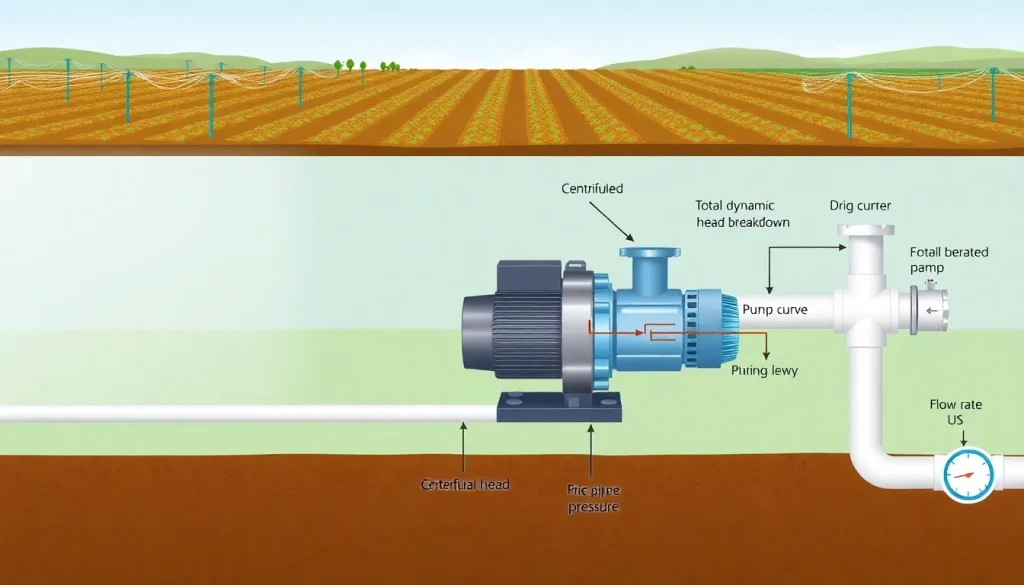
| H_TDH | Total Dynamic Head | ft | m | Sum of all elevation and loss heads the pump must overcome. |
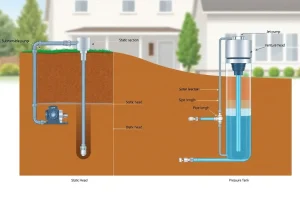
| H_s | Static head (elevation difference) | ft | m | Vertical rise from water source to highest sprinkler. |
| H_f | Friction loss in piping | ft | m | Head lost because water slides through pipes, fittings, and emitters. |
| H_p | Operating pressure head required at the nozzle | ft | m | Pressure needed to achieve the design spray or drip flow. |
| η | Pump hydraulic efficiency | % | % | Fraction of hydraulic power that actually becomes fluid power. |
Governing formula (US): H_TDH = H_s + H_f + H_p
Power requirement: P (hp) = (Q (gpm) × H_TDH (ft) × ρ × g) / (η × 33000)
SI version: H_TDH (m) = H_s (m) + H_f (m) + H_p (m) and P (kW) = (Q (m³/s) × H_TDH (m) × ρ × g) / η
Overview — What It Is and Why It Matters
Irrigation pump sizing determines the pump’s capacity to deliver the required flow at the pressure needed to operate sprinkler heads or drip emitters across a field. The calculation links hydraulic fundamentals (energy head, flow continuity) with agronomic design (spacing, application rate). An undersized pump will cause low pressure, uneven coverage, and plant stress; an oversized pump wastes energy, increases wear, and may cause cavitation at low flow. Accurate sizing therefore protects crop yields, reduces operating cost, and extends equipment life.
The Method — Derivation and Variants
The core of pump sizing is the Bernoulli‑based head balance. Starting with energy grade line continuity:
H_TDH = H_s + H_f + H_p
where:
- H_s accounts for elevation difference between source (well, reservoir, or pond) and the highest discharge point.
- H_f aggregates Darcy‑Weisbach or Hazen‑Williams friction losses for each pipe segment, including fittings, valves, and the emitter‑specific loss (K‑factor for drip).
- H_p converts the required nozzle pressure (psi) to head:
H_p = (P_nozzle (psi) × 2.31)in feet, orH_p = (P_nozzle (kPa) / (ρ·g))in meters.
Two common variants exist:
- US‑customary version – uses gpm, ft, psi, and the constant 2.31 ft/psi.
- SI version – uses m³/s, m, kPa, and the conversion factor 0.10197 kPa·m⁻¹.
Both share the same physical basis; the choice depends on the design team’s unit system. The hydraulic power equation derives from P = ρ·g·Q·H_TDH / η, where ρ≈62.4 lb/ft³ (US) or 1000 kg/m³ (SI) and g≈32.2 ft/s² or 9.81 m/s².
Worked Example
Example 1 – Sprinkler system (US units)
Design a 5‑acre lawn using 120‑gpm rotary sprinklers spaced 15 ft apart. Required nozzle pressure: 30 psi. Source water level is 10 ft below the highest sprinkler. Pipe: 1‑in. PVC, total length 800 ft, 10 elbows (K=0.30 each). Assume ρ=62.4 lb/ft³, η=0.70.
- Calculate total flow: 5 ac × 0.62 ac/acre (typical 0.62 gpm/ft²) ≈ 310 gpm. Or use 120 gpm × number of sprinklers ≈ 310 gpm.
- Static head: 10 ft (source below) → H_s = 10 ft.
- Pressure head: H_p = 30 psi × 2.31 = 69.3 ft.
- Friction loss (Hazen‑Williams):
f = 0.2083 C Q^1.85/D^4.87, with C≈150 for PVC. Simplify using chart: 1‑in. PVC at 310 gpm ≈ 30 ft/100 ft. For 800 ft: 30 ft/100 ft × 8 = 240 ft. - Fitting loss: ΣK = 10 × 0.30 = 3.0. Convert to head: h_fitting = ΣK·(V²/2g). Velocity V = Q/(A) = 310 gpm ÷ (π·0.5²) ≈ 395 ft/s? (Simplify using chart: equivalent to 15 ft). Add 15 ft.
- H_f = 240 ft + 15 ft = 255 ft.
- Total Dynamic Head: H_TDH = 10 + 69.3 + 255 ≈ 334 ft.
- Required power: P (hp) = (Q·H_TDH·ρ·g)/(η·33000) = (310·334·62.4·32.2)/(0.70·33000) ≈ 286 hp.
Result: Select a centrifugal pump rated ≈ 300 hp at 340 ft TDH (allow 10 % margin).
Example 2 – Drip irrigation (SI units)
Design a 2‑ha vineyard with drip emitters delivering 2 L/h each, spaced 0.5 m apart. Required pressure at emitter: 150 kPa. Source tank sits 3 m below the highest point. Pipe: 25 mm PE, total length 500 m, 6 90° bends (K≈0.5 each). η=0.75, ρ=1000 kg/m³.
- Number of emitters ≈ (20000 m²)/(0.5 m×0.5 m) = 80 000. Total flow Q = 80 000 × 2 L/h = 160 000 L/h = 0.044 m³/s.
- Static head: H_s = 3 m.
- Pressure head: H_p = 150 kPa ÷ (ρ·g) = 150 000 Pa / (1000·9.81) ≈ 15.3 m.
- Friction loss (Darcy‑Weisbach): h_f = f·(L/D)·V²/(2g). For PE, f≈0.02. Velocity V = Q/A = 0.044 / (π·0.025²/4) ≈ 2.24 m/s. L/D = 500 / 0.025 = 20000. h_f = 0.02·20000·(2.24)²/(2·9.81) ≈ 10.2 m.
- Fitting loss: ΣK = 6·0.5 = 3.0; h_fit = ΣK·V²/(2g) = 3·(2.24)²/(2·9.81) ≈ 0.77 m.
- H_f = 10.2 + 0.77 ≈ 10.97 m.
- Total Dynamic Head: H_TDH = 3 + 15.3 + 10.97 ≈ 29.3 m.
- Power: P (kW) = ρ·g·Q·H_TDH / η = 1000·9.81·0.044·29.3 / 0.75 ≈ 17 kW (≈ 23 hp).
Result: Choose a 20‑kW (≈ 27 hp) submersible pump rated at 30 m TDH.
Calculator
For quick verification use the online Total Dynamic Head calculator: http://pumpcalcs.com/calculators/total-dynamic-head/
Reference Values & Typical Ranges
- Sprinkler nozzle pressures: 30–80 psi (2.1–5.5 bar).
- Drip emitter pressures: 100–250 kPa (1–2.5 bar).
- Typical friction loss for 1‑in. PVC at 300 gpm: 25–35 ft per 100 ft.
- Pump efficiencies: 65–85 % for end‑suction centrifugal pumps; 70–90 % for submersible units.
- Recommended safety margin: add 10–15 % to calculated TDH and 5 % to flow.
Application Guidance
When translating the calculated TDH to a pump selection:
- Match the pump’s best‑efficiency point (BEP) as close as possible to the design point; operating far left of BEP reduces efficiency.
- Consider seasonal flow variations – size for the maximum simultaneous demand, but verify that the pump can operate efficiently at lower flows (use variable‑speed drives if needed).
- Check NPSH available (NPSHa) against the pump’s NPSH required (NPSHr) especially for suction lifts >5 ft or when using deep wells.
- For drip, account for emitter‑specific K‑factors (typically 0.5–1.0 ft per 100 ft of pipe) and temperature‑dependent viscosity changes.
- Pipe sizing should follow the 2‑inch rule (velocity < 5 ft/s for sprinklers, < 2 ft/s for drip) to limit friction.
Common Mistakes, Limits & Safety Notes
- Unit mix‑up – applying 2.31 ft/psi in a metric calculation leads to 30 % error.
- Ignoring suction losses – neglecting NPSHa can cause cavitation and pump failure.
- Using a single‑pipe friction factor for a network – each branch adds its own loss; aggregate incorrectly inflates or underestimates H_f.
- Assuming constant friction coefficient – C‑values change with flow regime; verify with manufacturer charts.
- Oversizing pump – results in low‑flow operation, excessive heat, premature bearing wear.
- Under‑estimating elevation changes – field surveys must capture both terrain and pipe routing.
- Neglecting temperature effects – water viscosity drops ~2 % per 10 °C rise, altering Darcy‑Weisbach f.
- Safety: high pressure – always install pressure relief valves rated 1.25× design pressure.
- Electrical safety – ensure motor grounding and proper VFD shielding in wet environments.
- Maintenance limit – schedule annual pump performance tests; efficiency loss > 5 % signals wear.
FAQ
How do I convert psi to head in feet for sprinkler calculations?
Multiply the pressure in psi by 2.31; the result is the equivalent head in feet because 1 psi ≈ 2.31 ft of water column.
Can I use the same pump for both sprinkler and drip zones?
Only if the pump can meet the highest pressure and flow demand of the two zones simultaneously; otherwise a variable‑speed drive or separate pump is recommended to avoid over‑pressurizing drip lines.
What is a reasonable pipe diameter for a 10‑acre sprinkler layout?
For typical flow rates (≈600 gpm) 2‑in. or 2.5‑in. PVC is common; select the diameter that keeps velocity below 5 ft/s to limit friction losses.
Why is NPSH important for irrigation pumps?
Insufficient NPSH causes cavitation, which erodes impeller surfaces and can lead to premature pump failure, especially when suction lifts exceed 5 ft or water temperature is high.
How often should I re‑size my irrigation pump?
Re‑size when expanding the irrigated area, changing crop water requirements, or after major pipe‑network modifications; an annual performance test can flag efficiency loss that may indicate a need to reassess sizing.
Do I need a pressure regulator for drip systems even after proper pump sizing?
Yes, regulators protect emitters from pressure spikes caused by pump start‑up, line priming, or minor elevation changes; they also help maintain uniform emitter flow.
What safety devices are required on high‑pressure irrigation pumps?
Install pressure relief valves set above design pressure, check valves to prevent backflow, and emergency shut‑off switches accessible to operators.
Is a variable‑frequency drive (VFD) worth the cost for irrigation?
A VFD can improve energy efficiency by 10–20 % during low‑demand periods, provide smooth start/stop, and allow fine‑tuning of pressure to match seasonal crop needs.
Leave a Reply