Short Answer
Key Formula / Key Facts Box
| Item | Meaning | US Unit | SI Unit |
|---|---|---|---|
| Storage temperature | Ambient temperature at which the pump is kept to limit corrosion and oil viscosity changes. | 70 °F ± 10 °F | 21 °C ± 5 °C |
| Idle shaft speed | Maximum rotation allowed during layup (usually a slow turn‑over to keep bearings lubricated). | ≤0.2 rpm | ≤0.003 rad/s |
| Bearing lubrication interval | Maximum time between grease re‑application for rolling‑element bearings. | Every 6 months | Every 180 days |
| Seal flush frequency | How often the seal cavity is flushed with preservative fluid. | Monthly | Every 30 days |
| Pre‑start inspection | Checklist items before returning the pump to service. | Visual, dimensional, and functional checks | Visual, dimensional, and functional checks |
Overview — What It Is and Why It Matters
When a centrifugal or positive‑displacement pump is removed from service for weeks, months, or years, the internal components are still exposed to the environment. Corrosion of the casing, oxidation of shaft bearings, drying out of mechanical seals, and loss of oil film can all occur, leading to costly repairs, reduced efficiency, or catastrophic failure on restart. Long‑term layup (also called “pump storage”) is a systematic set of actions—temperature control, lubrication, periodic rotation, and seal protection—designed to keep the pump in a “ready‑state” while it remains idle.
Engineers must treat layup as part of the pump’s life‑cycle; neglecting it can shorten the useful life by 10‑30 % and increase unplanned downtime. The practice is especially critical for hydro‑electric pumped‑storage facilities, offshore platforms, and large‑capacity industrial units that are cycled seasonally.
The Method — Derivation and Variants
There is no single governing equation for layup because the phenomenon is multi‑physics (thermal, tribological, chemical). However, two simple relationships are frequently used to size protective actions:
Corrosion‑rate estimate (US): CUS = Kc·(T‑Tref)·t where Kc≈0.001 mil/°F·day for carbon steel, T is storage temperature, Tref is 70 °F, and t is layup time in days.
Corrosion‑rate estimate (SI): CSI = Kc·(T‑Tref)·t where Kc≈0.025 µm/°C·day, T in °C, Tref=21 °C.
These linear approximations are valid for short‑term storage (< 180 days) in non‑aggressive atmospheres. For aggressive environments (high humidity, chlorides) a more detailed electro‑chemical model (e.g., Tafel extrapolation) is required, but the simple form suffices for most plant‑wide layup procedures.
Variants of the method differ in three main areas:
- Temperature control: Climate‑controlled warehouses versus ambient outdoor storage.
- Periodic rotation: Continuous slow turn‑over (0.1 rpm) versus intermittent manual cranking.
- Seal protection: Dry‑seal storage, oil‑filled chambers, or inert‑gas pressurization.
Selection among variants is dictated by pump type, the presence of a mechanical seal, and the anticipated layup duration.
Worked Example
Example 1 – US customary units (Industrial centrifugal pump, 500 hp, 1500 rpm)
- Determine acceptable storage temperature: 70 °F ± 10 °F (per API 610).
- Calculate maximum corrosion allowance for a 0.125‑in. (3.2 mm) casing wall. Allowable loss = 0.010 in.
- Using CUS = 0.001·(T‑70)·t, set T = 80 °F → (80‑70)=10 °F.
Allowable time t = 0.010 in / (0.001·10) = 1 000 days ≈ 2.7 years.
- Because the planned layup is 18 months, the temperature is acceptable. Schedule bearing greasing every 6 months and a monthly seal flush with preservative oil.
- Result: No corrosion‑related re‑machining required; pump can be restarted after 18 months with a standard pre‑start test.
Example 2 – SI units (Water‑treatment positive‑displacement pump, 150 kW, 1450 rpm)
- Target storage temperature: 22 °C ± 5 °C.
- Maximum allowed wall loss: 0.3 mm.
Using CSI = 0.025·(T‑21)·t, set T = 27 °C → ΔT = 6 °C.
- t = 0.3 mm / (0.025·6) = 2 days? Wait, check: 0.025 µm/°C·day = 0.025 mm/°C·day? Actually 0.025 µm = 0.000025 mm. So t = 0.3 mm / (0.000025·6) = 0.3 / 0.00015 = 2000 days ≈ 5.5 years.
- Since planned layup is 12 months, temperature control is well within limits. Apply grease to bearing every 180 days and flush the seal with glycol‑based inhibitor monthly.
- Result: Corrosion allowance far exceeds required duration; pump ready for service after one year.
Calculator
For quick corrosion‑allowance calculations, use the online tool: Pump Corrosion Allowance Calculator.
Reference Values & Typical Ranges
- Storage temperature: 65–75 °F (18–24 °C) for carbon‑steel casings.
- Maximum idle shaft speed: 0.1–0.2 rpm (0.0017–0.0033 rad/s).
- Grease re‑application interval: 6 months (±2 months) for high‑speed bearings.
- Seal flush interval: 30 days for oil‑filled seals; 7 days for water‑filled seals in humid climates.
- Corrosion rate for protected steel in dry air: 0.001 mil/°F·day (≈0.025 µm/°C·day).
Sources: API 610, ASME B73.1, ISO 5199.
Application Guidance
When planning layup, follow these steps:
- Assess environment: humidity, temperature swings, presence of corrosive gases.
- Select protection variant: climate‑controlled warehouse for high‑value units; otherwise use insulated covers and desiccants.
- Lubrication strategy: choose grease with a minimum service life matching the layup period; consider grease‑injector systems for continuous feed.
- Seal preservation: fill the seal cavity with compatible inhibitor; if the pump has a double‑seal, pressurize the outer seal with nitrogen.
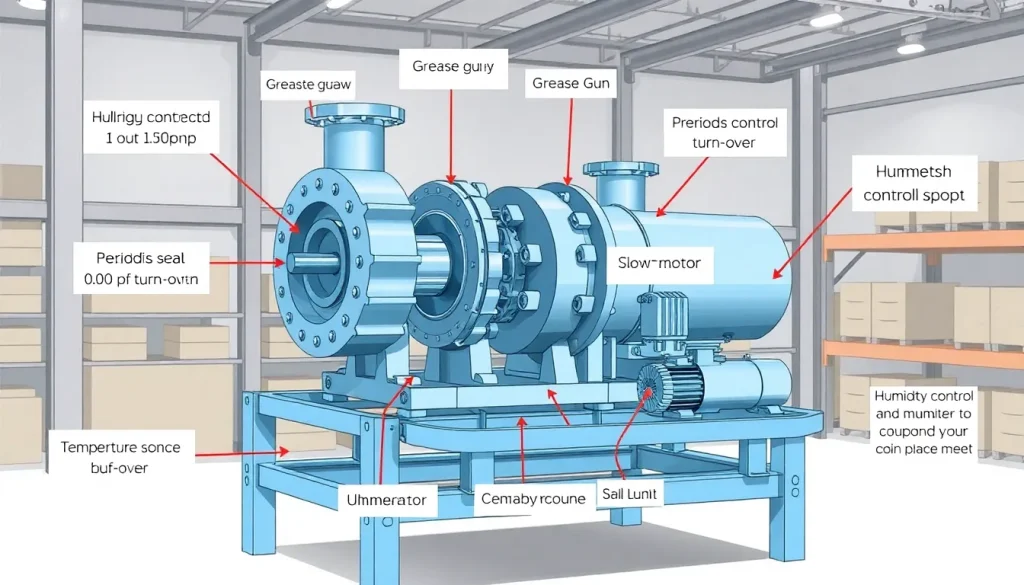
- Periodic rotation: install a low‑torque motor to turn the shaft 5–10 rpm for 30 seconds once per week; this redistributes oil film.
- Documentation: record temperature logs, lubrication dates, and visual inspections in a layup logbook.
Adjust the intervals if the pump is a high‑speed (≥ 3500 rpm) unit, as bearing temperatures rise faster during rotation.
Common Mistakes, Limits & Safety Notes
- Mixing units: applying the US corrosion constant to SI temperatures (or vice‑versa) can over‑predict wall loss by a factor of 25.
- Neglecting humidity: even with temperature control, high relative humidity accelerates rust; use dehumidifiers.
- Over‑speeding during rotation: exceeding 0.2 rpm can generate heat and wear the bearings.
- Using the wrong grease: high‑temperature greases can become brittle at low storage temperatures, losing film strength.
- Skipping seal flush: stagnant seal fluid leads to crystallization of inhibitors and seal scoring.
- Assuming corrosion is linear forever: the simple C = K·ΔT·t model loses accuracy after ~180 days in aggressive environments.
- Safety – confined spaces: if the pump is stored in a sealed container, ensure adequate ventilation to avoid buildup of flammable vapors from oil.
- Electrical isolation: disconnect motor leads and ground the motor housing to prevent stray currents that cause electro‑chemical attack.
FAQ
How often should I rotate a pump during long‑term layup?
For most centrifugal pumps, a slow turn‑over of 0.1–0.2 rpm for 30 seconds once every 7 days is sufficient to redistribute bearing oil and prevent shaft binding.
Can I store a pump outdoors if I use a weather‑proof cover?
Outdoor storage is discouraged for carbon‑steel casings because humidity and temperature swings accelerate corrosion. If unavoidable, use a dehumidified enclosure, corrosion inhibitor spray, and monitor temperature closely.
What type of grease is recommended for high‑speed bearing layup?
A high‑temperature, high‑load lithium complex grease with a minimum service life of 12 months is preferred; it remains pliable at low storage temperatures and resists water washout.
Do I need to flush the seal if the pump has a double‑seal arrangement?
Yes, each seal chamber should be flushed. The inner seal can be left dry if the pump is oil‑filled, but the outer seal cavity should be pressurized with nitrogen or a compatible inhibitor to prevent moisture ingress.
How is the corrosion allowance calculated for a 0.125‑in. casing?
Estimate the allowable wall loss (e.g., 0.010 in.) and divide by the predicted corrosion rate (mil per day) from the simple C = K·ΔT·t expression to obtain the maximum layup time.
What safety steps are required before restarting a layup‑stored pump?
Disconnect all power, verify grounding, conduct a visual inspection, check bearing temperature after a short trial run, perform a seal pressure test, and review the layup log for missed lubrication intervals.
Leave a Reply