
Short Answer
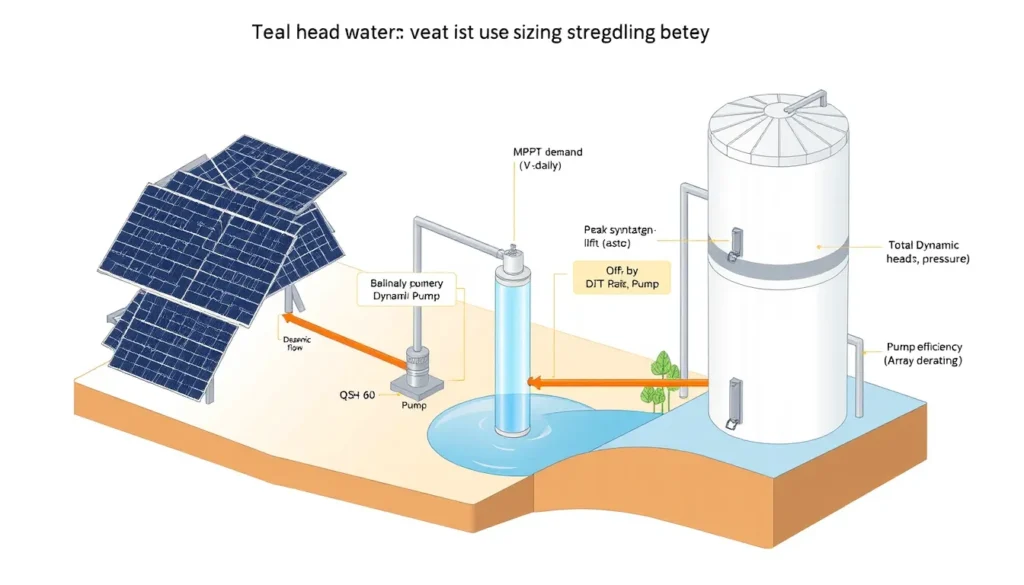
Governing formula (US customary): Qdesign = Vdaily / (PSH × 60)
Governing formula (SI): Qdesign = Vdaily / PSH
Hydraulic power: Phyd = Q × HTDH × SG / 3960 (hp, US) or Phyd = 0.002725 × Q × HTDH (kW, SI, water)
| Symbol | Meaning | US unit | SI unit |
|---|---|---|---|
| Vdaily | Daily water demand | gal/day | m³/day |
| PSH | Peak sun hours in design month | h/day | h/day |
| Qdesign | Design pumping flow | gpm | m³/h |
| HTDH | Total dynamic head | ft | m |
| ηoverall | Pump, motor, and drive efficiency | – | – |
Plain-English restatement: Divide the water needed in a day by the usable sunlight hours, then add head and efficiency corrections to select the pump and PV array.

Overview — What It Is and Why It Matters
Sizing a solar water pump from daily water demand is the process of converting a required volume per day into a design flow during the solar day, then matching that flow and the system total dynamic head to a pump, motor, controller, and photovoltaic array. The scope here is the common encyclopedic meaning: a photovoltaic water-pumping system serving a borehole, surface source, storage tank, livestock trough, irrigation line, or off-grid domestic supply. The method applies to direct-drive systems and to battery-backed systems, although the array and storage calculations differ.
The daily demand is the anchor because solar pumps do not usually run at a constant rate for 24 hours. They run when irradiance is sufficient, often for the equivalent of a few peak sun hours. If the designer starts with a pump curve instead of the demand, the system may be oversized, undersized, or mismatched to the source. Undersizing causes unmet demand, tank drawdown, dry-running, and premature controller or motor failure. Oversizing raises capital cost, can push a pump outside its efficient range, and may exceed the sustainable yield of a well.
The engineering relevance is direct: flow, head, and efficiency determine hydraulic power; hydraulic power and solar resource determine array size; source yield and storage determine reliability. A correct sizing calculation also exposes poor assumptions early, such as using static water level instead of dynamic drawdown, ignoring pipe friction, or using summer sun hours for a year-round critical supply.
The Method — Derivation and Variants
Start with the daily volume Vdaily. If the pump is expected to deliver that volume during PSH hours of useful solar pumping, the average design flow is Qdesign = Vdaily / (PSH × 60) in US units, where V is in gallons per day, PSH is in hours per day, and 60 converts minutes to hours. In SI, Qdesign = Vdaily / PSH, with V in cubic metres per day and Q in cubic metres per hour. This is the central derivation: daily volume divided by daily pumping time gives flow.
The next step is total dynamic head, HTDH. It includes static lift from the dynamic water level to the discharge point, well drawdown, discharge pressure head, friction losses in pipe and fittings, and velocity head. Friction is often estimated with Hazen-Williams or Darcy-Weisbach; for preliminary work, a 10–20% allowance is common, but long runs, small pipes, and high flow require calculation. Hydraulic power is then Phyd = ρgQH. In US customary units for water, Phyd (hp) = Q (gpm) × H (ft) × SG / 3960. The constant 3960 comes from unit conversions: 1 hp equals 550 ft·lb/s, and 1 gallon of water weighs about 8.34 lb.
Electrical input power is Pin = Phyd / ηoverall, where ηoverall includes pump, motor, and drive or controller efficiency. For a direct-drive system, the PV array is often estimated as Ppv = Pin / D, where D is a derating factor around 0.75, because the pump operates for roughly the same PSH used to design the flow. More generally, Ppv = Pin × toperating / (PSH × D). In SI, Phyd (kW) = 0.002725 × Q (m³/h) × H (m) for water, and Pin and Ppv follow the same efficiency and derating logic.
Variants matter. Direct-drive systems use a tank as the energy buffer and accept variable flow; battery systems decouple pumping from sunlight but need battery round-trip efficiency and depth-of-discharge checks. AC pumps with variable-frequency drives use an inverter and may have different part-load efficiency. Positive-displacement pumps are better for high head and low flow, while centrifugal pumps suit lower head and higher flow. The US and SI forms are algebraically identical; the only differences are the 60 min/h conversion and the 3960 or 0.002725 constants.
Worked Example
US customary example. A livestock system must water 50 cow-calf pairs. Assume 20 gal per pair per day, so Vdaily = 50 × 20 = 1,000 gal/day. The critical design month has PSH = 3.66 h/day (a winter value for a southern US location). Then Qdesign = 1,000 / (3.66 × 60) = 4.55 gpm. The dynamic lift is 80 ft, the discharge rise is 10 ft, and estimated friction is 1 ft, so HTDH = 80 + 10 + 1 = 91 ft. Hydraulic power is Phyd = 4.55 × 91 / 3960 = 0.105 hp. With an overall efficiency of 35%, Pin = 0.105 / 0.35 = 0.299 hp, or 223 W. Using a 0.75 derating, Ppv ≈ 223 / 0.75 = 297 W, so a 300 W array is a reasonable preliminary estimate.
SI example. A community needs 30 m³/day. The design PSH is 5 h/day, so Qdesign = 30 / 5 = 6 m³/h. The dynamic lift is 25 m, drawdown is 2 m, pressure head is 5 m, and friction is 3 m, giving HTDH = 35 m. Hydraulic power is Phyd = 0.002725 × 6 × 35 = 0.572 kW. With an overall efficiency of 45%, Pin = 0.572 / 0.45 = 1.27 kW. With a 0.75 derating, Ppv ≈ 1.27 / 0.75 = 1.70 kW. The designer would then check the pump curve at 6 m³/h and 35 m, confirm source yield, and select a controller and array with the manufacturer’s recommended voltage and current limits.
Calculator
Use a total dynamic head calculator to verify the head components before selecting equipment. A practical online tool is the pumpcalcs total dynamic head calculator at http://pumpcalcs.com/calculators/total-dynamic-head/. For a solar-specific shortlist, enter daily volume, peak sun hours, and TDH into a PV pump sizing calculator such as the Aquasolar solar pump calculator at https://www.aquasolarpump.com/en/tools/solar-pump-calculator. Treat calculator output as a preliminary selection and confirm the final pump against its published performance curve and the source yield.
Reference Values & Typical Ranges
| Parameter | Typical range or rule of thumb | Notes |
|---|---|---|
| Daily domestic use, US off-grid | 50–75 gal (190–285 L) per person per day | Includes drinking, cooking, hygiene, and basic household use; conservation can reduce this. |
| Basic rural WASH demand | 6–16 L per person per day | Drinking/cooking 4–6 L, basic hygiene 2–4 L, small productive use 0–6 L. |
| Beef cow or cow-calf pair | 15–20 gal (57–76 L) per day | Hot weather and lactation increase demand. |
| Dairy cow | 30–35 gal (113–133 L) per day | Includes drinking and milking-center use; verify local practice. |
| Sheep / hog / 100 chickens | 2 gal / 4 gal / 4 gal per day | Values are approximate and vary with climate and feed. |
| Peak sun hours | 3–6 h/day in sunny regions; 2–4 h/day in cloudy winters | Use the lowest design month for critical supply. |
| Overall pump-motor-drive efficiency | 30–60% | Small solar pumps often fall near 35–50%; use manufacturer data where available. |
| PV array oversizing | 1.3–1.5× pump rated power; derating about 0.75 | Accounts for temperature, soiling, wiring, controller, and mismatch losses. |
| Pipe friction allowance | 10–20% of TDH for preliminary work | Calculate for long runs or small pipes; keep velocity roughly 3–5 ft/s (0.9–1.5 m/s). |
| Storage for critical use | 2–3 days of average demand | More storage may be needed for prolonged cloudy periods or livestock reliability. |
Sources: SEIAPI (2019); Water Mission (2019); Solar Power & Pump (2024); SolarPoweredWaterPumps.com (2026); Aquasolar (n.d.). Ranges are preliminary and must be confirmed with site data and manufacturer curves.
Application Guidance
In real systems, the daily demand calculation is only the first link in a chain. A direct-drive pump will produce variable flow as irradiance rises and falls, so the storage tank becomes the hydraulic capacitor that turns intermittent pumping into steady supply. Size the tank for daily peak demand plus cloudy-day reserve, and use float switches or level sensors to prevent overflow and dry running. For livestock, place the tank above the troughs and use a float valve so animals drink without cycling the pump. For irrigation, zone the field to the volume the tank can deliver and avoid scheduling high-demand crops in the lowest sun month unless the array and storage are sized for it.
Selection implications are significant. A pump should be chosen near its best-efficiency point at the design flow and TDH, not at its maximum head or maximum flow limit. Check the pump curve at the design flow, at low-irradiance starting conditions, and at the maximum drawdown condition. Confirm that the well or surface source can sustain the design flow; if not, reduce the pump flow, add storage, or use a different source. Account for cable voltage drop, controller input voltage windows, array tilt and orientation, shading, and maintenance access. In cold climates, protect exposed pipes and tanks from freezing, and in hot climates, allow for panel temperature derating.
Field judgment should also include a modest design margin. A 10–25% flow margin is common for demand growth, pump wear, and fouling, but margin cannot replace a source yield test. If the demand is highly seasonal, size for the critical season and check that excess summer flow does not exceed the source yield or cause tank overflow. If the system is battery-backed, size the battery for energy autonomy and check round-trip efficiency; if it is direct-drive, size the array for the design-month PSH and confirm the controller can handle the open-circuit voltage at record low temperature.
Common Mistakes, Limits & Safety Notes
- Using average sun hours instead of design-month PSH. A system sized on annual average irradiance can fail in winter or cloudy seasons. Use the lowest month in which the demand must be met.
- Mixing units. Gallons per day, gallons per minute, cubic metres per hour, and litres per day are not interchangeable. The 60 min/h factor is frequently omitted, producing a flow that is 60 times too high.
- Using static water level. Pumping lowers the water level. Use dynamic drawdown, not the static level, or the pump will be undersized and may run dry.
- Ignoring friction and pressure head. Long pipes, fittings, filters, and discharge pressure can dominate TDH. A 10–20% allowance is only a starting point.
- Confusing hydraulic power with electrical input. The pump, motor, and controller consume more power than the water receives. Divide by overall efficiency before sizing the array.
- Sizing the array at pump nameplate only. Temperature, soiling, wiring, and controller losses require derating, typically around 0.75 for preliminary work.
- Neglecting source yield. A pump that can deliver the flow is useless if the well recovers more slowly. Add low-level cutoff and storage, and perform a yield test.
- Insufficient storage or dry-run protection. Direct-drive systems need a tank buffer and a low-level sensor. Dry running can destroy seals, bearings, and motors.
- Safety and compliance limits. Electrical work must follow applicable codes such as NEC or IEC, with grounding, disconnects, and certified components. Water systems need backflow protection, freeze protection, and safe access. This sizing method is preliminary; final design requires manufacturer curves, site testing, and qualified engineering review.
FAQ
How do I convert daily water demand into pump flow?
Divide the daily volume by the design peak sun hours. In US units, Q in gpm equals gallons per day divided by peak sun hours times 60. In SI, Q in m³/h equals m³ per day divided by peak sun hours. This gives the average flow the pump must deliver during the solar window, before adding a modest margin.
Should I size a solar pump for the worst month or the average month?
Size for the worst month in which the system must operate reliably. Winter or cloudy-season peak sun hours can be half the summer value, so an average-month design may fail when demand is critical. If the system is seasonal, use the lowest sun month in that season and check summer excess flow against well yield and storage.
What is total dynamic head and why does it matter?
Total dynamic head is the sum of vertical lift from the dynamic water level, discharge pressure head, friction losses, and velocity head at the design flow. It determines hydraulic power along with flow. Using static water level or omitting friction can undersize the pump and PV array, causing low output or dry running.
Can a solar water pump run without a battery?
Yes. Direct-drive solar pumps run whenever the array produces enough power and typically pump into a storage tank. Flow varies with sunlight. Batteries decouple pumping from irradiance but add cost and maintenance. For most water supply systems, a tank is a simpler and more durable buffer than a battery bank.
How many days of water storage should I plan for?
A common rule is two to three days of average demand for critical uses, and more where cloudy weather is prolonged or demand is livestock-critical. Storage also lets a direct-drive pump run at variable flow without affecting users. Check tank cost, freeze protection, and water quality before choosing the final volume.
What size solar array do I need for a 1 hp pump?
A 1 hp pump is about 746 W of shaft or input power, but the array must cover pump, motor, controller, and derating losses. Using 0.75 derating, start near 1 kW of array per 0.75 kW of electrical input. Always confirm against the manufacturer's recommended array because motor and controller efficiencies vary.
How do I measure the lift for a solar well pump?
Measure from the dynamic water level during pumping, not the static level before pumping. Add the vertical rise to the discharge point and any pressure head. Then add friction losses for the pipe, fittings, and valves at the design flow. Well drawdown can be significant, so a pump test is valuable.
What happens if the well yield is lower than the pump flow?
If the source recovers more slowly than the pump's design flow, the well will draw down and the pump may run dry. Size the pump to the sustainable yield, add a low-level cutoff, and use a storage tank to decouple source recovery from demand. A pump test or yield test is essential.
Leave a Reply