Short Answer
Key Formula / Key Facts Box
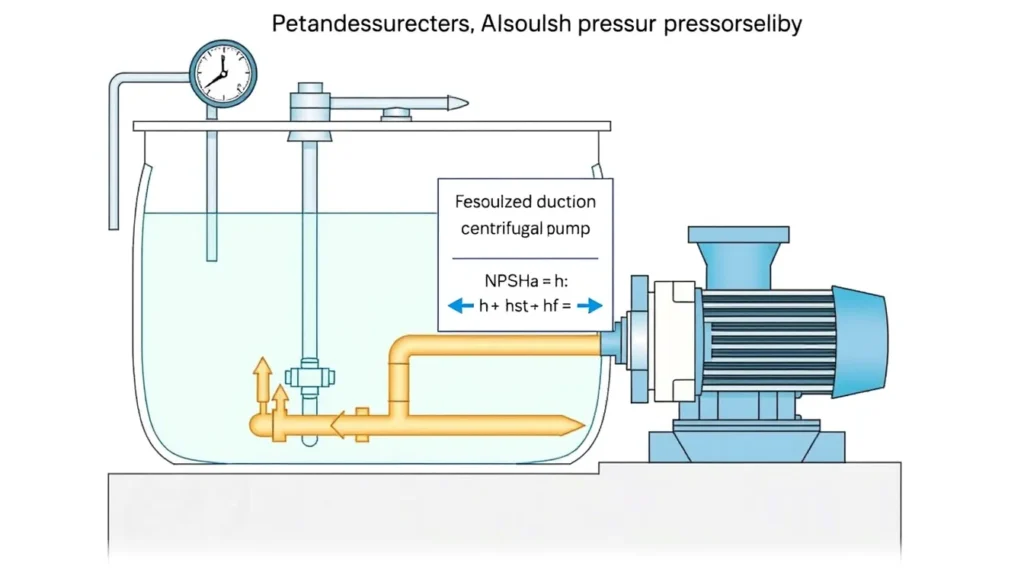
Governing formula (centrifugal or rotary pump, no acceleration head):
NPSHa = ha + hst − hf − hvp
where ha = (Patm + Ptank,g)/(ρg) and hvp = Pv/(ρg). Use absolute pressure for the pressure terms; tank gauge pressure must be added to local atmospheric pressure before subtracting vapor pressure.
US customary: NPSHa (ft) = (Patm + Ptank,g − Pv) × 2.31 / SG + hst − hf
SI: NPSHa (m) = (Patm + Ptank,g − Pv) × 100 / (9.81 × SG) + hst − hf, with pressures in bar.
Plain-English restatement: NPSHa is the absolute suction energy available above the liquid’s vapor pressure after elevation and friction are accounted for; if it is not greater than the pump’s NPSHr plus margin, cavitation is likely.
| Symbol | Meaning | US unit | SI unit | Plain-English note |
|---|---|---|---|---|
| ha | Absolute pressure head at the tank liquid surface | ft | m | Atmospheric pressure plus tank gauge pressure, converted to liquid head. |
| hst | Static head from liquid surface to pump datum | ft | m | Positive when liquid level is above the pump datum; negative for suction lift. |
| hf | Suction-line friction loss | ft | m | Always subtracted; includes pipe, fittings, valves, strainers, and entrance losses. |
| hvp | Vapor pressure head at pumping temperature | ft | m | True vapor pressure converted to head; use maximum operating temperature. |
| SG | Specific gravity of the liquid | dimensionless | dimensionless | Corrects pressure-to-head conversion for liquid density. |
Overview — What It Is and Why It Matters
NPSHa for a Pressurized Suction Tank: Step-by-Step Example is the system calculation of net positive suction head available when a pump draws from a closed tank whose vapor space is held above atmospheric pressure. The scope here is a centrifugal or rotary pump with a flooded suction; reciprocating and other positive-displacement pumps require an additional acceleration-head term.
NPSHa is not the pressure gauge reading at the pump, and it is not the tank pressure. It is the total absolute head at the pump suction datum minus the head equivalent of the liquid’s vapor pressure at the pumping temperature. API 610 defines NPSH as the absolute inlet total head above the head equivalent to vapor pressure, referred to the NPSH datum plane.
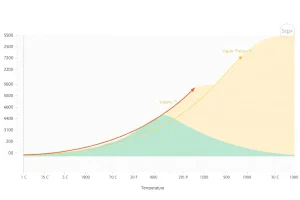
Pressurization raises the absolute pressure at the tank surface, which usually helps NPSHa. But in hot systems near saturation, the liquid’s vapor pressure rises with temperature and can cancel much or all of the tank-pressure benefit. That is why a tank reading 120 psig can still produce less than 7 ft of NPSHa. Because cavitation can erode impellers, reduce head and capacity, and cause vibration and noise, NPSHa must be calculated at the worst credible level, temperature, and pressure. Suction pressure is not NPSHa.
The Method — Derivation and Variants
The formula follows from the steady-flow energy equation between the liquid surface in the tank (point 1) and the pump suction datum (point 2): P1/(ρg) + z1 + v12/(2g) = P2/(ρg) + z2 + v22/(2g) + hf. Rearranging for the total absolute suction head above vapor pressure gives NPSHa = P1/(ρg) + z1 − z2 − hf − Pv/(ρg). With P1 = Patm + Ptank,g and z1 − z2 = hst, this becomes NPSHa = ha + hst − hf − hvp.

The velocity head terms cancel when the calculation starts at the tank surface and ends at the pump suction; this is why the basic NPSHa formula does not show a separate velocity-head term. If NPSHa is calculated from a pressure gauge at the pump inlet, however, the velocity head at the gauge location must be added back before subtracting vapor pressure.
Sign conventions matter. hst is positive when the liquid surface is above the pump datum and negative for suction lift. hf is always a positive loss. hvp is the true vapor pressure at the maximum operating temperature, converted to head using the same specific gravity used for the pressure-to-head conversion. For a closed tank with a breather valve or rupture disc that keeps the vapor space at essentially atmospheric pressure, set Ptank,g = 0 and use local atmospheric pressure at the site altitude.
US customary form: NPSHa (ft) = (Patm + Ptank,g − Pv) × 2.31 / SG + hst − hf. The constant 2.31 ft per psi is the head of water at SG = 1.0; dividing by actual SG corrects for the pumped liquid. SI form: NPSHa (m) = (Patm + Ptank,g − Pv) × 100 / (9.81 × SG) + hst − hf when pressures are in bar. For pressures in kPa, use NPSHa = (Patm + Ptank,g − Pv) / (9.81 × SG) + hst − hf. The 100 converts bar to kPa and 9.81 is gravitational acceleration.
For centrifugal and rotary pumps, acceleration head is zero. For reciprocating and some positive-displacement pumps, subtract an acceleration-head term hacc from NPSHa; pulsation can otherwise cause cavitation even when the steady-state calculation looks adequate.
Worked Example
US customary example — deaerator at 120 psig and 350°F. A closed deaerator tank is pressurized with 120 psig steam at sea level. The water is at about 350°F, the minimum liquid level is 10 ft above the pump datum, and total suction-line friction loss is 3.2 ft. At 350°F, water specific gravity is about 0.89 and the vapor pressure is essentially the saturation pressure of 120 psig steam, about 135 psia. Step 1: convert surface pressure to absolute: Psurface = 120 + 14.7 = 134.7 psia, rounded to 135 psia. Step 2: set vapor pressure: Pv ≈ 135 psia because the tank is near saturation. Step 3: convert pressure to head: ha = 135 × 2.31 / 0.89 ≈ 350 ft; hvp = 135 × 2.31 / 0.89 ≈ 350 ft. Step 4: hst = +10 ft. Step 5: hf = 3.2 ft. Step 6: NPSHa = 350 + 10 − 3.2 − 350 = 6.8 ft. The 120 psig tank pressure looks large, but it is almost entirely canceled by vapor pressure. If the pump requires 5 ft NPSHr, the margin is only 1.8 ft; if it requires 6 ft, the margin is 0.8 ft and the selection is marginal for a hot deaerator service.
SI example — nitrogen-pressurized water tank at 20°C. A closed water tank is pressurized to 0.50 barg with nitrogen at sea level. Local atmospheric pressure is 1.013 bar, vapor pressure at 20°C is 0.023 bar, SG = 1.0, minimum liquid level is 3.0 m above the pump datum, and suction friction loss is 0.8 m. Step 1: Psurface,abs = 1.013 + 0.50 = 1.513 bar. Step 2: pressure difference above vapor = 1.513 − 0.023 = 1.490 bar. Step 3: convert to head: 1.490 × 100 / (9.81 × 1.0) = 15.19 m. Step 4: add static head and subtract friction: NPSHa = 15.19 + 3.0 − 0.8 = 17.39 m. In kPa, the same pressure difference is 149.0 kPa, and 149.0 / 9.81 = 15.19 m. The nitrogen blanket is effective here because the water is far below its boiling point.
Calculator
Use an online NPSH calculator to check the arithmetic, but confirm that it accepts absolute pressures, local atmospheric pressure, true vapor pressure at temperature, specific gravity, and signed static head. A useful starting point is the Pump Fundamentals NPSH calculator. For a broader head-conversion check, a total dynamic head calculator such as pumpcalcs.com total dynamic head can help verify unit conversions. Always hand-check the result because unit-entry errors are common.
Reference Values & Typical Ranges
| Item | Typical value or rule | Source note |
|---|---|---|
| Atmospheric pressure at sea level | 14.7 psia; 1.013 bar; about 33.9 ft of water | Standard atmosphere; Pumps & Systems uses about 34 ft absolute at sea level. |
| Atmospheric pressure at 5,000 ft ASL | About 12.2 psia; about 28 ft of water | Pumps & Systems |
| Water vapor pressure at 20°C | About 0.023 bar; 0.34 psi | Steam tables |
| Water vapor pressure at 100°C | 1.013 bar; 14.7 psi | Steam tables |
| Water near 350°F / 177°C | About 135 psia at 120 psig steam saturation | Pumps & Systems deaerator example |
| Minimum NPSHa margin, water/cool water | About 5 ft (1.5 m) | Industrial Monitor Direct |
| Minimum margin, hydrocarbons below 200°F | About 3 ft (0.9 m) | Industrial Monitor Direct |
| High-vapor-pressure or hot hydrocarbons | 5–10 ft (1.5–3 m) margin; light ends often 10+ ft | Industrial Monitor Direct |
| NPSHa reporting convention | Above 25 ft (7.6 m), many specifications list 25 ft minimum unless special cases justify the actual value | PumpsDesign / API 610 guidance |
These values are screening aids, not substitutes for vendor NPSHr data and project specifications. Boiler feed and other critical services often add a pressure-drop safety factor; one common convention is a 5 psi safety factor for boiler feed water pumps.
Application Guidance
In real systems, NPSHa is a moving target. Calculate it at the minimum operable liquid level, maximum operating temperature, minimum atmospheric pressure expected at the site, and the control condition that produces the highest suction-line loss. For a pressurized tank, confirm whether the vessel is truly closed or fitted with a breather valve, vacuum breaker, or rupture disc. A tank that looks closed but breathes to atmosphere should be treated as an open tank at local atmospheric pressure.
Pressurization helps only to the extent that the surface pressure exceeds the liquid vapor pressure. In a deaerator, boiler-feed tank, or other hot saturated service, the tank pressure and vapor pressure are nearly equal, so the NPSHa margin is dominated by static head minus friction. That makes layout and level control critical: raise the tank, raise the minimum level, enlarge the suction pipe, reduce fittings and strainer loss, or select a pump with lower NPSHr.
Suction piping should be short, direct, and free of high spots that can trap vapor. Keep velocities moderate to control friction, and include the pressure drop of permanent strainers, valves, elbows, and inlet losses in hf. Check submergence to avoid vortexing: a common screening rule is Hsubmergence ≥ 1.5 × Dnozzle + NPSHr, with Dnozzle in the same units as the required submergence. For reciprocating pumps, add acceleration-head analysis and consider pulsation dampeners.
From a selection standpoint, compare NPSHa against the pump NPSHr at the rated flow and the maximum expected flow. NPSHr rises with flow and speed, so a pump that is adequate at design flow may cavitate during upset or high-demand operation. Maintain the project’s required margin, and revisit the calculation whenever temperature, tank pressure, level setpoint, or suction piping changes.
Common Mistakes, Limits & Safety Notes
- Using gauge pressure as absolute pressure. NPSHa requires absolute pressure for the surface pressure and vapor pressure. Add local atmospheric pressure to tank gauge pressure before subtracting Pv.
- Equating suction pressure with NPSHa. A high gauge at the pump inlet can still correspond to low NPSHa if the liquid is hot and vapor pressure is high.
- Assuming every covered tank is pressurized. Breather valves, vacuum breakers, and open vents keep the vapor space near atmospheric pressure; use local atmospheric pressure in that case.
- Using normal level instead of minimum level. The worst credible low level controls NPSHa, especially in batch or draw-down service.
- Using vapor pressure at the wrong temperature. Use true vapor pressure at the maximum operating temperature, not Reid vapor pressure or an ambient-temperature value.
- Ignoring density and specific gravity. Pressure-to-head conversion depends on SG. For hot water, SG can be significantly below 1.0.
- Omitting suction losses. Strainers, valves, elbows, entrance losses, and fouled filters must be included in hf.
- Forgetting acceleration head for reciprocating pumps. Centrifugal and rotary pump calculations may set it to zero, but positive-displacement pumps often cannot.
- Using insufficient margin. A result barely above NPSHr is not a safe design; use project margins and vendor guidance.
- Ignoring safety consequences. Cavitation can damage impellers, degrade performance, produce noise and vibration, and create loss-of-service risk. Hot-liquid suction lift is especially hazardous and should be reviewed by a specialist.
The method assumes a single-phase liquid, steady flow, and known vapor pressure. It does not cover entrained gas, flashing, foaming, vortexing, or transient pressure surges unless those effects are treated separately. For critical services, confirm the calculation with a detailed hydraulic model and vendor NPSHr test data.
FAQ
Can I add tank pressure directly to NPSHa?
You add it as absolute surface pressure, not as an arbitrary bonus. Convert tank gauge pressure to absolute, add local atmospheric pressure, convert to head with specific gravity, then subtract vapor-pressure head. If the tank is near saturation, vapor pressure can cancel most of the tank-pressure contribution.
Why can a 120 psig tank have less than 7 ft of NPSHa?
In a deaerator near 350°F, vapor pressure is about 135 psia, almost equal to 120 psig tank pressure plus atmosphere. The absolute-pressure head and vapor-pressure head nearly cancel, leaving mainly static head minus suction friction, about 10 minus 3.2 equals 6.8 ft in the example.
Do I use gauge or absolute pressure for NPSHa?
Use absolute pressure for the surface pressure and vapor pressure. Gauge pressure is relative to atmosphere, so it must be added to local atmospheric pressure. Mixing gauge and absolute values is one of the most common causes of incorrect NPSHa and poor pump selection.
What if my closed tank has a breather valve?
Treat it as an open tank at local atmospheric pressure. A breather valve, vacuum breaker, or open vent keeps the vapor space close to atmospheric, so the tank mechanical rating is not the operating pressure for NPSHa. Confirm the valve set pressure and normal operating condition first.
How much NPSHa margin is enough?
Common screening margins are about 5 ft for water, 3 ft for hydrocarbons below 200°F, 5 to 10 ft for high-vapor-pressure liquids, and 10 ft or more for light ends or boiling fluids. Project specifications and vendor requirements govern; critical services may require larger margins or a pressure safety factor.
Do I include velocity head in NPSHa?
When calculating from the tank surface to the pump suction, velocity head cancels and the basic formula is sufficient. If you start from a pressure gauge at the pump inlet, add the velocity head at that gauge location before subtracting vapor pressure.
Does tank pressure always increase NPSHa?
No. It increases absolute surface pressure, but if the liquid temperature rises or the tank is near saturation, vapor pressure rises too. The useful term is surface absolute pressure minus vapor pressure, so a pressurized hot liquid can have little or no NPSHa benefit.
Can NPSHa be negative?
Yes, mathematically. A negative NPSHa means the absolute suction head is below vapor pressure, so the liquid would flash or cavitate before reaching the pump. A centrifugal pump cannot operate reliably in that condition; revise the system or select different equipment.

Leave a Reply