Short Answer
Key Formula / Key Facts Box
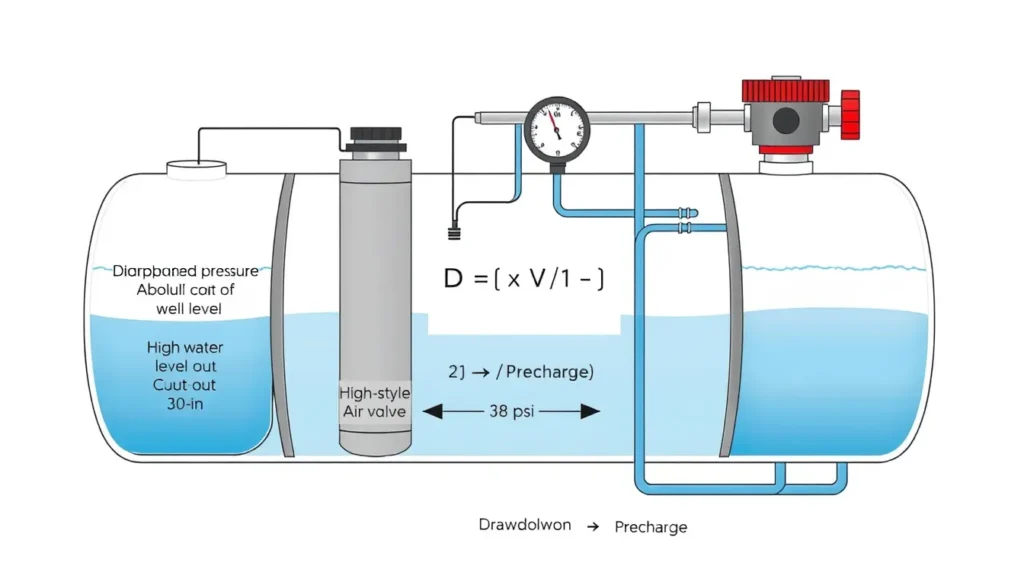
Drawdown formula (Boyle’s law):
D = V x [(P1 / P2) - (P1 / P3)]
All pressures must be absolute: P_abs = P_gauge + P_atm. Use local atmospheric pressure; at sea level, P_atm is about 14.7 psi or 101.3 kPa.
| Symbol | Meaning | US unit | SI unit |
|---|---|---|---|
| D | Drawdown, usable water between cut-out and cut-in | US gal | L or m3 |
| V | Total nominal tank volume | US gal | L or m3 |
| P1 | Air precharge pressure, absolute | psia | kPa absolute |
| P2 | Cut-in pressure, absolute | psia | kPa absolute |
| P3 | Cut-out pressure, absolute | psia | kPa absolute |
| P_atm | Local atmospheric pressure | psia | kPa absolute |
Plain-English restatement: drawdown is tank volume multiplied by the difference between the fraction of tank air at cut-in and the fraction at cut-out, using absolute pressures.

Overview — What It Is and Why It Matters
This article covers the most common encyclopedic meaning of the subject: how pressure switch cut-in and cut-out settings change the usable water volume, or drawdown, of a hydropneumatic pressure tank in a pumped water system. The scope is residential and light-commercial captive-air diaphragm or bladder tanks, with notes on conventional tanks. Variable-frequency drives use different control logic and are not the primary scope here.
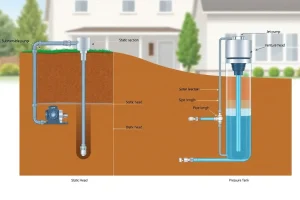
A pressure switch senses system pressure and starts the pump at the lower set point, called cut-in, and stops the pump at the higher set point, called cut-out. The difference between those two gauge pressures is the differential. For example, a 30/50 switch cuts in at 30 psi and cuts out at 50 psi, giving a 20 psi differential. The tank contains a captive air charge, normally set about 2 psi below cut-in, that acts as a spring. As water enters the tank, the air compresses; as water is drawn, the air expands and pressure falls until the switch reaches cut-in and restarts the pump.
Drawdown is the usable water delivered between pump cut-out and cut-in; it is set by tank volume, precharge, and the pressure switch band.
The engineering relevance is direct: too little drawdown causes short cycling, motor heating, contactor wear, diaphragm flexing, and unstable pressure. Too much pressure band or too high a cut-in can reduce drawdown in a fixed tank or stress the tank and piping. The common rule is to provide enough drawdown for at least about one minute of pump run time, so a 10 gpm pump needs roughly 10 gallons of drawdown. The pressure switch settings and precharge therefore drive tank sizing, pump start frequency, and service life.
The Method — Derivation and Variants
Boyle’s law for a fixed mass of gas at approximately constant temperature states that absolute pressure times gas volume is constant: P_abs x V_air = constant. In a captive-air tank, let V be total tank volume and let P1 be the precharge absolute pressure when the tank is empty of water. At cut-out, the air is compressed to volume V3 = P1 x V / P3. After water is drawn down to cut-in, the air has expanded to volume V2 = P1 x V / P2. Drawdown is the difference between those air volumes: D = V2 - V3 = V x [(P1 / P2) - (P1 / P3)].
| Form | Equation | Pressure basis | Volume unit |
|---|---|---|---|
| US customary | D_gal = V_gal x [(P1_psia / P2_psia) – (P1_psia / P3_psia)] | psia = psig + 14.7 at sea level | US gal |
| SI | D_L = V_L x [(P1_kPa abs / P2_kPa abs) – (P1_kPa abs / P3_kPa abs)] | kPa abs = kPa gauge + 101.3 at sea level | L or m3 |
The acceptance factor is the bracketed ratio: AF = P1/P2 - P1/P3, and D = AF x V. With the usual field rule that precharge is 2 psi below cut-in, P1 = cut-in – 2 psi plus atmospheric pressure. A simplified variant sometimes uses precharge equal to cut-in, which gives AF = 1 - P1/P3, but that is not recommended for captive-air tanks because pressure can drop abruptly near cut-in if the precharge is not below the switch setting. Conventional tanks without a diaphragm may have no useful precharge and therefore much lower drawdown factors.
Use the US customary form when pressures are in psi and volume is in US gallons. Use the SI form when pressures are in kPa or bar and volume is in liters or cubic meters. Always convert gauge pressure to absolute pressure first, and adjust atmospheric pressure for altitude. The isothermal assumption is reasonable for slow tank cycles; fast cycling and thermal effects can make actual behavior differ slightly from the calculation.
Worked Example
Example 1, US customary: A captive-air tank has V = 85 gal, a 30/50 pressure switch, and a 28 psi precharge at sea level. P1 = 28 + 14.7 = 42.7 psia; P2 = 30 + 14.7 = 44.7 psia; P3 = 50 + 14.7 = 64.7 psia. Then D = 85 x [(42.7 / 44.7) – (42.7 / 64.7)] = 85 x [0.9553 – 0.6600] = 85 x 0.2953 = 25.1 gal. The acceptance factor is about 0.295, so about 29.5 percent of the nominal tank volume is usable drawdown.
Example 1, SI equivalent: Convert 85 US gal to 321.8 L. Convert 28 psi to 193.1 kPa gauge plus 101.3 kPa atmospheric = 294.4 kPa absolute; 30 psi becomes 308.2 kPa absolute; 50 psi becomes 446.1 kPa absolute. D = 321.8 x [(294.4 / 308.2) – (294.4 / 446.1)] = 321.8 x [0.9553 – 0.6600] = 321.8 x 0.2953 = 95.0 L, matching 25.1 gal.
Example 2, higher pressure band: The same 85 gal tank uses a 40/60 switch with 38 psi precharge. P1 = 52.7 psia; P2 = 54.7 psia; P3 = 74.7 psia. D = 85 x [(52.7 / 54.7) – (52.7 / 74.7)] = 85 x [0.9634 – 0.7055] = 85 x 0.2579 = 21.9 gal. In SI, with 321.8 L and absolute pressures of 363.3, 377.1, and 515.0 kPa, D = 321.8 x 0.2579 = 83.0 L. The higher pressure setting provides stronger system pressure but about 3.2 gal less drawdown in this tank, roughly 13 percent less.
Calculator
For a quick estimate, enter P1, P2, P3, and V into the formula above in a spreadsheet. For related pump-system head calculations, see the PumpCalcs total dynamic head calculator. When using any online tool, confirm that it accepts absolute pressure, or convert gauge pressure to absolute before entry.
Reference Values & Typical Ranges
| Switch setting (psi) | Differential (psi) | Typical precharge (psi) | Approx. acceptance factor | Approx. drawdown in 44-gal tank (gal) |
|---|---|---|---|---|
| 20/40 | 20 | 18 | 0.34 | ~15.0 |
| 30/50 | 20 | 28 | 0.30 | 13.6 published |
| 40/60 | 20 | 38 | 0.26 | 11.8 published |
| 50/70 | 20 | 48 | 0.23 | 10.4 published |
Sources: The Driller drawdown articles; Global Water Solutions support data; County Road Home comparison of 20/40, 30/50, and 40/60 settings with Amtrol published figures. Published Amtrol factors may be about 4 to 5 percent higher than a 2 psi precharge gap calculation because some published sizing tables use precharge equal to cut-in.
- Common residential pressure switch settings are 20/40, 30/50, and 40/60 psi, usually with a 20 psi differential.
- Set captive-air tank precharge about 2 psi below cut-in with the tank completely empty of water: 28 psi for 30/50, 38 psi for 40/60.
- Minimum pump run time is commonly about one minute; choose drawdown at least equal to pump capacity in gpm for one minute.
- Many water pressure tanks have a maximum working pressure around 150 psi, but ratings vary widely; always confirm the nameplate.
- At 6,000 ft altitude, atmospheric pressure is about 11.8 psi, not 14.7 psi, so absolute-pressure conversions change slightly.
Application Guidance
In real systems, the pressure switch settings must satisfy fixture pressure needs while keeping pump cycling acceptable. Higher cut-in and cut-out pressures improve pressure at upper floors and long piping runs, but they usually reduce drawdown for a fixed tank because the air is compressed to a higher absolute pressure. A wider differential increases drawdown and run time, but it also increases the pressure swing at taps and may exceed the tank manufacturer’s allowable water-chamber expansion. Before widening beyond about 20 psi, check the tank and switch ratings.
For selection, start with the pump capacity and required minimum run time. If a 10 gpm pump needs one minute of run time, provide 10 gal of drawdown. At 30/50 with an acceptance factor of about 0.30, the theoretical nominal tank volume is 10 / 0.30 = 33 gal, so a standard 44 gal tank is a practical choice. At 40/60 with a factor of about 0.26, the same drawdown requires about 38 gal nominal, so the same tank delivers less drawdown. Field judgment should include the highest fixture elevation, friction loss, local atmospheric pressure, and whether the tank is diaphragm, bladder, or conventional.
Common Mistakes, Limits & Safety Notes
- Using gauge pressure in Boyle’s law instead of absolute pressure. Add local atmospheric pressure before dividing, or the acceptance factor will be wrong.
- Checking or setting precharge with water in the tank. Precharge must be measured with the tank empty and pump power off.
- Setting precharge equal to cut-in rather than about 2 psi below cut-in. This can cause a sudden pressure drop before the pump starts.
- Assuming total tank volume equals drawdown. Drawdown is only the acceptance-factor portion of nominal volume, often 20 to 35 percent.
- Raising cut-out pressure without reducing or resetting precharge. A higher cut-out with unchanged precharge usually lowers drawdown.
- Ignoring switch and tank ratings. Do not exceed the pressure switch range, tank maximum working pressure, or diaphragm temperature and chemical limits.
- Forgetting that conventional tanks lose air and can become waterlogged. They need air control, probes, or maintenance to preserve drawdown.
- Using a tank that is too small for the pump. Short cycling heats motors and stresses contactors, diaphragms, and piping.
- Re-pressurizing a corroded, damaged, or bladder-failed tank. Water from the air valve usually means the bladder has failed; replace the tank or bladder.
- Working on a live switch or pressurized tank. Shut off the breaker, relieve water pressure, use a non-contact voltage tester, and follow manufacturer safety instructions.
FAQ
What do cut-in and cut-out mean on a pressure switch?
Cut-in is the lower gauge pressure at which the switch starts the pump; cut-out is the higher pressure at which it stops the pump. A 30/50 switch cuts in at 30 psi and cuts out at 50 psi, giving a 20 psi differential. The tank precharge is normally set 2 psi below cut-in, so 28 psi for a 30/50 system.
Does raising cut-out pressure increase tank drawdown?
Usually no for a fixed tank and fixed precharge. Raising cut-out compresses the air more at the top of the cycle and reduces the volume delivered between cut-out and cut-in. Drawdown can increase if you widen the differential, but the pressure swing and bladder stress also increase. Check tank and switch limits.
What precharge should a 40/60 pressure tank have?
For a captive-air tank, set precharge to 2 psi below cut-in, so 38 psi for a 40/60 switch. Check it with the tank completely empty of water and pump power off. If precharge is too high, the tank can run out of water before the pump starts; if too low, drawdown is reduced.
How much water does a 44-gallon tank deliver at 30/50?
Using a common 28 psi precharge and sea-level absolute pressures, the acceptance factor is about 0.30, so drawdown is about 13 gallons. Published Amtrol figures for some 44-gallon models are about 13.6 gallons at 30/50. Actual drawdown depends on precharge, altitude, and tank type.
Why does my well pump short-cycle?
Short cycling often means the tank is waterlogged, precharge is low or lost, the tank is undersized, or the pressure switch differential is too narrow. Check air precharge with the tank empty, verify cut-in and cut-out, and confirm drawdown meets at least about one minute of pump run time. A failed bladder can also cause rapid cycling.
Can I increase the pressure switch differential to get more drawdown?
Yes, widening the differential increases drawdown for a given tank, but it also increases the pressure swing at fixtures and may over-expand the tank bladder. Many tank manufacturers limit acceptable differential or water-chamber expansion. Check the tank nameplate and manufacturer instructions before setting a differential much beyond 20 psi.
Should I use gauge or absolute pressure in the drawdown formula?
Use absolute pressure. Add local atmospheric pressure to every gauge reading before dividing. At sea level, add 14.7 psi or 101.3 kPa; at 6,000 ft, atmospheric pressure is about 11.8 psi. Using gauge pressure directly gives incorrect acceptance factors and can lead to poor tank sizing.
What if water comes out of the tank air valve?
Water at the air valve usually means the bladder or diaphragm has failed, so the tank is waterlogged and cannot hold precharge. Do not keep adding air. Shut off power and water, relieve pressure, and replace the tank or bladder if serviceable. Re-pressurizing a corroded or ruptured tank can be dangerous.
Leave a Reply