Short Answer
Key Formula / Key Facts Box
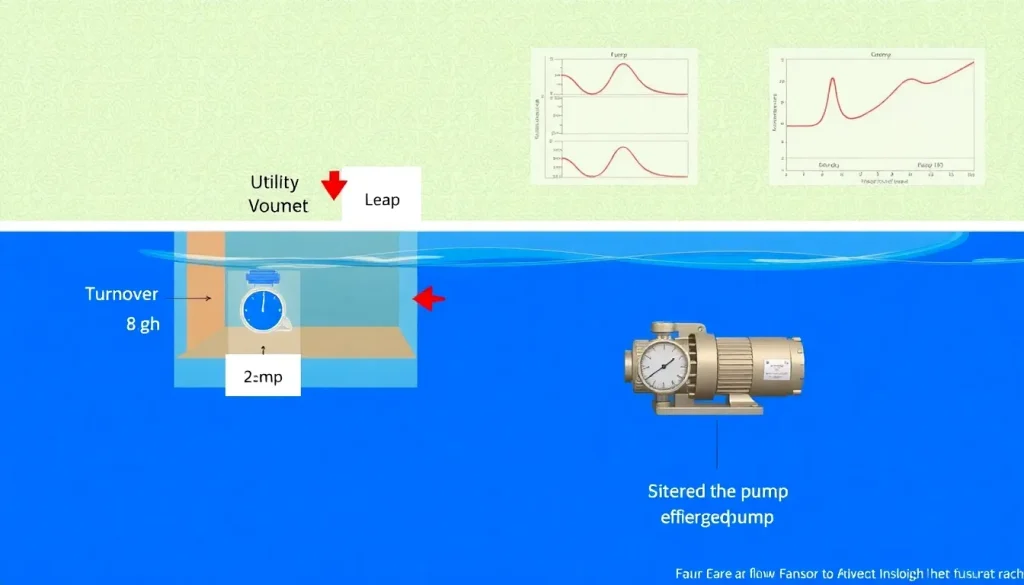
Turnover Equation
[Q = frac{V}{t}]
where:
| Symbol | Meaning | US Unit | SI Unit | Plain‑English Restatement |
|---|---|---|---|---|
| Q | Required flow rate | gpm (gal/min) | m³/h | How many gallons per minute must the pump move to turn the pool over. |
| V | Pool water volume | gal | m³ | Total water that needs to be circulated. |
| t | Desired turnover time | min | h | Target time for one complete water change. |
Key Facts
- Typical residential turnover: 6–8 h (≈ 8–12 gpm for a 20,000 gal pool).
- Pump efficiency falls sharply > 1.5× the required flow.
- Static head for an in‑ground pool is usually 10–30 ft (3–9 m).
- Dynamic head includes filter, skimmer, and pipe friction; often 40–70 ft total.
- Oversizing > 25 % raises electricity use 15–30 % and shortens motor life.
Overview — What It Is and Why It Matters
Pool circulation is governed by the turnover rate – the time needed for the pump‑filter system to move the entire water volume once. Engineers use the turnover rate to guarantee adequate mixing of chemicals, removal of debris, and thermal uniformity. Selecting a pump solely on horsepower or “bigger is better” leads to excessive hydraulic losses, higher energy bills, and premature bearing wear. By calculating the exact flow required for a target turnover, designers can choose a pump that meets the hydraulic head with the highest possible efficiency class (ISO 1940‑1, IEC 60335‑2‑7). Errors in sizing are costly: an undersized pump may never reach the desired turnover, while an oversized unit can cause cavitation, increased noise, and wasted power.
The Method — Derivation and Variants
The core relationship is a simple continuity equation: volume equals flow multiplied by time. In US units the formula appears as:
[Q_{text{gpm}} = frac{V_{text{gal}}}{t_{text{min}}}]
In SI units the same physics is expressed as:
[Q_{text{m³/h}} = frac{V_{text{m³}}}{t_{text{h}}}]
Derivation starts from the definition of flow rate (Q = dV/dt). Assuming constant flow, integration over a full turnover yields Q = V/t. The only constant that changes between variants is the unit conversion factor (1 m³ = 264.172 gal). When using commercial pump curves, the flow is often given in gpm; therefore the US form is most convenient for residential pool owners.
Two practical variants are used:
- Design turnover – 6 h for in‑ground pools, 8 h for above‑ground. This is the baseline used by the U.S. Consumer Product Safety Commission (CPSC).
- Performance‑adjusted turnover – accounts for high‑temperature climates or heavy‑use facilities; turnover may be reduced to 4 h.
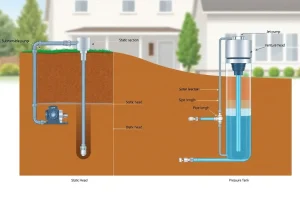
When the desired turnover is known, the required flow is inserted into the pump selection chart together with the total dynamic head (TDH). The TDH is the sum of static head (height difference between water surface and pump inlet) and all friction losses (pipes, fittings, filter). The selected pump must deliver the calculated Q at or near its Best Efficiency Point (BEP) on the curve.
Worked Example
Example 1 – US customary units
Pool dimensions: 30 ft × 15 ft × 5 ft (average depth). Desired turnover: 8 h.
- Calculate volume: V = 30 × 15 × 5 = 2,250 ft³. Convert to gallons (1 ft³ = 7.48 gal): V = 2,250 × 7.48 ≈ 16,830 gal.
- Convert turnover time to minutes: t = 8 h × 60 = 480 min.
- Required flow: Q = 16,830 gal / 480 min ≈ 35.1 gpm.
- Estimate TDH: static head ≈ 12 ft, filter loss ≈ 20 ft, pipe friction ≈ 15 ft → TDH ≈ 47 ft.
- Consult a pump curve: a 1‑hp, 0.75 efficiency pump provides 35 gpm at 45 ft and 38 gpm at 55 ft. Choose the 1‑hp model, operating near its BEP.
Example 2 – SI units
Pool dimensions: 9 m × 4.5 m × 1.5 m. Desired turnover: 6 h.
- Volume: V = 9 × 4.5 × 1.5 = 60.75 m³.
- Turnover time: t = 6 h.
- Required flow: Q = 60.75 m³ / 6 h = 10.125 m³/h (≈ 2.8 m³/h per 100 m³?).
- TDH: static head ≈ 3 m, filter ≈ 6 m, pipe friction ≈ 4 m → TDH ≈ 13 m.
- From an ISO‑efficiency pump catalog, a 0.55 kW (0.75 hp) centrifugal pump delivers 10 m³/h at 13 m head with 78 % efficiency. Select this unit.
Calculator
Use an online turnover calculator to verify your numbers: Pool Turnover & Flow Calculator.
Reference Values & Typical Ranges
| Parameter | Typical Residential | Typical Commercial | Source |
|---|---|---|---|
| Turnover time | 6–8 h | 4–6 h | ASTM F1346‑20 |
| Flow per 10,000 gal | 8–12 gpm | 12–20 gpm | Pool & Spa Chem. Handbook, 3rd ed. |
| Total dynamic head | 40–70 ft (12–21 m) | 70–120 ft (21–36 m) | ANSI/HI 9.6‑2015 |
| Pump efficiency at BEP | 60–70 % | 70–80 % | IEC 60335‑2‑7 |
| Motor size (hp/kW) | 0.5–1.5 hp (0.37–1.1 kW) | 2–5 hp (1.5–3.7 kW) | National Electrical Code (NEC) 2023 |
Application Guidance
When translating the calculated flow into a pump choice, follow these steps:
- Determine the total dynamic head with a pipe‑friction calculator (e.g., Hazen‑Williams for PVC). Include every fitting, valve, and the filter’s rated loss.
- Locate a pump curve that intersects the required Q at a head within ±5 % of the TDH. Prefer curves that show the BEP close to this intersection.
- Check the motor’s service factor (SF ≥ 1.15) to allow occasional spikes.
- Verify that the pump’s Net Positive Suction Head Available (NPSHA) exceeds the NPSHR by at least 2 ft (0.6 m) to avoid cavitation.
- Consider variable‑speed drives (VSD) for pools that need multiple turnover rates (e.g., winter vs. summer). A VSD can trim flow by 30 % while keeping the pump near its BEP, dramatically improving energy use (up to 50 % savings).
Common Mistakes, Limits & Safety Notes
- Using motor horsepower as a proxy for flow. Pump curves, not motor size, dictate Q‑H performance.
- Ignoring friction losses. Underestimating TDH leads to a pump that cannot meet the required flow.
- Oversizing beyond 25 % of required flow. Results in lower efficiency, higher operating temperature, and increased motor current.
- Mixing US and SI units. A 1‑hp pump rated at 75 gpm cannot be directly compared to a 0.55 kW pump rated at 10 m³/h without conversion.
- Neglecting NPSH. Low suction head can cause cavitation, damaging impeller blades.
- Running the pump continuously at BEP. Periodic shutdowns for cleaning and chemical balance prolong pump life.
- Failing to match pump speed to pipe diameter. Too high a speed in undersized piping creates excessive velocity, erosion, and noise.
- Bypassing the filter for “extra flow.” This defeats water quality goals and can void warranty.
FAQ
What is the minimum turnover rate required for a residential pool?
Most industry guidelines, such as ASTM F1346, recommend a 6‑hour turnover for in‑ground pools and 8‑hour turnover for above‑ground pools to maintain water quality and proper chemical distribution.
Can I simply buy the biggest pump I can afford and run it faster?
No. Oversizing a pump by more than 25 % usually drops efficiency, raises electricity use, and can cause cavitation and premature motor failure. Choose a pump that meets the required flow at its Best Efficiency Point.
How do I calculate the total dynamic head for my pool?
Add the static head (height difference between water surface and pump inlet) to all friction losses: pipe length, fittings, valves, and filter pressure drop. Use the Hazen‑Williams equation for PVC or consult a pipe‑friction calculator.
Is a variable‑speed pump worth the extra cost?
Yes, especially for pools that vary turnover rates seasonally. A VSD can trim flow while keeping the pump near its BEP, often cutting annual energy consumption by 30‑50 % compared to a single‑speed pump.
What happens if my pump’s NPSHA is lower than the NPSHR?
The pump will experience cavitation, producing audible noise, vibration, and damage to the impeller. Ensure at least a 2 ft (0.6 m) margin between NPSHA and NPSHR.
Do I need to size the pump differently for heating vs. cooling?
The turnover rate remains the same, but heating adds a slight increase in viscosity, marginally raising head loss. In most cases the same pump can handle both; just verify the TDH at the higher temperature if you use a heat exchanger.
How often should I recalculate the pump size after renovations?
Any change to pool volume, plumbing diameter, filter type, or added water features (spa, waterfall) requires a new turnover calculation and possibly a different pump.
Is a larger pump motor always more durable?
Not necessarily. Larger motors run cooler at lower loads, but if the pump is oversized the impeller operates far from its BEP, increasing wear. Properly sized pumps generally have longer service lives.
Leave a Reply