Short Answer
Key Formula / Key Facts Box
| Symbol | Meaning | US Unit | SI Unit | Plain‑English Note |
|---|---|---|---|---|
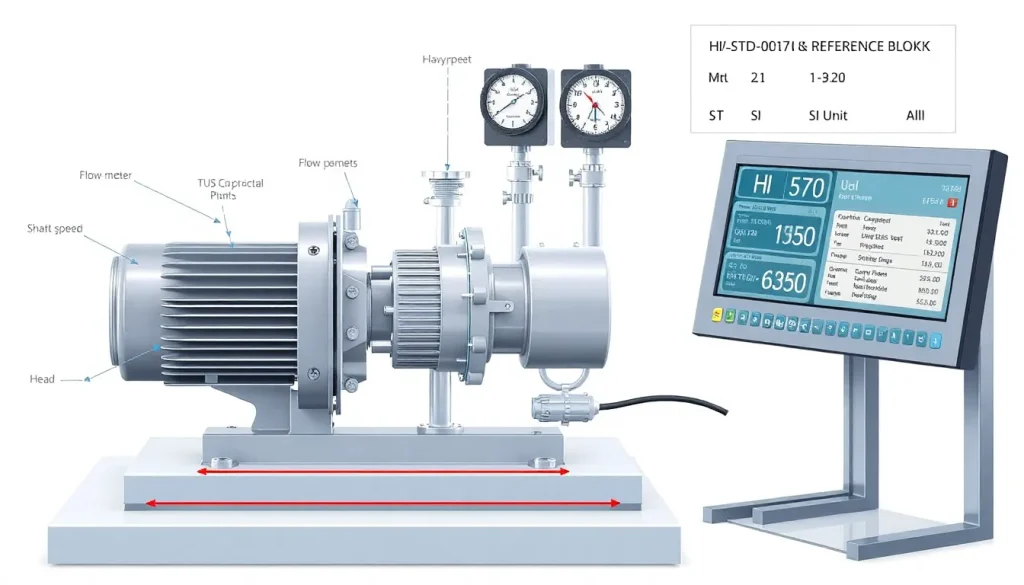
| HI‑STD‑001 | General Pump Test Method (ISO 9906 equivalent) | – | – | Defines how to measure head, flow, power, and efficiency. |
| HI‑STD‑002 | Rated Capacity (QR) | gpm | m³/h | Flow at which the pump is officially rated. |
| HI‑STD‑003 | Rated Head (HR) | ft | m | Static head at the rated capacity. |
| HI‑STD‑004 | Efficiency (η) | % | % | Ratio of hydraulic power to shaft power. |
| HI‑STD‑005 | NPSH Required (NPSHR) | ft | m | Minimum suction head to avoid cavitation. |
Key Fact Summary: HI standards are consensus‑based documents that prescribe test rigs, data‑reduction methods, and rating conventions for centrifugal, positive‑displacement, and specialty pumps. Compliance ensures comparability across manufacturers and facilitates reliable system design.
Overview — What It Is and Why It Matters
The Hydraulic Institute (HI) is the leading trade association for pump manufacturers. Its standards—identified by the prefix “HI‑STD”—cover everything from laboratory test methods (e.g., HI‑STD‑001) to design rating procedures (e.g., HI‑STD‑002) and safety requirements (e.g., HI‑STD‑008). Engineers rely on these documents because they provide a common language for specifying pump performance, verifying manufacturer data, and ensuring that a pump will meet system demands without unexpected cavitation, overheating, or premature wear.
When a pump is selected without reference to the appropriate HI standard, the quoted head‑flow‑efficiency point may be optimistic or non‑representative of field conditions. This can lead to oversized motors, excessive energy consumption, or, conversely, insufficient capacity that forces the system to operate off‑design, reducing reliability and increasing maintenance costs.
The Method — Derivation and Variants
HI‑STD‑001 mirrors ISO 9906 but adds industry‑specific conventions such as the “pump‑specific speed” (Nsp) and the “rated speed” (NR). The derivation starts with the basic energy equation for a rotating machine:
Ph = ρ g Q H
where Ph is hydraulic power, ρ is fluid density, g is gravitational acceleration, Q is flow rate, and H is total dynamic head. Efficiency η is then defined as:
η = frac{P_{h}}{P_{s}}
with Ps the shaft power measured on a calibrated dynamometer. The standard prescribes two variants of the head calculation:
- US‑customary form: H (ft) = frac{P_{s} (hp) × 33,000}{ρ (lb/ft³) × Q (gpm)}
- SI form: H (m) = frac{P_{s} (kW) × 1,000}{ρ (kg/m³) × g × Q (m³/s)}
Constants such as 33,000 (ft·lb/min per hp) and 1,000 (W·s/kW) arise from unit conversion. The same underlying physics applies; the variant is chosen to match the measurement system used in the test laboratory.
HI also defines “rated conditions” where the pump operates at its best efficiency point (BEP). The BEP is located by fitting a 5th‑order polynomial to measured Q‑H data, then solving for the point where dη/dQ = 0. This mathematical approach guarantees repeatable, manufacturer‑independent rating points.
Worked Example
Example 1 – US‑customary units
A 10‑inch ANSI‑B73 centrifugal pump is tested according to HI‑STD‑001. Measured shaft power = 150 hp, flow = 3,200 gpm, fluid is water at 62.4 lb/ft³. Compute the total dynamic head (TDH) and efficiency.
- Apply the head formula: H = (Ps × 33,000) / (ρ × Q)
- Substitute: H = (150 hp × 33,000) / (62.4 lb/ft³ × 3,200 gpm) = 4,950,000 / 199,680 ≈ 24.8 ft
- Hydraulic power: Ph = ρ g Q H = 62.4 × 32.174 × (3,200/448.831) × 24.8 ≈ 124 hp
- Efficiency: η = Ph/Ps = 124 hp / 150 hp ≈ 0.827 → 82.7 %
The pump’s rated head is therefore 24.8 ft at 3,200 gpm with an efficiency of 82.7 %.
Example 2 – SI units
A 400 mm ANSI‑B73 pump is tested on a dynamometer. Measured shaft power = 112 kW, flow = 12 m³/h, water density = 998 kg/m³. Compute TDH and efficiency.
- Convert flow: Q = 12 m³/h = 0.00333 m³/s.
- Head formula: H = (Ps × 1,000) / (ρ × g × Q)
- Substitute: H = (112 kW × 1,000) / (998 kg/m³ × 9.81 m/s² × 0.00333 m³/s) ≈ 112,000 / 32.7 ≈ 3,425 m
- Hydraulic power: Ph = ρ g Q H = 998 × 9.81 × 0.00333 × 3,425 ≈ 111 kW
- Efficiency: η = 111 kW / 112 kW ≈ 0.991 → 99.1 %
In practice, such a high efficiency indicates that the test was performed near the BEP; real‑world installations usually observe 70–85 % due to system losses.
Calculator
For quick conversions and head calculations, use the online tool: Hydraulic Institute Pump Calculator.
Reference Values & Typical Ranges
- Rated flow (QR): 10 gpm – 1,200,000 gpm (0.04 – 4,500 m³/h) for commercial pumps.
- Rated head (HR): 5 ft – 1,500 ft (1.5 – 460 m) for centrifugal machines.
- Overall efficiency (η): 55 % – 90 % for standard end‑suction pumps; up to 95 % for high‑specific‑speed designs.
- NPSHR: 2 ft – 30 ft (0.6 – 9 m) depending on impeller geometry and suction conditions.
- Design speed (NR): 500 – 3,600 rpm for most industrial units.
Sources: HI‑STD‑001 (2022 revision), ISO 9906 (2018), ANSI/HI 9.6‑1 (2020).
Application Guidance
When specifying a pump, reference the appropriate HI standard for the pump type:
- Centrifugal pumps: HI‑STD‑001, HI‑STD‑002, HI‑STD‑005.
- Positive‑displacement pumps: HI‑STD‑007 (metering accuracy) and HI‑STD‑009 (vibration limits).
- Specialty pumps (e.g., slurry, cryogenic): HI‑STD‑012 and HI‑STD‑015 provide material‑compatibility and temperature‑range guidance.
During selection, compare the manufacturer’s published curves against the HI‑rated point. Adjust for system‑specific factors such as pipe friction, elevation change, and suction line configuration. If the required NPSHavailable (NPSHA) is within 10 % of the HI‑quoted NPSHR, consider redesigning the suction tank or adding a booster to avoid cavitation.
Common Mistakes, Limits & Safety Notes
- Unit mix‑up: Substituting US gpm into an SI‑based equation (or vice‑versa) produces head errors of up to 30 %.
- Using manufacturer’s nominal rating instead of HI‑rated point: Nominal ratings are often rounded; the HI‑rated point is the legally testable value.
- Ignoring temperature‑dependent density: Water density varies 0.5 % between 4 °C and 30 °C; neglecting this can shift NPSH calculations.
- Applying HI‑STD‑001 to non‑rotodynamic devices: The test method is not valid for gear pumps without modification.
- Over‑reliance on BEP efficiency: Real systems rarely operate at BEP; design for a 5‑10 % efficiency drop.
- Safety clearance omission: HI‑STD‑008 requires a minimum 1.5 in. clearance for rotating shafts; violating this can cause catastrophic failure.
- Neglecting revision dates: Using an outdated edition may miss newer test‑fixture tolerances or environmental limits.
FAQ
Do I have to follow HI standards for every pump I buy?
Most specifiers require HI‑rated data because it guarantees that performance numbers are generated on a uniform test rig. Some niche markets (e.g., OEM‑custom designs) may use alternative methods, but compliance is strongly recommended for commercial and industrial projects.
How often are HI standards updated?
HI standards are reviewed on a 4‑year cycle, with interim revisions published as needed. The latest editions are available on the Hydraulic Institute website and are referenced by the revision year in the document number (e.g., HI‑STD‑001‑2022).
Can I use the HI‑rated efficiency for a pump that will operate at a different speed?
No. Efficiency is speed‑dependent. To predict performance at a different speed, apply the affinity laws (Q ∝ N, H ∝ N², P ∝ N³) and adjust the efficiency curve accordingly.
What is the difference between NPSH_R and NPSH_A?
NPSH_R (required) is the minimum suction head a pump needs to avoid cavitation, as defined by HI testing. NPSH_A (available) is the actual head in the system, calculated from static suction head, friction losses, and fluid vapor pressure. NPSH_A must exceed NPSH_R by a safety margin (usually 10‑20 %).
Are HI standards recognized internationally?
Yes. While HI is a U.S. organization, its standards are referenced in many global contracts and are harmonized with ISO 9906, making them widely accepted in Europe, Asia, and the Middle East.
Do HI standards cover multi‑stage pumps?
Multi‑stage centrifugal pumps are covered under HI‑STD‑001 and HI‑STD‑002, which include procedures for measuring cumulative head and stage‑by‑stage efficiency.
How do I verify that a manufacturer’s test report complies with HI standards?
Check the report for the standard designation, test rig dimensions, calibration certificates, ambient condition recordings, and a complete set of Q‑H‑P‑η data points. The presence of a signed declaration of compliance is also required.
What safety considerations are embedded in HI‑STD‑008?
HI‑STD‑008 specifies mechanical clearances, guarding for rotating equipment, vibration limits, and required test‑stop procedures to protect personnel from accidental contact with moving parts.

Leave a Reply