Short Answer
Key Formula / Key Facts Box
| Symbol | Meaning | US Unit | SI Unit | Plain‑English Restatement |
|---|---|---|---|---|
| NPSHa | Net Positive Suction Head available | ft | m | Head that the pump actually sees at the suction inlet. |
| NPSHr | Net Positive Suction Head required (pump data) | ft | m | Minimum head the pump needs to avoid cavitation. |
| P_atm | Atmospheric pressure at the site | psia | kPa | Pressure exerted by the surrounding air. |
| P_vap | Vapor pressure of the pumped liquid at operating temperature | psia | kPa | Pressure at which the liquid begins to boil. |
| ρ | Liquid density | lb/ft³ | kg/m³ | Mass per unit volume of the fluid. |
| g | Acceleration due to gravity | 32.174 ft/s² | 9.806 m/s² | Standard gravity constant. |
| h_static | Static suction lift or head | ft | m | Vertical distance between fluid source surface and pump inlet. |
| h_friction | Friction loss in suction line | ft | m | Head loss due to pipe friction and fittings. |
Governing equation:
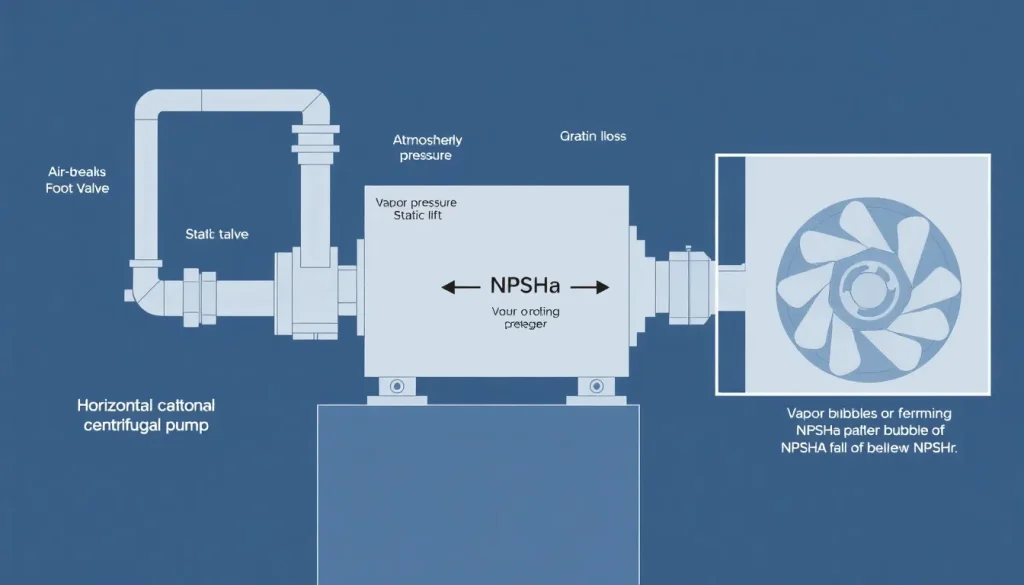
NPSHa = (P_atm – P_vap) / (ρ·g) + h_static – h_friction
Overview — What It Is and Why It Matters
A centrifugal pump cannot create suction; it relies on the pressure differential generated by the rotating impeller. If the inlet pressure falls below the liquid’s vapor pressure, vapor bubbles form (cavitation), and the pump will lose its ability to move fluid – a condition called “loss of prime.” Proper priming removes air from the suction line, establishes a continuous column of liquid, and ensures that NPSHa exceeds the pump’s NPSHr. Failure to prime correctly leads to reduced flow, excessive vibration, seal damage, and premature bearing wear.
The Method — Derivation and Variants
The NPSHa expression originates from Bernoulli’s equation applied between the liquid surface in the supply tank and the pump suction eye, with the addition of head losses. In US‑customary form:
NPSHa (ft) = (P_atm (psia) – P_vap (psia)) / (ρ (lb/ft³)·32.174) + h_static (ft) – h_friction (ft)
In SI form the same relationship becomes:
NPSHa (m) = (P_atm (kPa) – P_vap (kPa)) / (ρ (kg/m³)·9.806) + h_static (m) – h_friction (m)
Key constants (32.174 ft/s² and 9.806 m/s²) convert pressure differences to head. The equation is valid as long as the fluid is incompressible, the flow is steady, and elevation changes are modest (< 300 ft or 90 m).
Priming variants include:
- Manual priming – filling the suction pipe and pump casing with liquid using a bucket, hose, or vacuum pump.
- Self‑priming pumps – special impeller and volute designs that retain enough liquid to re‑establish suction after a short break.
- Venturi‑assist priming – a venturi or ejector creates a low‑pressure zone that draws liquid into the suction line.
- Air‑break priming – a controlled air inlet momentarily reduces inlet pressure, helping the pump pull liquid.
Worked Example
Example 1 – US customary units
Assume a 2‑in. suction pipe delivering water (ρ = 62.4 lb/ft³) from a tank 10 ft below the pump. Atmospheric pressure = 14.7 psia, water vapor pressure at 70 °F = 0.4 psia. Friction loss in the suction line = 1.2 ft.
- Calculate pressure head: (14.7 – 0.4) / (62.4 × 32.174) = 0.0073 ft⁻¹ → 7.3 ft of head.
- Add static head: 7.3 ft + 10 ft = 17.3 ft.
- Subtract friction: 17.3 ft – 1.2 ft = 16.1 ft.
- Result: NPSHa = 16.1 ft.
If the pump’s NPSHr at the desired flow is 12 ft, the pump will stay primed (16.1 > 12). If the tank were only 4 ft below the pump, NPSHa would drop to 10.5 ft, causing loss of prime.
Example 2 – SI units
Same conditions expressed in metric: suction lift = 3.05 m, ρ = 998 kg/m³, P_atm = 101.3 kPa, P_vap = 0.7 kPa, pipe friction = 0.36 m.
- Pressure head: (101.3 – 0.7) / (998 × 9.806) = 0.0102 m⁻¹ → 10.2 m.
- Add static: 10.2 m + 3.05 m = 13.25 m.
- Subtract friction: 13.25 m – 0.36 m = 12.89 m.
- NPSHa = 12.9 m.
With a pump NPSHr of 9 m, the system is safe; with a lift of only 1 m the NPSHa would fall to 9.1 m, flirting with cavitation.
Calculator
For quick NPSH calculations, use the online tool at http://pumpcalcs.com/calculators/total-dynamic-head/.
Reference Values & Typical Ranges
- Typical NPSHr for small‑size (≤ 2 in.) centrifugal pumps: 3 – 8 ft (1 – 2.5 m).
- Self‑priming pumps often specify a maximum suction lift of 15 ft (4.5 m) for water.
- Vapor pressure of water at 90 °F (32 °C) ≈ 0.9 psia (6 kPa).
- Maximum practical suction lift for a single‑stage centrifugal pump on water at sea level ≈ 12 ft (3.7 m) without assistance.
- Rule of thumb: design NPSHa ≥ NPSHr + 2 ft (0.6 m) to provide a safety margin.
Application Guidance
When installing a centrifugal pump:
- Locate the pump as low as possible relative to the source tank to maximize static head.
- Minimize suction‑line length and keep pipe diameters as large as practical to reduce h_friction.
- Use a foot valve or check valve at the tank inlet to retain liquid when the pump stops.
- Consider a vacuum‑assist priming device for systems that must start from a dry condition.
- Periodically inspect suction line for leaks or air ingress; even a small leak can introduce enough air to break the prime.
In field adjustments, if the pump repeatedly loses prime, increase the suction pipe diameter, lower the pump, or add a priming tank with a venturi‑assist.
Common Mistakes, Limits & Safety Notes
- Ignoring vapor pressure – using atmospheric pressure alone overestimates NPSHa, especially with hot liquids.
- Unit mix‑up – substituting psia for kPa or ft for m causes 3‑to‑4× errors in head calculations.
- Underestimating friction loss – neglecting elbows, valves, or long runs reduces NPSHa dramatically.
- Assuming a pump can self‑prime from any depth – only pumps specifically rated as self‑priming have that capability.
- Starting a pump with a dry suction line – can cause immediate cavitation and damage the impeller.
- Exceeding the manufacturer’s NPSHr – leads to cavitation, noise, and reduced life.
- Safety hazard – a priming vacuum can draw in debris; always close the suction line before using a vacuum pump.
FAQ
Why does my centrifugal pump lose prime after a few minutes of operation?
Most often the suction line develops a small leak or the foot valve fails, allowing air to re‑enter. The resulting drop in NPSHa below NPSHr creates cavitation, and the pump can no longer sustain the liquid column.
Can I use a higher‑speed motor to compensate for loss of prime?
Increasing motor speed raises the pump’s head but also raises NPSHr. Without improving NPSHa, the problem persists and may even worsen cavitation.
Is a self‑priming pump truly “no‑prime” required?
Self‑priming pumps are designed to re‑prime from a limited air‑filled condition, but they still have a maximum suction lift (usually 12‑15 ft for water). Exceeding that limit will cause loss of prime.
How do temperature changes affect priming?
Higher fluid temperature raises vapor pressure, reducing the (P_atm – P_vap) term in NPSHa. Hot liquids therefore need more static head or lower suction lift to stay primed.
What is the role of a venturi in priming?
A venturi creates a localized low‑pressure region that draws liquid into the suction line, effectively increasing NPSHa without altering pump elevation.
Do I need to prime a pump when the suction tank is full?
Even with a full tank, air can be trapped in the suction pipe or pump casing. Manual or vacuum priming ensures that all air is expelled before startup.
Can cavitation damage be repaired?
Minor cavitation erosion can be sanded out, but repeated cavitation typically requires impeller replacement and a redesign to raise NPSHa or lower NPSHr.
Why is NPSHr listed on the pump’s performance curve?
NPSHr is an intrinsic pump characteristic that varies with flow rate. It indicates the minimum suction head the pump needs at each operating point to avoid cavitation.
Is it safe to use a portable vacuum pump for priming?
Yes, provided the vacuum source is rated for the fluid and the suction line is sealed. Always follow lock‑out/tag‑out procedures to prevent accidental start‑up during priming.
What maintenance checks help prevent loss of prime?
Inspect foot valves, tighten suction line connections, verify that suction filters are clean, and periodically run a priming test after shutdowns.
Leave a Reply