Short Answer
Key Formula / Key Facts Box
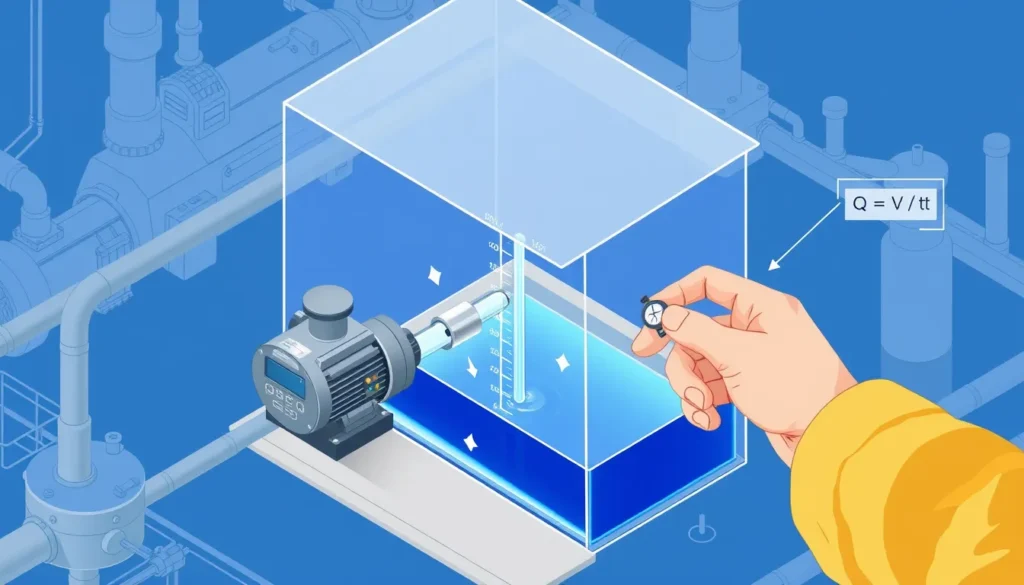
Governing formula: Q = V / t
US customary form: Qgpm = 60 × Vgal / ts
SI form: Qm³/h = 3.6 × VL / ts = 3600 × Vm³ / ts
| Symbol | Meaning | US unit | SI unit |
|---|---|---|---|
| Q | Volumetric flow rate | gallons per minute (gpm) | cubic metres per hour (m³/h) |
| V | Collected or displaced volume | gallons (gal) | litres (L) or cubic metres (m³) |
| t | Collection time | seconds (s) | seconds (s) |
| 60 | Seconds per minute | s/min | not used in the listed SI form |
| 3.6 | Litres per second converted to cubic metres per hour | not used | (L/s) to (m³/h) |
Plain English: Flow is the volume captured divided by the time required to capture it, converted to the desired per-minute or per-hour unit.

Overview — What It Is and Why It Matters
In this article, “tank and stopwatch” refers to the common field meaning: a direct volumetric, end-line flow measurement in which a pump discharge is collected in a tank, bucket, or other container of known volume while elapsed time is recorded. The scope is steady, clean or otherwise safely handled liquid flow where the discharge can be accessed and the container can be managed safely. It is not a factory performance test and does not by itself produce a full pump curve.
The physical idea is simple. A known volume V collected over a measured time t gives the average volumetric flow rate Q. Because the method measures volume and time directly, it bypasses many assumptions built into pressure-drop or velocity-based estimates. End-line flow measurement is recognized as extremely accurate and is often used to calibrate in-line flowmeters. The California State Water Resources Control Board notes that a bucket and stopwatch is a simple and accurate alternative for constant pipe flows and is useful for low-flow diversions, gravity springs, small pumps, and confirming existing flowmeter calibration.
The method matters because pump problems are often described only qualitatively: the flow seems weak, the tank empties slowly, or the discharge looks forceful. A timed volume turns those impressions into a repeatable number. That number can support troubleshooting, maintenance decisions, flowmeter checks, and performance trending. If it is measured carelessly, however, it can mislead operators into changing pump size, adjusting valves, or replacing equipment when the real issue is an uncalibrated bucket, a submerged outlet, or a changing water level.
The Method — Derivation and Variants
If a volume V is collected in time t, the average volumetric flow rate is Q = V/t. For US customary units, Q in gallons per second is Vgal/ts; multiplying by 60 gives gallons per minute. For SI units, a result in litres per second is converted to cubic metres per hour by multiplying by 3.6, because 1 L/s = 3.6 m³/h. If volume is already in cubic metres, use 3600 to convert cubic metres per second to cubic metres per hour. These constants are unit conversions, not efficiency or correction factors.
| Measurement | US customary form | SI form |
|---|---|---|
| Volume | gallons (gal) | litres (L) or cubic metres (m³) |
| Time | seconds (s) | seconds (s) |
| Flow result | Qgpm = 60 × Vgal / ts | Qm³/h = 3.6 × VL / ts |
Fill-and-time variant. This is the common tank, bucket, or container method. Use a stable container with a known volume mark or a calibrated measuring tank. Keep the discharge route as close as possible to normal operation, keep the hose outlet above the collected water surface so backpressure does not change, and allow the pump to reach a steady discharge. Start timing when collection begins and stop when the liquid reaches the selected mark. Record individual trial times and conditions.
- Confirm that the liquid is compatible with the method and that the electrical and physical site is safe.
- Verify the container volume; do not rely on an uncalibrated mark without checking.
- Keep the normal hose diameter, length, fittings, valves, and discharge elevation unless a change is unavoidable and recorded.
- Run several practice trials, then record at least three measured trials under the same conditions.
- Average the times or, preferably when volumes differ, divide total collected volume by total elapsed time.
Tank-drawdown variant. If a pump draws from a straight-sided tank and there is no simultaneous inflow, the volume removed is cross-sectional area A multiplied by level drop Δh. Thus Q = AΔh/t. For a cylindrical tank, A = πr². In US customary units, Qgpm = 448.83 × Aft² × Δhft / ts. In SI units, Qm³/h = 3600 × Am² × Δhm / ts. Use this variant when the discharge cannot be collected or when supply-tank drawdown is the practical measurement. The tank cross-section must be known, the level measurement must be stable, and inflow must be isolated.
The fill-and-time variant is usually best for accessible discharges and small to medium flows. The drawdown variant is useful for larger volumes and tanks, but level and area errors can reduce accuracy. Both variants require steady operation; pulsating flow, automatic cycling, or a falling water level can make a single timed result unrepresentative.
Worked Example
US customary example. A small transfer pump discharges into a 5.0 gal bucket. Three trials give 24.2 s, 23.8 s, and 24.0 s. The average time is (24.2 + 23.8 + 24.0)/3 = 24.0 s. Using Q = 60 × V/t, Q = 60 × 5.0 / 24.0 = 12.5 gpm. Equivalent values are 12.5 × 3.785 ≈ 47.3 L/min and 12.5 × 0.2271 ≈ 2.84 m³/h. The interpretation is that the installed discharge is about 12.5 gpm under those hose, lift, and outlet conditions; the conditions must be recorded with the result.
SI example. A submersible pump fills a 20 L mark in 24.0 s. Using Q = 3.6 × V/t, Q = 3.6 × 20 / 24.0 = 3.00 m³/h. This is 50 L/min, or about 13.2 US gpm. If three trials are 24.0 s, 23.6 s, and 24.4 s with 20 L each, the combined volume is 60 L and the combined time is 72.0 s; Q = 3.6 × 60 / 72.0 = 3.00 m³/h. The total-volume divided by total-time approach is preferred when volumes or times differ.
Calculator
For a quick arithmetic check, use the Omni Calculator volumetric flow-rate calculator. For pump-system cross-checks involving head and power, see the pumpcalcs total dynamic head calculator. Enter volume and time in consistent units; the calculator performs unit conversion, but field records should still show the original container volume, elapsed time, and test conditions.
Reference Values & Typical Ranges
Field rules of thumb for tank-and-stopwatch testing are summarized below. These are guidance values for field checks, not guaranteed accuracies for every installation.
| Item | Typical value or guidance | Notes and source |
|---|---|---|
| Bucket-and-stopwatch accuracy | About ±3–5% | Industrial Monitor Direct comparison table; good when volume and timing errors are controlled. |
| Tank drawdown accuracy | About ±5–10% | Industrial Monitor Direct; depends on tank area and level measurement. |
| Minimum trials | 3 | California State Water Resources Control Board recommends at least three trials and averaging. |
| Five-gallon bucket | Useful up to about 50 gpm | California State Water Resources Control Board; stop using if fill is too fast to time safely. |
| Small-container example | 20 L in 24 s ≈ 3.0 m³/h | YARDPUMP worked example; illustrates SI conversion. |
| End-line method status | Extremely accurate; often used to calibrate in-line flowmeters | Cimbala, Penn State University. |
Also record the container volume and calibration method, average and individual times, hose diameter and length, discharge elevation, fittings and valves, water level, pump model, and any cycling. Flow rates should be rechecked when water levels or system conditions change; the California guide notes that pumping uphill or changing suction lift can alter the operating point. A single field result should not be treated as the pump’s maximum rated flow.
Application Guidance
Use this measurement to establish actual flow in an installed system, verify that a pump is delivering expected flow, confirm flowmeter calibration, check low-flow diversions, or trend performance after maintenance. The result describes the installation at that moment; if the hose, lift, discharge elevation, valves, or water level changes, the measured flow may change. In real systems, a pump operates where its curve intersects the system curve, so a lower-than-expected timed result may indicate added head, a worn impeller, a partly closed valve, suction lift, or a measurement error rather than a defective pump.
Keep the discharge route as close as possible to normal operation, keep the outlet above the collected liquid, and avoid changing the hydraulic arrangement just to make collection easier. For pump selection, use the measured flow together with head and power data. For regulatory, design, or acceptance work, use calibrated methods and traceable standards rather than relying on a single container test.
Common Mistakes, Limits & Safety Notes
- Using an unverified container. A nominal 5 gal bucket or 20 L mark may not be calibrated; verify volume or use a measured tank.
- Timing only once. Take at least three trials and average; if times vary widely, investigate cycling, water-level change, splashing, or unstable flow before trusting the result.
- Submerging the discharge outlet. If the hose outlet goes below the collected water surface, backpressure can change the flow; keep it above the liquid surface.
- Changing the installation during the test. Shortening the hose, removing fittings, or lowering the outlet changes hydraulic conditions and can invalidate comparison with normal operation.
- Averaging individual flow rates with unequal volumes. Prefer total collected volume divided by total elapsed time.
- Using the wrong conversion constant. Check gpm, L/min, and m³/h conversions; 1 US gpm ≈ 3.785 L/min, and 1 L/s = 3.6 m³/h.
- Measuring during cycling or changing water level. Automatic float switches, intermittent demand, or falling suction levels produce non-steady results; isolate the steady period or use another method.
- Ignoring safety. Do not use this method with contaminated, hazardous, hot, or electrically risky liquids; keep the timer dry, use a stable container, and isolate power before moving hoses or opening equipment.
- Treating the result as a factory curve. A field bucket test is not a factory performance test; it is an installed-condition check and should be recorded with its conditions.
- Using the method outside its limits. If the container fills in a few seconds, if flow is pulsating, or if the tank cross-section is unknown, use a larger measuring tank, a flowmeter, or a professional test method.
FAQ
How accurate is the tank-and-stopwatch method?
For a clean, steady discharge, a well-run bucket-and-stopwatch test is commonly within about ±3 to ±5% when volume and timing errors are controlled. Accuracy falls if the container is uncalibrated, the outlet is submerged, splashing occurs, or the pump is cycling. Tank drawdown is often less precise because level and tank-area errors add to timing error.
How many trials should I run?
At least three trials are recommended. Run several practice attempts first, then record three or more under the same conditions. If the times are close, average them or divide total volume by total time. If they vary widely, look for changing water level, automatic cycling, a moving hose, uncertain volume marks, or inconsistent start and stop timing.
Can I use a large tank instead of a bucket?
Yes. A large tank is often better for higher flows or when a bucket would fill too quickly to time safely. Use a tank with a known volume or a simple straight-sided shape, keep the outlet above the water surface, and record the starting and ending levels. For a supply-tank drawdown test, the tank cross-section must be known.
Why is my measured flow lower than the pump rating?
The pump rating is usually a maximum or curve-point value under specified conditions. Installed flow can be lower because of discharge elevation, long or narrow hose, fittings, valves, suction lift, clogging, wear, or low water level. The bucket test measures the actual installation at that moment, not the pump’s best-case catalogue flow.
What if the discharge fills a bucket in a few seconds?
Do not trust a very short collection time. Use a larger measuring tank, reduce the collected volume to a safely manageable marked level, or use a calibrated flowmeter. A few seconds amplifies stopwatch reaction error and makes splashing and start-stop timing errors more significant. Safety and manageable lifting also become limiting factors.
Does hose length or outlet height affect the result?
Yes. Hose length, diameter, bends, fittings, valves, and discharge elevation all change the system head and therefore the flow. To measure normal operation, keep the discharge route as close as possible to its installed arrangement. If you must change it, record the change as a separate test condition rather than comparing it directly with the original result.
Can I measure a submersible pump with a bucket?
Only in a safe, accessible clean-water installation with stable electrical protection and a manageable flow. Do not stand in water near energized equipment, do not hold a live discharge hose, and keep the timer dry. Use a stable container, keep the outlet above the water, and stop if the flow is too fast or the site is unsafe.
How do I convert the result to other units?
For US units, Q in gpm = 60 × gallons ÷ seconds. For SI, Q in m³/h = 3.6 × litres ÷ seconds. Useful conversions are 1 US gpm ≈ 3.785 L/min, 1 L/s = 3.6 m³/h, and 1 m³/h ≈ 4.403 US gpm. Keep the original volume and time records so conversions can be checked.
Leave a Reply