Short Answer
Key Formula / Key Facts Box
Governing NPSH available relation for a suction system: NPSHA = ha − hvpa ± hst − hf
Dirty-strainer penalty: NPSHA,dirty = NPSHA,clean − Δhstrainer
Strainer head loss: Δhstrainer = K v2/(2g) = ΔPstrainer/(ρg)
| Symbol | Meaning | US customary unit | SI unit | One-line plain-English restatement |
|---|---|---|---|---|
| NPSHA | Net positive suction head available at the pump suction | ft | m | Useful suction energy above vapor pressure. |
| ha | Absolute pressure head at the liquid surface in the suction source | ft | m | Push from tank pressure or atmosphere. |
| hvpa | Vapor pressure head of the liquid at pumping temperature | ft | m | Head already used by boiling tendency. |
| hst | Static elevation head from source liquid surface to pump centerline; positive when flooded, negative when lifting | ft | m | Gravity assist or lift penalty. |
| hf | Total suction-line friction and fitting head loss, including strainer | ft | m | Cost of pushing liquid through pipe, valves, and screen. |
| Δhstrainer | Additional head loss caused by a dirty strainer relative to clean condition | ft | m | Extra screen resistance from collected debris. |
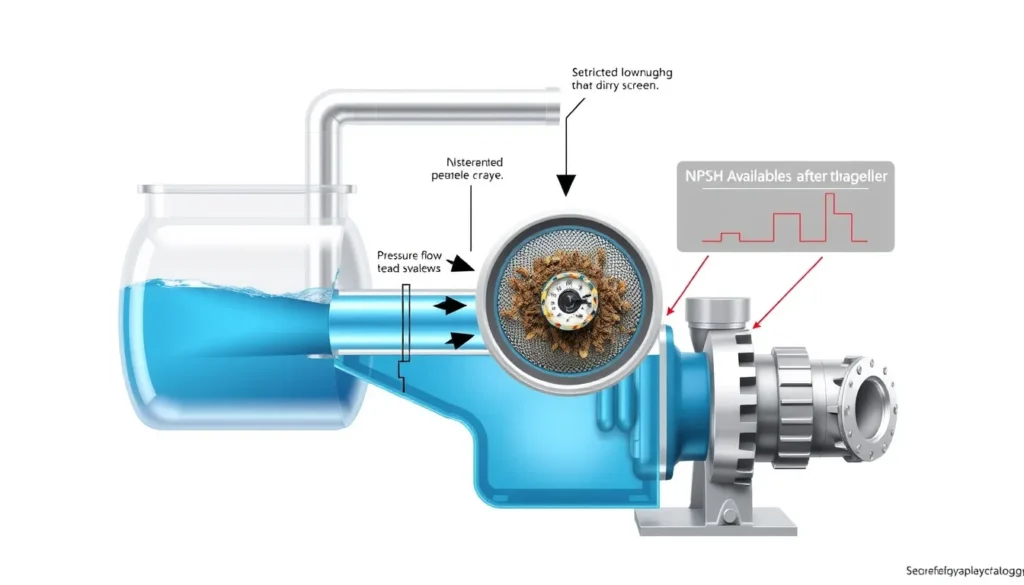
Plain-English restatement: a dirty suction strainer does not create suction; it consumes part of the absolute pressure energy that would otherwise be available at the impeller eye. The extra loss appears as a larger hf term, so NPSHA falls by the same head amount.

Overview — What It Is and Why It Matters
Scope: this article uses the common encyclopedic meaning for liquid-pump suction systems. A suction strainer is dirty when its open area is partly blocked by retained solids, not merely discolored. The canonical subject is the hydraulic mechanism by which that blockage reduces net positive suction head available, NPSHA, and why that matters for pump reliability.
NPSHA is the absolute suction energy available at the pump suction above the liquid vapor pressure. It is expressed as head in feet or meters of the pumped liquid. If NPSHA falls below the pump net positive suction head required, NPSHr, the liquid can flash at the impeller eye and cavitation can occur. The consequences include noise, vibration, loss of flow or head, impeller erosion, seal and bearing damage, and unscheduled downtime.
A clean suction strainer already adds resistance. A dirty strainer adds much more because debris reduces net open area, raises local velocity through the remaining openings, and increases the effective resistance coefficient or reduces the effective Cv. The added pressure drop appears directly in the suction-side friction term hf. Because hf is subtracted in the NPSHA equation, every additional foot or meter of strainer loss is a one-for-one reduction in available NPSH. Small changes matter: in many systems even 1 to 2 psi of extra strainer differential pressure can consume a large share of the installed NPSH margin.
The Method — Derivation and Variants
Start with the steady-flow energy equation between the liquid surface in the suction source and the pump suction flange. For a liquid of density ρ and gravitational acceleration g, the energy balance can be written as pa/(ρg) + za = ps/(ρg) + vs2/(2g) + zs + hf, where subscript a denotes the source surface and s denotes the pump suction. Rearranging gives the suction energy at the flange: ps/(ρg) + vs2/(2g) = ha + hst − hf. Subtracting the vapor pressure head hvpa gives the standard surface-to-flange form NPSHA = ha − hvpa ± hst − hf. Velocity head is not added separately in this form because it is already contained in the energy balance when referenced to the source surface.
The total suction friction term is a sum: hf = hpipe + hfittings + hstrainer. For a strainer, the loss can be expressed with a resistance coefficient K: hstrainer = K v2/(2g). When the strainer becomes dirty, the effective open area falls, the local velocity through the screen rises, and K increases. Equivalently, the manufacturer may give a flow coefficient Cv. In US customary form, Q = Cv √(ΔP/SG), so ΔP = SG(Q/Cv)2 with Q in gpm, Cv in gpm at 1 psi water drop, and ΔP in psi. The head form is h = 2.31ΔP/SG, or h = 2.31(Q/Cv)2 for the strainer. For a dirty strainer, use the reduced effective Cv or field-measured ΔP; do not reuse the clean Cv.
| Form | US customary | SI |
|---|---|---|
| Basic NPSHA | NPSHA (ft) = ha − hvpa ± hst − hf, all in ft of liquid | NPSHA (m) = ha − hvpa ± hst − hf, all in m of liquid |
| Pressure drop to head | h = 2.31ΔP/SG, with ΔP in psi and h in ft of liquid | h = ΔP/(ρg), with ΔP in Pa and h in m |
| Strainer Cv form | ΔP (psi) = SG(Q/Cv)2; h (ft) = 2.31(Q/Cv)2 | Use K or manufacturer metric Kv; then h = ΔP/(ρg) |
The constant 2.31 ft per psi applies to water at standard conditions and follows from the specific weight of water. It is valid only when ΔP is in psi and head is in feet of the same liquid; for other specific gravities, divide by SG as shown. SI forms are direct when pressure is in Pa and density is in kg/m3. The Cv variant applies when a strainer manufacturer publishes Cv; the K variant applies when geometry and velocity are known; the measured-ΔP variant is preferred in the field because it captures actual clogging, viscosity, and installation effects.
Worked Example
Example 1 — US customary units. An open tank supplies water at about 20°C to a centrifugal pump. Assumptions: ha = 33.9 ft absolute, hvpa = 0.78 ft, hst = +10.0 ft flooded suction, clean suction friction including clean strainer hf,clean = 3.8 ft, dirty strainer adds Δhstrainer = 6.0 ft, and NPSHr = 32.0 ft.
Clean case: NPSHA = 33.9 − 0.78 + 10.0 − 3.8 = 39.32 ft. Dirty case: hf,dirty = 3.8 + 6.0 = 9.8 ft, so NPSHA = 33.9 − 0.78 + 10.0 − 9.8 = 33.32 ft. Margin clean = 39.32 − 32.0 = 7.32 ft; margin dirty = 33.32 − 32.0 = 1.32 ft. The dirty strainer removed 6.0 ft of NPSHA. For water, that 6.0 ft equals ΔP = 6.0 × SG/2.31 = 2.60 psi.
Example 2 — SI units. An open tank supplies water at about 80°C. Assumptions: pabs = 101.3 kPa, vapor pressure ≈ 47.4 kPa, ρ ≈ 971.8 kg/m3, g = 9.81 m/s2, hst = +3.0 m, clean hf = 1.5 m, dirty strainer adds 2.5 m, and NPSHr = 4.0 m.
Convert the pressure heads: ha = 101300/(971.8 × 9.81) = 10.63 m; hvpa = 47400/(971.8 × 9.81) = 4.97 m. Clean case: NPSHA = 10.63 − 4.97 + 3.0 − 1.5 = 7.16 m. Dirty case: hf = 1.5 + 2.5 = 4.0 m, so NPSHA = 10.63 − 4.97 + 3.0 − 4.0 = 4.66 m. Margin clean = 7.16 − 4.0 = 3.16 m; margin dirty = 4.66 − 4.0 = 0.66 m. The extra 2.5 m of strainer loss equals ΔP = ρgΔh = 971.8 × 9.81 × 2.5 = 23,835 Pa ≈ 23.8 kPa, or about 3.45 psi.
Calculator
For a rapid check, use an online pump head/NPSH calculator such as the PumpCalcs total dynamic head calculator. Enter suction pressure head, vapor pressure head, static head, and clean or dirty strainer loss in consistent units. Treat the strainer term as an additional negative contribution to NPSHA, and compare the result with NPSHr at the actual pump flow.
Reference Values & Typical Ranges
| Parameter | Typical range or rule | Notes and source |
|---|---|---|
| Clean suction strainer differential pressure | Often targeted below about 0.5 to 1 psi (0.03 to 0.07 bar) for permanent screens; confirm by test | Keep clean loss low and establish a baseline; even 1 to 2 psi can matter. Sources [2], [5]. |
| Dirty-strainer action threshold | Investigate when ΔP rises 1 to 2 psi above clean baseline, or earlier if NPSH margin is thin | Monitor with a differential gauge or transducer and trend readings. Source [2]. |
| Typical suction strainer apertures | 1/8 in (3.2 mm); 1/16 in (1.6 mm); 20 mesh ≈ 850 µm; 40 mesh ≈ 425 µm; 60 mesh ≈ 250 µm; 100 mesh ≈ 150 µm | Choose from downstream clearances and duty, not habit. Source [5]. |
| Suction-line water velocity | About 1 to 2 m/s (3 to 7 ft/s) | High velocity increases friction and strainer loss. Source [5]. |
| NPSH margin | Follow ANSI/HI 9.6.1; common screening is 10 to 20% above NPSHr or at least 0.5 to 1 m (1.6 to 3.3 ft) for many clean-water pumps | Confirm for pump type, speed, and service. Source [5]. |
Application Guidance
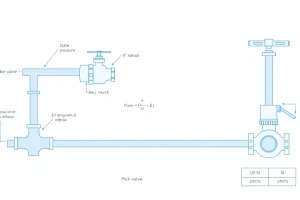
In real systems, a dirty suction strainer behaves like a variable orifice that closes as debris accumulates. The NPSH penalty grows with flow because strainer loss rises roughly with velocity squared, and it grows more severe in hot liquids because hvpa is larger. Permanent basket or duplex strainers should therefore be sized by net open area and Cv, installed with differential-pressure instrumentation, and given a documented clean baseline. Temporary conical start-up screens should be removed after commissioning unless a formal risk review justifies leaving them in service.
- Select the strainer aperture from the smallest downstream clearance and the required protection level, then verify that the clean and dirty pressure drops leave adequate NPSH margin.
- Use a differential-pressure gauge or transducer across the strainer; a duplex gauge avoids errors from separate gauge calibration and location.
- For hot water, boiler feed, deaerator, condensate, and hydrocarbon services, treat strainer loss as a safety-critical NPSH term.
- When margin is thin, consider a larger strainer body, more open area, a duplex arrangement for on-line cleaning, or relocation to the discharge side where hydraulically acceptable.
Common Mistakes, Limits & Safety Notes
- Selecting a suction strainer by line size alone instead of net open area, Cv, and dirty-condition pressure drop.
- Leaving a temporary commissioning cone screen in permanent service until it plugs, collapses, or releases debris.
- Using a Y-strainer pocket as a sediment trap directly upstream of the impeller without considering NPSH loss and flow disturbance.
- Ignoring the clean-to-dirty differential-pressure trend; without a baseline, the NPSH penalty is discovered only after cavitation damage appears.
- Applying clean Cv or K values to a dirty strainer; effective Cv falls and K rises as open area is blocked.
- Mixing units: psi with meters of head, kPa with feet, or gauge pressure with absolute pressure in the NPSH equation.
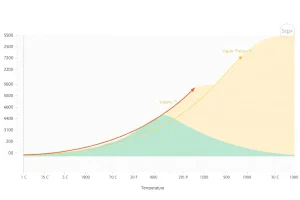
- Forgetting that vapor pressure changes with temperature; hot liquids can flash with a smaller strainer loss than cold liquids.
- Assuming NPSHr is constant; it varies with flow and speed, so compare NPSHA and NPSHr at the actual operating point.
- Safety consequence: sustained low NPSHA can cause cavitation, seal and bearing failures, loss of flow, product release, and costly downtime. Isolate and clean strainers under a controlled procedure, and never open a strainer housing while it is pressurized.
FAQ
How does a dirty suction strainer reduce NPSH available?
A dirty suction strainer raises suction-line head loss hf. In NPSHA = ha - hvpa ± hst - hf, the extra loss subtracts directly, so NPSHA falls by Δhstrainer. The effect is most severe at high flow, high temperature, or low static head because the remaining margin to vapor pressure is small.
Does a suction strainer always reduce NPSH?
Any suction strainer adds some loss, even when clean, because it has finite open area and a resistance coefficient or Cv. A dirty strainer simply increases that loss. The NPSHA reduction equals the additional pressure drop divided by ρg, or the additional head in feet or meters.
What pressure drop across a suction strainer is too high?
There is no universal number because the allowable rise depends on NPSH margin, flow, and OEM limits. A practical field rule is to investigate when dirty differential pressure rises by 1 to 2 psi above the clean baseline, or sooner if the calculated NPSHA margin approaches the project minimum.
Can I calculate NPSH loss from strainer Cv?
Yes. If the manufacturer provides Cv, use ΔP = SG(Q/Cv)² in US units, then convert to head with h = 2.31ΔP/SG. For a dirty strainer, reduce effective Cv or use field-measured differential pressure; do not reuse the clean Cv.
Why does hot water cavitate more when the strainer is dirty?
Hot water has a high vapor pressure head, so less absolute pressure head is available before flashing. When a dirty strainer adds loss, NPSHA falls faster below NPSHr. Deaerator and boiler-feed services are especially sensitive because the liquid may already be near saturation.
Should I remove a temporary suction strainer after commissioning?
Temporary conical start-up screens should normally be removed after commissioning and flushing. If left in place, they can collapse, plug, or impose an unmonitored NPSH penalty. Any permanent strainer should have a documented clean baseline and differential-pressure monitoring.
What symptoms indicate a clogged suction strainer?
Symptoms include rising strainer differential pressure, falling pump flow or discharge pressure, increased vibration, cavitation noise, seal leakage, and bearing temperature rise. Confirm by comparing NPSHA with NPSHr at actual flow and inspecting the screen.
Can a dirty strainer damage mechanical seals?
Yes. Cavitation from low NPSHA can damage seals and bearings through vibration, poor lubrication, and axial or radial loading. The strainer itself may also release debris if a screen tears or collapses. Correct the root cause by cleaning or redesigning the suction strainer and verifying NPSH margin.

Leave a Reply