
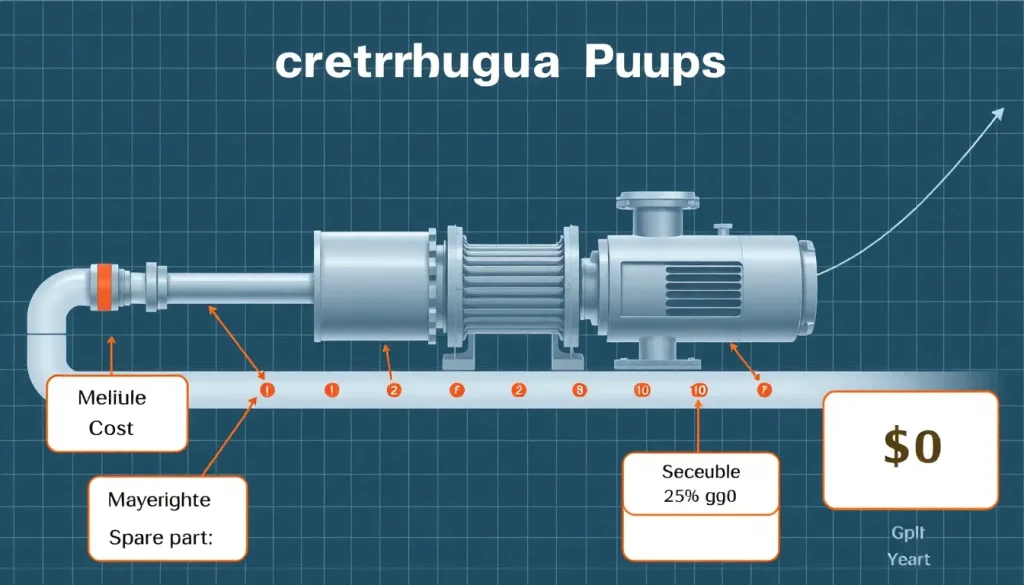
Short Answer
Key Formula / Key Facts Box
Governing Formula (Total Life Cycle Cost, LCC)
[ LCC = C_{cap} + sum_{n=1}^{N} frac{C_{energy,n}+C_{maint,n}+C_{spare,n}}{(1+i)^{n}} ]
| Symbol | Meaning | US Unit | SI Unit | Plain English |
|---|---|---|---|---|
| C_{cap} | Initial capital cost | USD | EUR or local currency | What you pay up‑front for pump and installation. |
| C_{energy,n} | Energy cost in year n | USD/yr | EUR/yr | Electricity (or fuel) bill for that year. |
| C_{maint,n} | Maintenance & labor cost in year n | USD/yr | EUR/yr | Scheduled service, oil, seals, etc. |
| C_{spare,n} | Spare‑part depreciation in year n | USD/yr | EUR/yr | Cost of replacing consumables. |
| i | Discount (interest) rate | fraction/yr | fraction/yr | Time‑value of money factor. |
| N | Analysis horizon (years) | yr | yr | How many years you plan to own the pump. |
Overview — What It Is and Why It Matters
Life Cycle Cost Analysis (LCCA) for pumping systems quantifies the total economic burden of a pump from purchase through disposal. Unlike a simple purchase‑price comparison, LCCA incorporates recurring energy consumption, routine maintenance, spare‑part replacement, and the effect of inflation or discounting. Engineers use LCCA to select pumps that minimize the total cost of ownership (TCO), not just the lowest upfront price.
Physical intuition: a pump that is cheap to buy but runs at 70 % efficiency may cost twice as much in electricity over a ten‑year horizon. Conversely, a high‑efficiency premium pump can recoup its extra capital cost within a few years. Errors in LCCA—such as ignoring discounting or under‑estimating maintenance frequency—lead to sub‑optimal selections, higher operating expenses, and possibly premature pump replacement.
The Method — Derivation and Variants
The basic LCCA equation stems from the present‑value concept used in financial engineering. The present value (PV) of a future cash flow C occurring in year n is C/(1+i)^n. Summing PVs of all yearly costs and adding the upfront capital cost yields the total life‑cycle cost.
US‑customary form (costs in dollars, power in hp, flow in gpm):
[ LCC_{US}=C_{cap}+sum_{n=1}^{N}frac{bigl(frac{P_{elec}times kW_{hp}times h_{ft}times Q_{gpm}}{3960}times text{Rate}_{$!/kWh}+C_{maint,n}+C_{spare,n}bigr)}{(1+i)^n} ]
where the hydraulic power conversion factor 3960 converts hp·ft·gpm to kW.
SI form (costs in euros, power in kW, flow in m³/h):
[ LCC_{SI}=C_{cap}+sum_{n=1}^{N}frac{bigl(P_{elec}times Q_{m³/h}times H_{m}times rhotimes gtimes eta^{-1}times text{Rate}_{€/kWh}+C_{maint,n}+C_{spare,n}bigr)}{(1+i)^n} ]
Key constants:
- (rho) – fluid density (≈1000 kg/m³ for water).
- (g) – gravitational acceleration (9.81 m/s²).
- (eta) – overall pump‑motor efficiency (decimal).
- Conversion factor 3960 in US form derives from 1 hp = 745.7 W and 1 ft = 0.3048 m.
Variants:
- Annualized LCC (ALCC): divides LCC by N to obtain a yearly cost for budgeting.
- Net Present Value (NPV) of Savings: compares two pump alternatives by subtracting one LCC from the other.
- Reliability‑adjusted LCC: adds expected downtime cost (lost production) to C_{maint,n}.
Worked Example
Scenario A – US Units
- Process: 5,000 gpm of water at 150 ft head.
- Motor‑pump efficiency: 0.78 (78 %).
- Electricity rate: $0.12/kWh.
- Capital cost: $45,000.
- Annual maintenance: $2,200.
- Spare‑part budget: $800 per year.
- Discount rate: 5 %.
- Analysis horizon: 10 years.
Step 1 – Compute hydraulic power (hp):
[ P_h = frac{Qtimes H}{3960}=frac{5,000times150}{3960}=189.4text{ hp} ]
Step 2 – Convert to electric power (kW):
[ P_{elec}=frac{P_h}{eta}times0.7457=frac{189.4}{0.78}times0.7457=181.0text{ kW} ]
Step 3 – Annual energy cost:
[ C_{energy}=P_{elec}times8760times0.12=181.0times8760times0.12=$190,057 ]
Step 4 – Present‑value factor for each year (i=0.05):
PV factor for year n = 1/(1.05)^n.
Step 5 – Sum discounted yearly costs (energy + maintenance + spare):
Using a spreadsheet, Σ PV ≈ $1,256,300.
Step 6 – Add capital cost:
[ LCC = 45,000 + 1,256,300 approx $1,301,300 ]
Result: Over ten years the pump will cost roughly $1.3 M, dominated by electricity.
Scenario B – SI Units
- Flow: 0.94 m³/s (≈ 2,000 gpm).
- Head: 45 m.
- Overall efficiency: 0.80.
- Electricity price: €0.10/kWh.
- Capital cost: €28,000.
- Annual maintenance: €1,500.
- Spare‑part budget: €600 per year.
- Discount rate: 4 %.
- Horizon: 8 years.
Step 1 – Hydraulic power (kW):
[ P_h = rho g Q H = 1000times9.81times0.94times45 = 3,922text{ kW} ]
Step 2 – Electrical input power:
[ P_{elec}=frac{P_h}{eta}=frac{3,922}{0.80}=4,902text{ kW} ]
Step 3 – Annual energy cost:
[ C_{energy}=4,902times8760times0.10 = €4,293,000 ]
Step 4 – Discount factor (i=0.04): PV factor for year n = 1/(1.04)^n.
Step 5 – Discounted sum of yearly costs ≈ €5,780,000.
Step 6 – Add capital cost:
[ LCC = 28,000 + 5,780,000 approx €5,808,000 ]
The SI example shows the same pattern: energy dominates, and a modest discount rate barely reduces the total.
Calculator
For quick computation, use the online LCC tool: Life Cycle Cost Calculator.
Reference Values & Typical Ranges
| Parameter | Typical Range (US) | Typical Range (SI) | Source |
|---|---|---|---|
| Motor‑pump efficiency (η) | 0.65 – 0.85 | 0.65 – 0.85 | ANSI/HI 9‑1‑2010 |
| Electricity price | $0.07 – $0.20/kWh | €0.06 – €0.18/kWh | U.S. EIA 2023 |
| Annual operating hours | 4,000 – 8,000 h | 3,600 – 7,200 h | ISO 9906:2012 |
| Discount rate (i) | 3 % – 7 % | 3 % – 7 % | ASME B31.3 2021 |
| Maintenance cost factor | 5 % – 15 % of capital per year | 5 % – 15 % of capital per year | API 610 |
Application Guidance
- Early‑stage screening: Use a simplified LCC (ignore discounting) to eliminate clearly inferior pumps.
- Detailed design: Apply the full discounted formula once hydraulic sizing is locked.
- Energy‑intensive processes: Prioritize high efficiency (≥80 %) even if capital cost rises.
- Variable‑speed drives (VSD): Include VSD energy savings in C_{energy,n} and add VSD capital cost to C_{cap}.
- Reliability data: Adjust C_{maint,n} and C_{spare,n} using MTBF/MTTR statistics from OEM manuals.
Common Mistakes, Limits & Safety Notes
- Mixing US and SI units in the same calculation – always convert before inserting into the formula.
- Omitting the discount factor – results in overstated LCC for long horizons.
- Using motor efficiency instead of overall pump‑motor efficiency – underestimates energy cost.
- Assuming constant electricity price – ignore projected rate escalations or demand charges.
- Neglecting downtime cost – especially critical in continuous‑process plants.
- Extending the horizon beyond the pump’s design life – leads to unrealistic cost amortization.
- Applying the method to a single‑point operating condition – real systems fluctuate; use representative average or weighted‑average conditions.
- Forgetting to include VSD control electronics in capital cost when VSDs are used.
FAQ
Why does a higher‑efficiency pump sometimes have a lower total life‑cycle cost despite a higher purchase price?
Because the energy savings over the analysis horizon outweigh the extra capital outlay. The LCC formula discounts future energy costs, so a pump that uses less electricity each year reduces the sum of discounted cash flows.
Can I ignore the discount rate if my project life is only 2‑3 years?
For very short horizons the effect of discounting is minimal (<2 %). However, if the financing cost is high, even a few years can make a difference, so it’s safer to include the rate.
How do I account for variable electricity rates (e.g., peak demand charges)?
Break the annual energy consumption into peak and off‑peak periods, apply the respective rates to each, and sum them to obtain C_{energy,n}. Some LCC tools have fields for demand charges as a separate line item.
Is it necessary to include the cost of pump downtime in LCC?
Yes, especially for critical processes. Estimate the monetary value of lost production per hour and add it to C_{maint,n} or create a separate downtime cost term. This converts reliability considerations into a financial metric.
What discount rate should I use for a private‑sector project?
Common practice is to use the company’s weighted average cost of capital (WACC) or a risk‑adjusted rate, typically between 4 % and 7 % for industrial equipment.
Do I need to recalculate LCC when I change the pump speed with a VSD?
Yes. Changing speed alters hydraulic power and therefore energy consumption. Re‑run the LCC with the new operating point and include the VSD’s capital cost in C_{cap}.

Leave a Reply