Short Answer
Key Formula / Key Facts Box
| Parameter | Symbol | US Unit | SI Unit | Definition |
|---|---|---|---|---|
| Rated motor current | I_r | A | A | Current at full‑load torque and rated voltage. |
| Starting current (DOL) | I_{start} | A | A | Peak current drawn when the motor is connected directly to line. |
| Starting torque | T_{start} | lb·ft | N·m | Torque developed during the first few seconds of start‑up. |
| Voltage reduction factor (Soft‑Start) | k_v | – | – | Ratio of reduced voltage to line voltage (0 < k_v ≤ 1). |
| Frequency reduction factor (VFD) | k_f | – | – | Ratio of programmed frequency to line frequency (0 < k_f ≤ 1). |
Overview — What It Is and Why It Matters
Motor starting is the transient phase when an electric motor is first energized. During this period the motor draws a large inrush current and experiences a torque surge that can stress the power network, the motor windings, and the driven equipment such as centrifugal pumps. Selecting an appropriate starting method balances three competing goals: limiting electrical stress, providing sufficient mechanical torque, and minimizing cost and complexity. Errors in selection often lead to nuisance tripping of protective devices, premature bearing wear, or even catastrophic pump failure.
The Method — Derivation and Variants
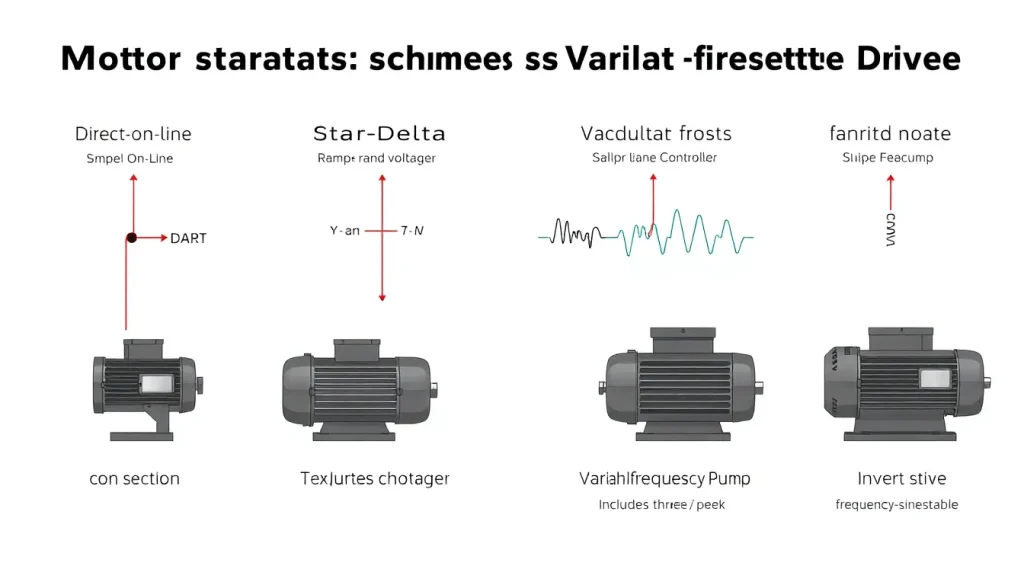
Four widely used techniques dominate industrial pump drives:
- Direct‑On‑Line (DOL) – The motor terminals are connected directly to the supply. The starting current is roughly 6 × I_r for squirrel‑cage induction motors, and the starting torque is about 1.5–2.2 × rated torque. No voltage reduction occurs; the motor accelerates to full speed in a few seconds.
- Star‑Delta – The motor is first connected in a star (Y) configuration, reducing line‑to‑phase voltage to V_L/√3. Starting current drops to I_r × √3 (≈1.73 × I_r) and torque to about 0.33 × rated. After the motor reaches ~80 % of speed, the connection switches to delta, restoring full voltage.
- Soft‑Start – A solid‑state controller ramps the supply voltage from zero to line voltage using a programmable ramp time (typically 2–10 s). Current follows the voltage linearly, so I_{start}=k_v × I_{DOL}. Torque scales similarly because slip is a function of voltage for induction motors.
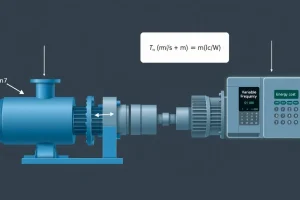
- Variable‑Frequency Drive (VFD) – An inverter first supplies a reduced frequency and voltage (maintaining V/f ratio). The current is limited by the programmed frequency, and torque is proportional to the square of the voltage reduction factor. VFDs can provide a smooth acceleration over 5–30 s and also allow speed control during steady‑state operation.
In SI form, the DOL current is I_{DOL}=k_i I_r with k_i≈6. For star‑delta, I_{Y}=I_r √3. Soft‑start uses I_{soft}=k_v k_i I_r. VFD starting current is approximately I_{VFD}=k_f k_i I_r where k_f is the frequency ratio.
Worked Example
Scenario (US units): A 75 hp, 460 V, 3‑phase, 4‑pole pump motor (rated current I_r = 115 A). Determine the starting current and torque for each method, assuming a 6‑second DOL acceleration.
- DOL: I_{DOL}=6 × 115 = 690 A. Starting torque ≈ 2 × rated torque. For a 75 hp motor, rated torque T_r = (5252 × hp)/(rpm) ≈ (5252 × 75)/1785 ≈ 221 lb·ft. Starting torque ≈ 2 × 221 = 442 lb·ft.
- Star‑Delta: I_{Y}=√3 × 115≈199 A. Starting torque ≈ 0.33 × 221 ≈ 73 lb·ft.
- Soft‑Start (k_v=0.5, ramp 5 s): I_{soft}=0.5 × 6 × 115≈345 A. Torque ≈ 0.5 × 2 × 221≈221 lb·ft.
- VFD (k_f=0.4, ramp 10 s): I_{VFD}=0.4 × 6 × 115≈276 A. Torque ≈ (0.4)^2 × 2 × 221≈71 lb·ft.
Scenario (SI units): Same motor, 55 kW, 400 V, rated current I_r = 95 A, speed 1450 rpm.
- DOL: I_{DOL}=6 × 95=570 A. Rated torque T_r = (P)/(2π n) = (55 000)/(2π × (1450/60))≈36 N·m. Starting torque ≈ 2 × 36≈72 N·m.
- Star‑Delta: I_{Y}=√3 × 95≈165 A. Starting torque ≈ 0.33 × 36≈12 N·m.
- Soft‑Start (k_v=0.6): I_{soft}=0.6 × 6 × 95≈342 A. Torque ≈ 0.6 × 2 × 36≈43 N·m.
- VFD (k_f=0.5): I_{VFD}=0.5 × 6 × 95≈285 A. Torque ≈ (0.5)^2 × 2 × 36≈18 N·m.
Calculator
For quick sizing of starting current and torque, use the online calculator at Motor Starting Calculator.
Reference Values & Typical Ranges
- DOL inrush current: 5–8 × rated current.
- Star‑Delta inrush current: 1.5–2 × rated current.
- Soft‑Start voltage reduction: 30 %–80 % of line voltage.
- VFD acceleration time: 5–30 s for pumps up to 200 hp.
- Starting torque (DOL): 150 %–250 % of rated torque.
- Starting torque (Star‑Delta): 30 %–45 % of rated torque.
Sources: IEC 60034‑1, NEMA MG‑1, IEEE Std 1415‑2009.
Application Guidance
When selecting a starting method for a pump, consider the following hierarchy:
- Network capacity: If the supply can tolerate a 6 × I_r surge, DOL is the simplest and cheapest.
- Mechanical torque requirement: Pumps with high start‑up head (e.g., positive‑displacement or high‑viscosity liquids) often need DOL or a VFD to guarantee sufficient torque.
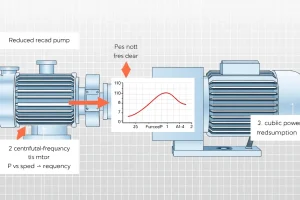
- Energy efficiency: VFDs recover slip power and can reduce motor heating during start‑up, yielding up to 15 % energy savings in frequent‑start cycles.
- Process control: Soft‑starts provide a gentle ramp, reducing water hammer in piping systems.
- Maintenance budget: Star‑Delta contacts wear; VFDs require periodic firmware updates and harmonic filters.
Field engineers should verify that protective relays are coordinated with the chosen start‑up current, and that motor thermal overloads are set according to the expected duty cycle.
Common Mistakes, Limits & Safety Notes
- Assuming DOL starting current is always 6 × I_r – actual value varies with motor design and supply impedance.
- Neglecting harmonic distortion from VFDs; without line‑reactors, voltage stress on motor insulation can increase.
- Using Star‑Delta on motors that require >30 % of rated torque at start – the reduced torque may cause stall.
- Setting soft‑start ramp time too short; the current spike can still exceed breaker ratings.
- Mixing US and SI units in calculations – always convert before applying formulas.
- Over‑looking the need for a bypass contactor for VFDs in emergency‑stop scenarios.
- Failing to inspect star‑delta contactor contacts for arcing after many cycles – leads to premature failure.
- Ignoring motor inertia; large pump impellers may need longer acceleration than the default VFD ramp.
- Bypassing motor thermal overloads when using VFDs – this defeats built‑in protection.
- Not providing adequate grounding for soft‑start thyristor modules – creates shock hazard.
FAQ
What is the main advantage of a VFD over a soft‑start for pump applications?
A VFD not only limits inrush current but also provides continuous speed control, allowing the pump to operate at the most efficient point on its curve, which reduces energy consumption and cavitation risk.
Can I use a star‑delta starter on a motor that drives a centrifugal pump with a high head?
Usually not. Star‑delta reduces starting torque to about 30 % of rated, which may be insufficient to overcome the pump’s static head, causing stall or excessive slip.
How does a soft‑start limit the starting current?
It gradually increases the voltage supplied to the motor, so current follows the voltage ramp (I≈k_v × I_DOL). The shorter the ramp, the higher the peak current.
Do VFDs increase motor heating during start‑up?
Because VFDs maintain the V/f ratio, the motor sees lower voltage and frequency, which reduces core losses. However, switching losses in the inverter can cause additional heating if not properly filtered.
What protective device should be coordinated with a DOL start?
A short‑circuit protective device sized to 1.25 × the DOL inrush current, typically a 2‑pole circuit breaker, and a thermal overload set to 115 % of full‑load current.
Is harmonic distortion a concern with soft‑starts?
Soft‑starts use thyristors that generate limited harmonics compared to VFDs, but large soft‑start units can still produce 3rd‑order harmonics that may affect sensitive equipment.
How do I calculate the required VFD ramp time for a 150 hp pump?
Use the motor’s inertia (J) and desired acceleration (α). A typical rule of thumb is 0.2 s per 10 hp of motor rating, giving about 3 s for 150 hp, but check the pump curve for water‑hammer constraints.
Can a star‑delta starter be retrofitted to an existing pump motor?
Yes, provided the motor’s voltage rating matches the star‑delta wiring and the control circuit can accommodate the additional contactor and timer.
What is the typical voltage drop across a VFD during start‑up?
Voltage drop is proportional to the frequency reduction; at 30 % of rated frequency, the line‑to‑phase voltage is about 30 % of nominal, resulting in ~70 % voltage reduction.
Why is grounding critical for soft‑start modules?
Thyristor modules can develop high transient voltages; proper grounding prevents hazardous fault currents and protects personnel and equipment.
Leave a Reply