Short Answer
Key Formula / Key Facts Box
Governing runtime relationship
toutage = (Cbat × Vnom × u × kage × (1 − R)) ÷ (Prun,bat × DC + Pstandby,bat)
where Prun,bat = Pload ÷ ηconv for inverter-backed AC pumps, and Prun,bat = Vbat × Ipump for direct-DC pumps. DC = min[1, Qin ÷ Qpump(H)] when the backup pump can keep up; if Qin ≥ Qpump(H), adding battery capacity does not solve the capacity shortfall.
| Symbol | Meaning | US unit | SI unit | Plain-English restatement |
|---|---|---|---|---|
| toutage | supported outage runtime | h | h | Hours of protection under the stated duty and battery condition. |
| Cbat | battery rated capacity | Ah | Ah practical; C charge | Nameplate amp-hours at the manufacturer test rate. |
| Vnom | nominal battery voltage | V | V | Battery system voltage. |
| u | usable depth-of-discharge fraction | dimensionless | dimensionless | Share of nameplate that may be used without damaging the battery or hitting cutoff. |
| kage | age and condition factor | dimensionless | dimensionless | Multiplier for battery degradation. |
| R | planning reserve fraction | dimensionless | dimensionless | Fraction held back for standby, uncertainty, and recharge. |
| Prun,bat | battery-side power while pumping | W | W | Running watts drawn from the battery during pump-on periods. |
| Pstandby,bat | battery-side standby power | W | W | Controller or inverter draw while the pump rests. |
| DC | duty cycle | dimensionless | dimensionless | Fraction of each hour the pump runs to balance inflow. |
| Qin | inflow to sump | gpm | m³/s or L/s | Water arriving at the pit. |
| Qpump(H) | pump flow at total dynamic head | gpm | m³/s or L/s | Flow from the pump curve at the real head. |
| H | total dynamic head | ft | m | Vertical lift plus friction and discharge losses. |
Plain-English restatement: usable battery watt-hours divided by average pump-plus-controller watts gives outage hours; the average includes the fraction of time the pump actually runs, which depends on inflow and pump flow at the real head.

Overview — What It Is and Why It Matters
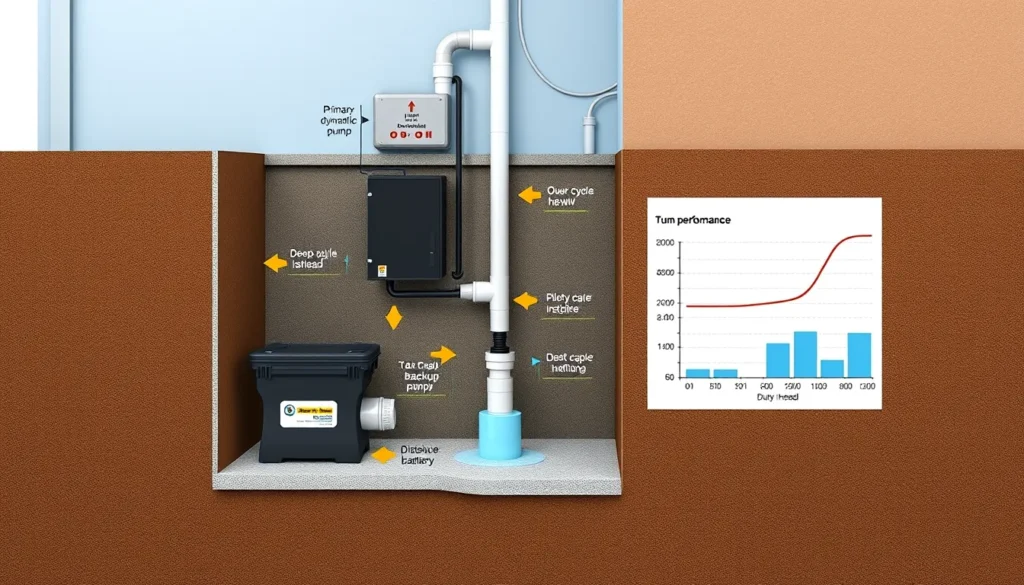
This article uses the common residential meaning of battery backup sump pump runtime: the number of hours a battery-backed sump pump can hold the water level during a utility outage under a stated inflow, total dynamic head, battery condition, and controller behavior. It is not the maximum minutes a battery can spin a pump once, and it is not a property of the battery alone. Runtime is a system result. The battery supplies energy, the pump converts that energy into flow at a head, and the storm sets how often the pump must run.
The engineering relevance is immediate because basements flood when energy runs out before the storm does. A backup that is sized from a headline amp-hour label or a headline pump flow can fail in two different ways: it may have enough energy but not enough flow to keep up with inflow, or it may have enough flow but too little usable energy to last the outage. Correct runtime planning separates capacity from duration, then checks both against the actual head and the actual duty cycle.
Runtime is a system result: usable battery energy divided by the average power demanded by the pump, its controller, and the storm’s duty cycle.
Errors are costly in both directions. Oversizing battery banks adds cost, weight, hydrogen and maintenance burden; undersizing turns a short outage into a finished basement. The practical target is a defensible estimate with visible assumptions, followed by a load test of the installed system.
The Method — Derivation and Variants
Start with battery energy. A battery rated Cbat amp-hours at nominal voltage Vnom has nominal watt-hours Enom = Cbat × Vnom. Not all of that energy is usable. Apply a usable depth-of-discharge fraction u, an age and condition multiplier kage, and a planning reserve R: Euse = Cbat × Vnom × u × kage × (1 − R). For lead-acid batteries, 50 percent is a common conservative planning fraction; lithium iron phosphate systems may allow 80 to 90 percent if the manufacturer and battery management system permit it. These are planning choices, not universal constants.
Next convert the load to battery-side power. For a direct-DC backup pump, Prun,bat = Vbat × Ipump. For an inverter-backed AC pump, Prun,bat = Pload ÷ ηconv, where ηconv is the inverter efficiency at the pump load. Include controller or inverter standby power Pstandby,bat because it drains the battery even when the pump is resting. Then average the running power over the duty cycle: Pavg = Prun,bat × DC + Pstandby,bat. Runtime is toutage = Euse ÷ Pavg.
Hydraulics set the duty cycle and often set the running power. Total dynamic head is H = static lift + friction loss + velocity head + discharge pressure equivalent. The pump curve gives Qpump(H). If inflow is Qin, the steady duty cycle needed to hold level is DC = Qin ÷ Qpump(H), capped at 1.0. If inflow reaches or exceeds pump flow at the real head, the pit cannot be held regardless of battery size; that is a capacity problem, not an energy problem.
Head and flow also connect to pump power. Hydraulic power is Phyd = ρgQH in SI units. In US customary water-power form, Phyd(hp) ≈ Q(gpm) × H(ft) ÷ 3960. Pump input power is hydraulic power divided by pump, motor, and drive efficiencies. A higher head usually lowers flow on a centrifugal pump curve and raises power per unit flow; both effects shorten runtime when the storm inflow is fixed. A lower head increases flow and reduces duty for a given inflow, but the pump may draw more power, so the net runtime must be calculated rather than guessed.
Variants matter. For a simple direct-DC system, use amp-hours directly: toutage = (Cbat × u × kage × (1 − R)) ÷ (Irun × DC + Istandby). For an inverter-backed AC pump, keep all power on the battery side or all power on the load side, and apply conversion efficiency exactly once. For manufacturer runtime tables, adjust only within stated test conditions: tnew ≈ ttable × (Cnew ÷ Ctable) × (DCtable ÷ DCnew) × condition derating. Peukert or high-rate discharge effects can make delivered amp-hours lower than the 20-hour label, so use the manufacturer’s capacity at the actual pump current when available.
Worked Example
Example A — US customary units. A direct-DC backup pump is selected for a pit with total dynamic head H = 10 ft. The manufacturer curve at 10 ft gives Qpump = 60 gpm and a battery-side running current of 30 A at 12 V. The battery is a 100 Ah, 12 V lead-acid unit. Assume u = 0.50, kage = 0.90, R = 0.10, ηconv = 1.0, and Pstandby,bat = 2 W. Storm inflow is Qin = 20 gpm.
- Duty cycle: DC = 20 gpm ÷ 60 gpm = 0.333. The pump runs about one-third of the time.
- Running power: Prun,bat = 12 V × 30 A = 360 W.
- Usable energy: Euse = 100 Ah × 12 V × 0.50 × 0.90 × (1 − 0.10) = 486 Wh.
- Average power: Pavg = 360 W × 0.333 + 2 W = 121.9 W.
- Runtime: toutage = 486 Wh ÷ 121.9 W = 3.99 h, or about 4.0 hours.
If inflow doubles to 40 gpm, duty becomes 0.667 and runtime falls to about 2.0 hours. If inflow exceeds 60 gpm at 10 ft, the pump cannot hold the pit and battery capacity is irrelevant to the capacity shortfall.
Example B — SI units. An inverter-backed AC backup pump works at total dynamic head H = 3.0 m. The pump curve gives Qpump = 3.6 L/s = 0.0036 m³/s. Inflow is Qin = 1.2 L/s = 0.0012 m³/s. The pump load is 250 W, inverter efficiency is ηconv = 0.85, and standby draw is 3 W. The battery is 12 V, 100 Ah; use u = 0.50, kage = 0.90, and R = 0.10.
- Duty cycle: DC = 1.2 L/s ÷ 3.6 L/s = 0.333.
- Battery-side running power: Prun,bat = 250 W ÷ 0.85 = 294 W.
- Usable energy: Euse = 100 Ah × 12 V × 0.50 × 0.90 × 0.90 = 486 Wh.
- Average power: Pavg = 294 W × 0.333 + 3 W = 101 W.
- Runtime: toutage = 486 Wh ÷ 101 W = 4.81 h, or about 4.8 hours.
The SI example is not a unit conversion of the first; it is a different pump and battery-side load. The common result is the method: convert head to pump flow, convert inflow to duty cycle, convert load to battery-side average power, and divide usable watt-hours by that average.
Calculator
For a direct runtime estimate using amp-hours, pump amps, and minutes pumping per hour, use the Battery Backup Sump Pump Runtime Calculator. For checking whether the pump can keep up with inflow at actual head before estimating runtime, use the FloodMart pump capacity and backup runtime checker. Treat every calculator output as a planning estimate until the installed system has been load-tested.
Reference Values & Typical Ranges
Values below are planning ranges and manufacturer examples, not guarantees for a specific installation. Always prefer the pump curve, battery data sheet, and controller manual for the exact equipment.
| Parameter | Typical planning range or example | Notes and source context |
|---|---|---|
| Single 12 V deep-cycle battery | 75 to 120 Ah | Group 27 batteries are often 75 to 100 Ah; two-battery configurations must follow the manufacturer (Pumpendium; SumpDirect). |
| Planning usable depth of discharge | 50 percent lead-acid; 80 to 90 percent LiFePO4 if allowed | Conservative planning fraction; not a universal battery rule (Pumpendium; FloodMart). |
| Storm duty cycle | 10 percent light; 10 to 20 percent heavy; up to 100 percent if inflow matches capacity | Measure minutes pumping per hour; duty cycle is the main storm-side variable (Pumpendium; SumpDirect). |
| Pump flow at about 10 ft head | 1/3 HP examples 44 to 52 gpm; 1/2 HP example 64 gpm; 3/4 HP example 75 gpm | Model-specific examples, not universal ratings (SumpDirect). |
| Manufacturer runtime example at 10 percent duty | BA50 1/2 HP with two 120 Ah batteries: 30 h; BA75 3/4 HP with two 120 Ah: 15 h; WC33 1/3 HP with one 120 Ah: 15 h | Stated test conditions only; do not scale blindly to another head or duty (SumpDirect). |
| Planning reserve | 10 to 20 percent | Covers standby, age, temperature, and recharge uncertainty (Ready Home Systems). |
| Pump capacity headroom | 20 to 30 percent above expected inflow | Keeps duty below 100 percent and provides storm margin (FloodMart). |
Application Guidance
Begin with the pump curve at the same total dynamic head the backup will see, not the headline flow at zero or low head. A backup pump rated at 60 gpm at 5 ft may deliver far less at 12 ft, and the shortfall appears as a higher duty cycle before it appears as a flood. Check vertical lift, discharge pipe size, elbows, check valve, and hose or pipe friction. If the primary pump and backup discharge through different routes, calculate each route separately.
Size capacity before duration. The backup pump should be able to move more water than the expected inflow, preferably with 20 to 30 percent headroom, so the duty cycle stays below 100 percent. If inflow exceeds pump flow at the real head, a larger battery only delays the inevitable; add a higher-flow pump, a second pump on a separate circuit, or improve drainage. Once capacity is adequate, size battery energy for the desired outage duration and the storm duty cycle, not for a marketing runtime at 10 percent duty.
Use field judgment for battery condition and temperature. Cold basement air reduces lead-acid capacity; aging reduces it further; a charger that has failed silently can leave a battery at partial charge. Keep a reserve and test under load by killing utility power, adding water to the pit, and observing start, drawdown, shutoff, and alarm. Confirm charger recovery and controller compatibility, and do not improvise series or parallel battery connections beyond the manufacturer’s instructions.
Common Mistakes, Limits & Safety Notes
- Using headline pump flow instead of flow at actual total dynamic head. A pump curve is not a single number.
- Treating nameplate amp-hours as fully usable. Depth of discharge, age, temperature, and high-rate discharge all reduce delivered capacity.
- Mixing load-side AC watts with battery-side DC amps without applying inverter efficiency exactly once.
- Ignoring standby or controller draw. It matters during long outages and low duty cycles.
- Assuming a fixed 10 percent duty cycle for every storm. Duty depends on inflow and pump flow at the real head.
- Adding batteries when the pump cannot keep up with inflow. That is a capacity problem, not an energy problem.
- Forgetting starting surge, charger compatibility, and control voltage. A battery can have energy and still fail to start the pump.
- Relying on an untested system. Test under load, check the alarm, and record the date.
- Ignoring battery safety. Lead-acid batteries can release hydrogen and contain corrosive electrolyte; wiring errors can cause burns, fire, or equipment damage.
- Using a calculator outside its assumptions. Manufacturer runtime tables are valid only at their stated head, duty, battery, and controller conditions.
FAQ
How long will a 100 Ah battery run a sump pump?
It depends on pump current, head, duty cycle, battery condition, and usable capacity. A 12 V 100 Ah battery has about 1,200 Wh nominal, but only roughly 486 Wh may be usable after a 50 percent depth-of-discharge limit, age derating, and reserve. Divide that by average battery-side watts, not by the pump label alone.
Does higher head shorten backup runtime?
Yes, usually. Higher total dynamic head lowers pump flow on a centrifugal curve and raises power per unit of flow. For a fixed inflow, lower flow means a higher duty cycle, so the pump runs longer each hour. Both effects reduce runtime; calculate with the pump curve at the actual head rather than a low-head rating.
How do I calculate sump pump duty cycle?
Divide inflow by pump flow at actual head: duty cycle equals Q_in divided by Q_pump(H), capped at 100 percent. If 20 gpm enters and the pump moves 60 gpm at that head, duty is about 33 percent. Measure minutes pumping per hour when inflow is known from observation.
Is a 10 percent duty cycle realistic?
It can be realistic for light seepage or a modest storm, but not for heavy inflow. Manufacturer runtime examples often use 10 percent duty. Heavy storms may run 10 to 20 percent, and if inflow approaches pump capacity, duty approaches 100 percent. Use your own observed inflow and pump curve.
Should I use 50 percent or 80 percent of battery capacity?
Use the battery manufacturer's allowed depth of discharge. A 50 percent planning fraction is common for flooded lead-acid and AGM batteries. Lithium iron phosphate systems may allow 80 to 90 percent if the battery management system and charger are designed for it. Do not apply a lithium fraction to a lead-acid battery.
Can I double runtime by adding a second battery?
Only if the batteries are properly configured and the controller permits it. Two identical batteries in parallel at the same voltage can approximately double amp-hours, but wiring, fusing, charging, and manufacturer limits must be followed. Runtime may not double in practice because of age mismatch, high-rate discharge, cold temperature, and standby loads.
Why does my backup pump run out faster than the label says?
The label likely assumes a lower head, a lower duty cycle, a new battery, a specific usable depth of discharge, or no standby draw. Real head reduces pump flow and raises current; real inflow raises duty cycle; cold and age reduce capacity. Compare the label's test conditions with your installed conditions.
Does a water-powered backup need a battery?
No. A water-powered backup uses municipal water pressure instead of electricity, so it does not need a battery. It does require adequate water pressure and is generally unsuitable for homes on wells. Battery runtime planning applies to battery-backed sump pumps, not water-powered backups.
Can a large battery make up for a pump that cannot keep up?
No. If inflow exceeds pump flow at the actual head, the water level rises even with a full battery. A larger battery only extends the time before energy runs out; it does not increase pumping capacity. Fix the capacity problem with a higher-flow pump, a second pump, or better drainage.
Leave a Reply