
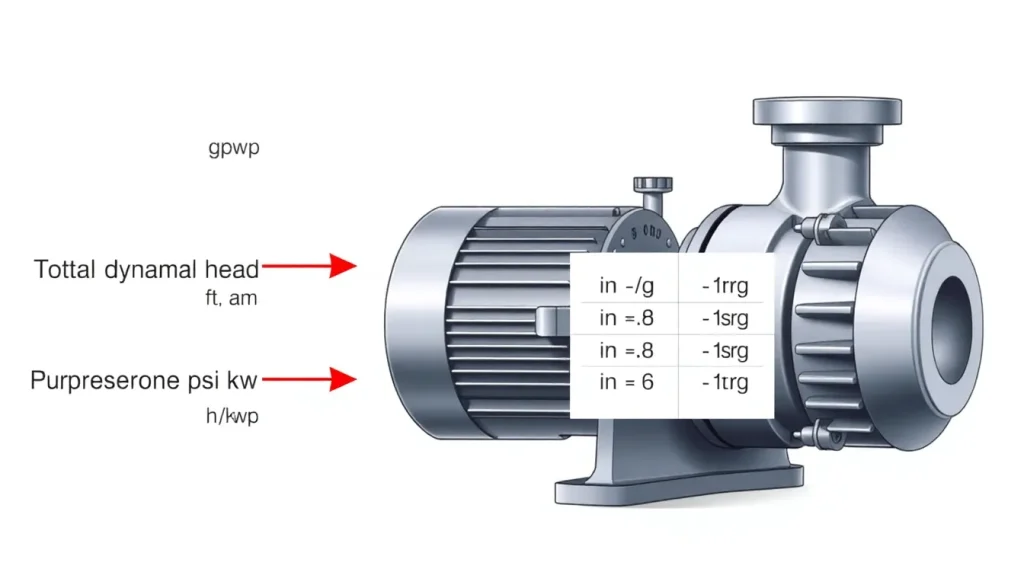
Short Answer
Key Formula / Key Facts Box
Fundamental hydraulic power equation:
P_h = frac{rho ; g ; Q ; H}{eta}
| Symbol | Meaning | US Unit | SI Unit | Plain‑English Restatement |
|---|---|---|---|---|
| P_h | Hydraulic power | hp (horsepower) | kW | Power delivered to the fluid. |
| rho | Fluid density | lb/ft³ | kg/m³ | Mass per unit volume of the pumped liquid. |
| g | Gravitational acceleration | 32.174 ft/s² | 9.80665 m/s² | Force that converts head into pressure. |
| Q | Volumetric flow rate | gpm (gal/min) | m³/h | How much fluid moves per unit time. |
| H | Total dynamic head | ft | m | Energy per unit weight that the pump must add. |
| eta | Overall efficiency (hydraulic × mechanical) | fraction (0‑1) | fraction (0‑1) | Ratio of useful power to input power. |
Additional conversion relationships:
- Head ↔ Pressure: H (ft) = P (psi) / (rho·g) × 144
- Flow: Q (gpm) = Q (m³/h) × 4.403
- Pressure: 1 psi = 6.89476 kPa = 6894.76 Pa
- Power: 1 hp = 0.7457 kW
Overview — What It Is and Why It Matters
Pump engineers constantly translate between four fundamental hydraulic quantities: volumetric flow rate (Q), total dynamic head (H), pressure rise (ΔP), and hydraulic power (P_h). In the United States the customary practice is to express Q in gallons per minute (gpm), H in feet, and pressure in pounds per square inch (psi). Internationally, the SI system uses cubic meters per hour (m³/h) or liters per second (L/s), meters for head, and pascals (Pa) or kilopascals (kPa) for pressure.
Accurate conversion is critical for three reasons:
- Correct pump selection: Manufacturers provide performance curves in one unit system; the designer’s system specifications may be in another.
- Energy estimation: Power calculations drive motor sizing, operating cost predictions, and compliance with energy‑efficiency standards (e.g., IEC 60300‑3‑5).
- Safety and reliability: Mis‑interpreting pressure or head can lead to cavitation, seal failure, or catastrophic over‑pressurization.
Even a 5 % error in head conversion can shift the required pump size by one standard series, increasing capital cost and reducing system efficiency.
The Method — Derivation and Variants
The starting point is the definition of hydraulic power as the product of pressure rise and flow rate, divided by efficiency:
P_h = frac{Delta P ; Q}{eta}
Using the head‑pressure relationship (Delta P = rho g H), the equation becomes the familiar form shown in the Key Facts Box:
P_h = frac{rho g Q H}{eta}
Because (rho) and (g) differ numerically between US and SI units, the constant term changes:
| System | Constant (K = rho g / eta) |
|---|---|
| US (water at 4 °C, (eta=1)) | 62.4 lb/ft³ × 32.174 ft/s² ≈ 2009 lb·ft/(ft³·s) |
| SI (water at 4 °C, (eta=1)) | 1000 kg/m³ × 9.80665 m/s² = 9806.65 N/m³ |
When converting to power in horsepower or kilowatts, an additional conversion factor is applied:
- US: (1,text{hp}=550,text{ft·lb/s}=0.7457,text{kW})
- SI: (1,text{kW}=1.341,text{hp})
Two common variants appear in practice:
- Head‑Pressure Form: (Delta P, (psi) = 0.433,rho, H, (ft)) for water ((rho≈1) in relative terms). This is handy when a pump curve is plotted as pressure vs. flow.
- Power‑Flow‑Head Form: (P_{hp}=frac{Q_{gpm}, H_{ft}}{3960,eta}). The denominator 3960 combines the US constants and the conversion from ft·lb/s to horsepower.
Worked Example
Scenario A – US customary system
A chemical plant requires 1500 gpm at a total dynamic head of 85 ft. The selected centrifugal pump has an overall efficiency of 78 % (0.78). Determine the hydraulic power in horsepower and the corresponding pressure rise in psi.
- Use the power‑flow‑head variant:
(P_{hp}=dfrac{Q,H}{3960,eta}) - Substitute: (Q=1500,text{gpm},; H=85,text{ft},; eta=0.78).
[P_{hp}=frac{1500times85}{3960times0.78}=frac{127,500}{3,088.8}=41.3,text{hp}] - Convert to kilowatts (optional): 41.3 hp × 0.7457 = 30.8 kW.
- Pressure rise using head‑pressure form (water, (rho≈1)):
[Delta P_{psi}=0.433times H_{ft}=0.433times85=36.8,text{psi}]
Result: 41 hp (≈31 kW) hydraulic power, 37 psi pressure rise.
Scenario B – SI system
The same requirement expressed in metric: 340 L/s at a head of 26 m, pump efficiency 0.78. Compute hydraulic power in kilowatts and pressure in kilopascals.
- Convert flow to m³/h: (340,text{L/s}=0.34,text{m³/s}=1224,text{m³/h}).
- Use the SI power equation:
(P_{kW}=frac{rho g Q_{m³/s} H_{m}}{etatimes1000})
(division by 1000 converts watts to kilowatts). - Substitute (rho=1000,text{kg/m³},; g=9.80665,text{m/s²},; Q=0.34,text{m³/s},; H=26,text{m}):
[P_{kW}=frac{1000times9.80665times0.34times26}{0.78times1000}=frac{86,786}{780}=111.3,text{kW}] - Pressure rise: (Delta P = rho g H = 1000times9.80665times26 = 254,973,text{Pa}=254.9,text{kPa}).
Result: 111 kW hydraulic power, 255 kPa pressure rise (≈37 psi, confirming the US calculation).
Calculator
For quick, on‑line conversions, use the following tool: Pump Total Dynamic Head & Power Calculator.
Reference Values & Typical Ranges
- Water density: 62.4 lb/ft³ (US) or 1000 kg/m³ (SI) at 4 °C.
- Typical pump efficiencies: 60 %–85 % for centrifugal, 80 %–95 % for positive‑displacement.
- Common flow ranges:
- Small‑scale laboratory: 0.5–5 gpm (0.03–0.3 m³/h)
- Industrial process: 500–10,000 gpm (1.9–38 m³/h)
- Head ranges:
- Low‑head (circulating) pumps: 5–30 ft (1.5–9 m)
- High‑head (booster) pumps: 100–500 ft (30–150 m)
- Pressure conversion constants (ISO 5167): 1 psi = 6.89476 kPa = 6894.76 Pa.
Application Guidance
When integrating pump data into a system model:
- Start with the design specification in the unit system used by the process (often SI for large plants).
- Convert flow to the units required by the pump catalog (most manufacturers publish in gpm and ft).
- Apply the efficiency factor at the best‑guess operating point; use the pump’s best‑efficiency point (BEP) as a reference.
- Check cavitation risk by comparing the Net Positive Suction Head Available (NPSHa) to the NPSH Required (NPSHr) expressed in the same head units.
- After selecting a pump, recalculate power in kilowatts to size the motor, then verify that the motor’s rated voltage, frequency, and service factor meet the site’s electrical standards (e.g., IEC 60034‑1).
Common Mistakes, Limits & Safety Notes
- Mixing units in the same expression: Substituting Q in L/s while using H in ft leads to errors up to 30 %.
- Neglecting fluid density variations: For oil, (rho) can be 0.8–0.9 times water; using water density over‑estimates power.
- Assuming 100 % efficiency: Real pumps rarely exceed 85 %; ignoring (eta) inflates power estimates and can cause motor overload.
- Using the 3960 constant for non‑water fluids: The constant embeds (rho) for water; replace with (frac{rho g}{550}) for other liquids.
- Overlooking pressure losses in piping: The quoted head is often only the pump’s contribution; add friction loss, fittings, and valve drops before final sizing.
- Ignoring temperature effects on viscosity: Higher viscosity reduces (eta) and may increase required NPSH.
- Safety note: A pressure exceedance of >10 % above design rating can rupture seals, cause pipe bursts, and pose personnel hazards. Always verify that relief devices are sized for the maximum calculated pressure.
FAQ
How do I convert pump flow from gpm to L/s?
Divide the flow in gallons per minute by 15.8503 to obtain liters per second (1 gpm = 0.06309 L/s).
Why does the 3960 constant appear in power calculations?
The constant 3960 combines the US unit factors for density (62.4 lb/ft³), gravity (32.174 ft/s²), and the conversion from ft·lb/s to horsepower (550 ft·lb/s per hp).
Can I use the same head‑pressure factor for oil as for water?
No. Oil’s specific gravity differs; use (Delta P = rho g H) with the oil’s actual density, or apply a corrected factor (e.g., 0.433 psi/ft × SG).
What efficiency should I assume for a new pump if the data sheet is missing?
For a well‑designed centrifugal pump, a safe assumption is 0.75 (75 %); for positive‑displacement, use 0.85–0.90.
How does temperature affect the conversion constants?
Temperature changes fluid density and viscosity; recompute (rho) at the operating temperature and adjust efficiency accordingly. The gravitational constant (g) remains unchanged.
Is it acceptable to ignore friction losses when estimating total head?
Only for very short, straight runs with low flow. In most industrial systems, pipe friction, fittings, and valves add 10‑30 % to the static head and must be included for accurate sizing.
What safety factor is recommended for motor power rating?
Select a motor whose rated power is at least 1.25 times the calculated hydraulic power to accommodate start‑up currents and efficiency drops.
Do I need to convert pressure to head before calculating power?
No. You can use either the pressure–flow form (P = Delta P Q / eta) or the head–flow form (P = rho g Q H / eta); just keep units consistent throughout the calculation.

Leave a Reply