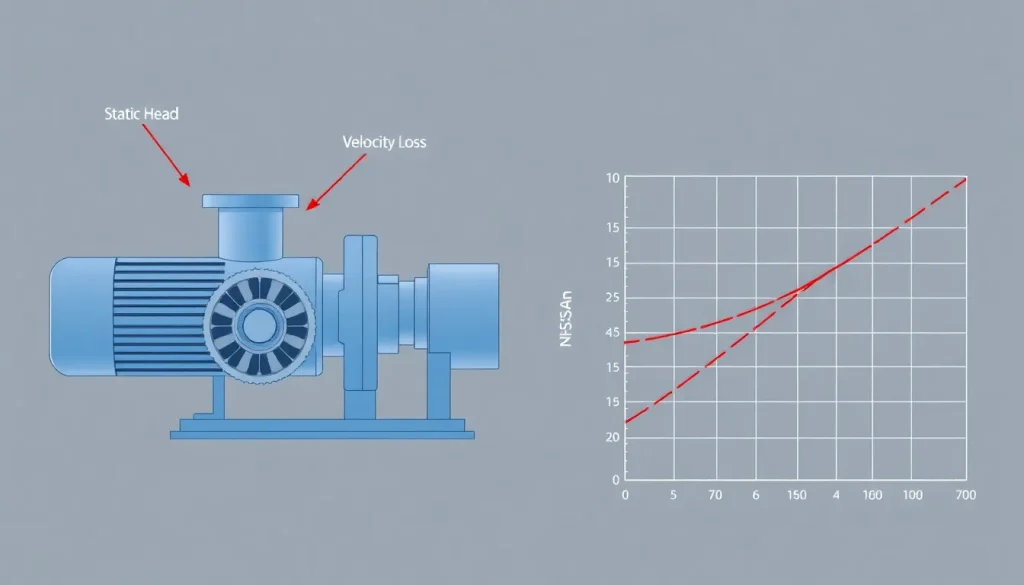
Short Answer
Key Formula / Key Facts Box
Governing Formula (US Customary)
NPSHa = (frac{P_{suction}}{rho g}) + (frac{V^{2}}{2g}) – (frac{P_{vapor}}{rho g}) – h_{f}
Governing Formula (SI)
NPSHa = (frac{P_{suction}}{rho g}) + (frac{V^{2}}{2g}) – (frac{P_{vapor}}{rho g}) – h_{f}
| Symbol | Meaning | US Unit | SI Unit | Plain‑English Restatement |
|---|---|---|---|---|
| P_suction | Absolute pressure at pump inlet | psia | kPa (absolute) | How hard the fluid is being pushed into the impeller. |
| ρ | Fluid density | lb/ft³ | kg/m³ | Mass per unit volume of the liquid. |
| g | Gravitational acceleration | 32.174 ft/s² | 9.80665 m/s² | Force that pulls the fluid downwards. |
| V | Mean velocity of fluid at the impeller eye | ft/s | m/s | Speed of the liquid entering the pump. |
| P_vapor | Saturation vapor pressure of the liquid at suction temperature | psia | kPa (absolute) | Pressure at which the liquid would start to boil. |
| h_f | Friction & minor losses between source and impeller | ft | m | Head lost due to pipe friction, fittings, valves. |
Key Facts
- NPSHa must exceed NPSHr by a safety margin (commonly 0.5–1.0 m or 2–3 ft).
- Both NPSHa and NPSHr are expressed in meters of liquid head or feet of liquid head.
- Cavitation begins when local pressure drops below the vapor pressure of the fluid.
- NPSHr is supplied by the pump manufacturer; it varies with flow rate.
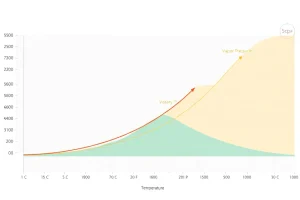
- Temperature has a strong effect because vapor pressure rises with temperature.
Overview — What It Is and Why It Matters
Net Positive Suction Head (NPSH) is a hydraulic concept that quantifies the energy available at a pump’s inlet relative to the liquid’s vapor pressure. Two distinct quantities are used:
- NPSHa (available) – the actual head present in the suction line, derived from system pressures, velocities, and losses.
- NPSHr (required) – the minimum head the pump needs to avoid cavitation, supplied by the pump maker as a curve versus flow.
If NPSHa < NPSHr, the impeller sees local pressures below vapor pressure, causing bubbles to form, collapse, and potentially damage the impeller, wear seals, and degrade performance. Engineers therefore treat NPSH as a “cavitation guardrail” during pump selection, system layout, and troubleshooting.
The Method — Derivation and Variants
The derivation begins with the Bernoulli equation applied between a reservoir (or tank) surface and the pump’s impeller eye, accounting for head losses. In differential form:
(frac{P_1}{rho g} + frac{V_1^2}{2g} + z_1 = frac{P_2}{rho g} + frac{V_2^2}{2g} + z_2 + h_f)
Setting point 1 at the free surface (where (V_1≈0) and (z_1) is the tank elevation) and point 2 at the impeller eye, rearranging gives the suction head available:
(NPSHa = frac{P_{suction}}{rho g} + frac{V^2}{2g} – frac{P_{vapor}}{rho g} – h_f)
Two practical variants exist:
- Static‑only NPSHa – neglects kinetic energy term for low‑velocity suction lines. Useful for large‑diameter suction pipes where (V) is small.
- Full‑energy NPSHa – retains the (V^2/2g) term, required for high‑speed suction or when suction pipe diameter is comparable to impeller eye.
In SI units the same expression uses (g = 9.80665,text{m/s}^2) and head is expressed in metres; in US customary units (g = 32.174,text{ft/s}^2) and head is expressed in feet. The numeric value of (rho g) differs, but the structure of the equation is identical.
Worked Example
Example 1 – US Customary
A 10‑in. centrifugal pump draws water at 68 °F (ρ = 62.4 lb/ft³). The suction tank is 15 ft above the pump centerline, the suction pipe is 8 ft long with a 4‑in. diameter, and the friction loss is 2 ft. The velocity at the impeller eye (diameter 5 in.) is 30 ft/s. Vapor pressure of water at 68 °F is 0.45 psia. Compute NPSHa.
- Static suction head: (z_s = 15,text{ft})
- Velocity head: (V^2/(2g) = 30^2/(2·32.174) = 900/64.348 ≈ 14.0,text{ft})
- Losses: (h_f = 2,text{ft})
- Convert vapor pressure to head: (P_{vapor}/(ρ g) = 0.45,text{psia} / (62.4·32.174) ≈ 0.000225,text{ft}) – negligible.
- Apply formula: (NPSHa = 15 + 14.0 – 0.0002 – 2 ≈ 27.0,text{ft})
The pump’s published NPSHr at the design flow is 12 ft. Since 27 ft > 12 ft, cavitation is unlikely.
Example 2 – SI
A 150 kW centrifugal pump moves glycol (ρ = 1100 kg/m³) at 20 °C. The suction tank sits 4.5 m above the pump shaft. The suction line is 3 m long, 0.1 m diameter, with a calculated friction loss of 0.6 m. The velocity at the eye (diameter 0.13 m) is 6 m/s. Vapor pressure of glycol at 20 °C is 0.8 kPa (≈0.008 bar). Compute NPSHa.
- Static head: (z_s = 4.5,text{m})
- Velocity head: (V^2/(2g) = 6^2/(2·9.80665) = 36/19.6133 ≈ 1.84,text{m})
- Losses: (h_f = 0.6,text{m})
- Vapor‑pressure head: (P_{vapor}/(ρ g) = 0.8·10^3,text{Pa} / (1100·9.80665) ≈ 0.074,text{m})
- Result: (NPSHa = 4.5 + 1.84 – 0.074 – 0.6 ≈ 5.67,text{m})
The manufacturer lists NPSHr = 3.5 m at the design point. With a 0.5 m safety margin, the system is acceptable.
Calculator
For quick verification, use an online NPSH calculator such as PumpCalcs NPSH Calculator. Enter suction pressure, temperature, pipe dimensions, and loss coefficients to obtain NPSHa instantly.
Reference Values & Typical Ranges
- Water at 20 °C: vapor pressure ≈ 0.023 psia (0.16 kPa); NPSHr for most small‑size centrifugal pumps ranges 5–12 ft (1.5–3.5 m).
- Light oils (ρ ≈ 800 kg/m³): NPSHr often 2–4 m due to higher vapor pressures.
- High‑temperature service (>80 °C): NPSHr can exceed 10 m; NPSHa must be carefully managed.
- Typical safety margin: add 0.5 m (1.5 ft) or 10 % of NPSHr, whichever is larger.
Sources: API 610, ANSI/HI 9.6.4, ISO 5199.
Application Guidance
When sizing a pump, follow these steps:
- Determine suction conditions (tank level, pipe layout, fluid temperature).
- Calculate static head and velocity head; include all fittings, valves, and filters in (h_f).
- Obtain NPSHr curve from the pump data sheet; read the value at the intended flow.
- Apply a safety margin (0.5 m or 2 ft is common). Ensure NPSHa ≥ NPSHr + margin.
- If the margin is insufficient, consider raising the suction tank, enlarging pipe diameter, reducing pipe length, or selecting a pump with a lower NPSHr.
Field adjustments: In practice, engineers often add an extra 1 ft (0.3 m) to account for temperature spikes, elevation changes, or measurement uncertainty.
Common Mistakes, Limits & Safety Notes
- Mixing US and SI units – using ft for head but kg/m³ for density yields erroneous NPSHa.
- Ignoring velocity head – for small‑diameter suction lines the kinetic term can be >10 % of total NPSHa.
- Using NPSHr at off‑design flow – NPSHr increases sharply near shut‑off; always read the curve at the actual flow.
- Neglecting temperature effect on vapor pressure – a 10 °C rise can double vapor pressure for many liquids.
- Assuming zero friction loss – even smooth steel pipe incurs ~0.5 ft loss per 10 ft at typical Reynolds numbers.
- Applying NPSH formulas to positive‑displacement pumps – NPSH is primarily a centrifugal‑pump concern; PD pumps tolerate lower suction heads.
- Over‑relying on manufacturer’s NPSHr – test data may be based on laboratory conditions; verify with on‑site measurements for critical applications.
- Safety note – Cavitation can cause rapid erosion, loss of efficiency, and seal failure, potentially leading to unplanned shutdowns.
FAQ
What is the difference between NPSHa and NPSHr?
NPSHa (Net Positive Suction Head available) is the actual head present at the pump inlet, calculated from system pressures, velocities, and losses. NPSHr (Net Positive Suction Head required) is the minimum head the pump needs to avoid cavitation, supplied by the manufacturer as a function of flow.
Why do I need a safety margin on NPSHa?
A safety margin accounts for measurement tolerances, temperature fluctuations, and unmodeled losses. Without it, a small drop in suction pressure could push the system below NPSHr, causing cavitation.
Can I use the static head alone for NPSHa?
Only when the suction velocity is negligible (large‑diameter pipe, low flow). In most practical systems, the velocity head term (V²/2g) contributes significantly and should be included.
How does fluid temperature affect NPSH?
Higher temperature raises the fluid’s vapor pressure, reducing the term (P_{vapor}/(ρg)) and thus lowering NPSHa. Designers must recalculate NPSHa for the hottest operating temperature.
Is NPSHr the same for all pump speeds?
No. NPSHr varies with impeller speed and flow rate; manufacturers provide curves for each speed. When using a variable‑speed pump, select the NPSHr curve that matches the intended operating point.
Can I ignore friction losses in short suction lines?
Even short, smooth pipes have measurable losses (≈0.5 ft per 10 ft). Ignoring them can lead to an over‑optimistic NPSHa and unexpected cavitation.
Do positive‑displacement pumps require NPSH analysis?
Cavitation is less critical for positive‑displacement pumps because they do not rely on kinetic energy to develop head. However, excessive vapor formation can still cause seal or valve issues, so a basic NPSH check is advisable.
What happens if NPSHa is lower than NPSHr?
The pump will experience cavitation, leading to noise, vibration, reduced efficiency, impeller erosion, seal failure, and potentially catastrophic shutdown.
Leave a Reply