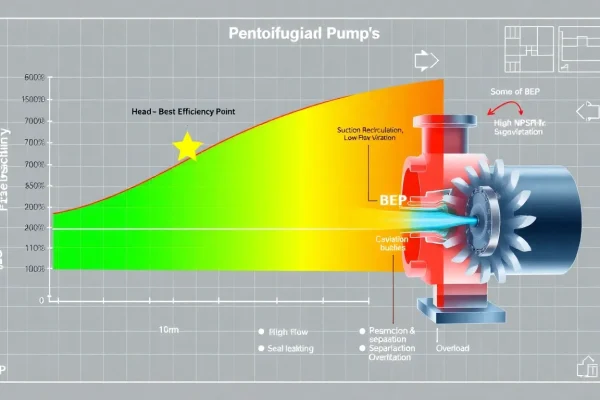
Cavitation in Pumps: Causes, Warning Signs, and How to Prevent It
Cavitation occurs when local pressure in a pump falls below the liquid’s vapor pressure, causing vapor bubbles that implode and damage components. This article…
PumpCalcs reference library
Core concepts and equations that define pump hydraulic behavior.
Cavitation occurs when local pressure in a pump falls below the liquid’s vapor pressure, causing vapor bubbles that implode and damage components. This article…
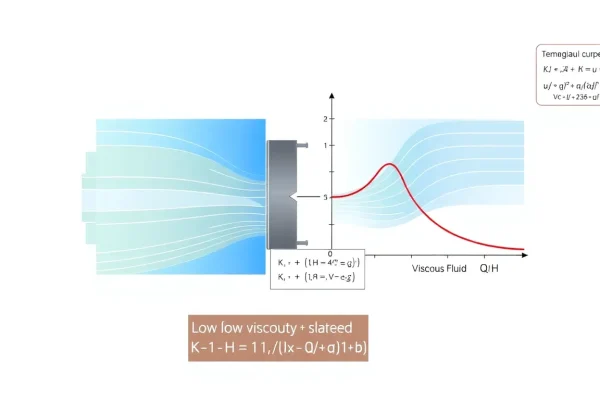
Viscosity reduces a centrifugal pump's flow, head, and efficiency. This article explains the governing equations, shows how to apply viscosity correction factors, and tells…
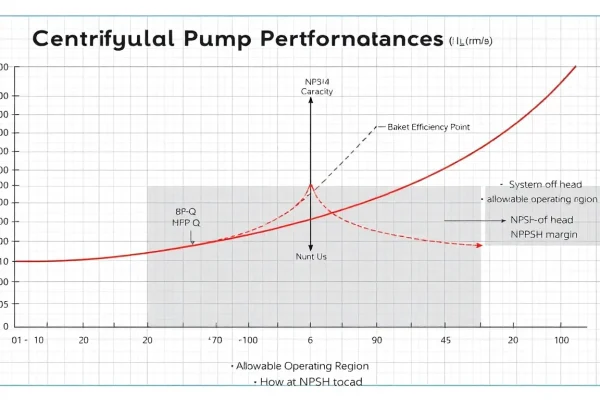
A pump performance curve graphically relates flow rate to head, power, efficiency, and NPSH required. Learning to read these curves is essential for selecting…
Pump manufacturers express performance in feet of head because head directly represents the energy added to the fluid per unit weight, independent of fluid…
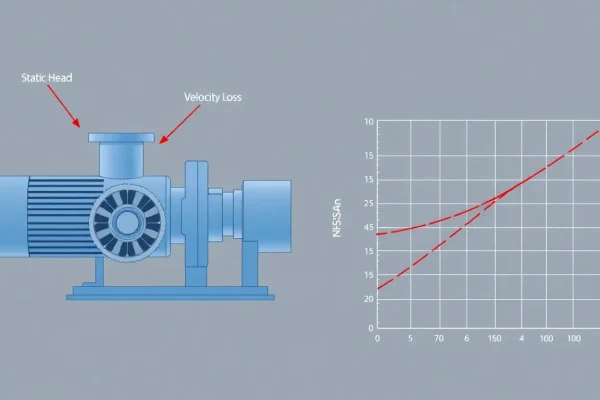
Net Positive Suction Head (NPSH) determines whether a centrifugal pump will cavitate. This article clarifies the difference between available NPSH (NPSHa) and required NPSH…
K‑factors and equivalent length provide engineers with two practical ways to quantify the head loss introduced by valves, elbows, tees and other pipe fittings.…
Specific speed and suction specific speed are dimensionless (or quasi‑dimensionless) indices that classify pump impeller geometry, predict performance curve shape, and quantify suction capability.…
Hydraulic power, brake horsepower, and motor power describe three distinct stages of energy transfer in a pump system. Understanding their definitions, relationships, and conversion…
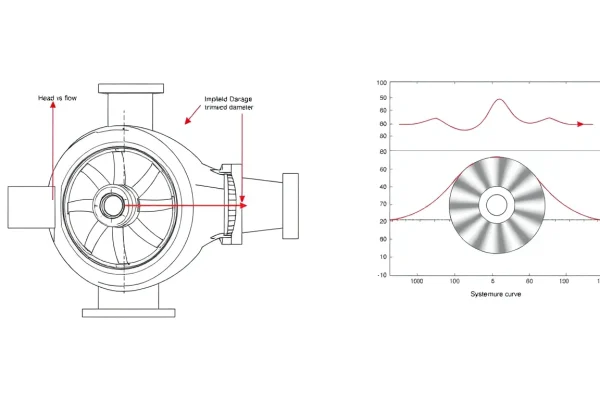
The pump affinity laws are fundamental scaling relationships that predict how centrifugal pump performance changes when rotational speed or impeller diameter is varied. Flow…
The Best Efficiency Point (BEP) is the flow rate and head at which a centrifugal pump operates with maximum hydraulic efficiency. Sustained operation far…