Short Answer
Key Formula / Key Facts Box
Governing nozzle-flow equation, US customary: qs = 29.82 Cd D2 √P
Common simplified field form: qs ≈ 29 D2 √P
Plain English: A sprinkler nozzle discharges more water as its orifice gets larger and as pressure at the nozzle rises; diameter matters much more than pressure.
| Symbol | Meaning | US unit | SI unit |
|---|---|---|---|
| qs | Nozzle discharge | gpm | L/min |
| Cd | Discharge coefficient | dimensionless | dimensionless |
| D | Effective nozzle orifice diameter | in | mm |
| P | Pressure at sprinkler inlet/nozzle | psi | kPa |
SI field form: qs ≈ 0.0667 Cd D2 √P, with q in L/min, D in mm, and P in kPa for water near 20 °C. If using a manufacturer chart, use the pressure at the nozzle and the actual drilled orifice size, not the nominal head size.
Overview — What It Is and Why It Matters
Calculating irrigation flow from sprinkler nozzle data means estimating the discharge of one nozzle—and then the total flow of a sprinkler head, lateral, or irrigation zone—from the nozzle orifice diameter and the pressure at the sprinkler. In this article the scope is agricultural and landscape sprinkler nozzles, especially impact, spray, and rotor heads that discharge a jet through a fixed or replaceable orifice. It does not treat drip emitters or open-pipe discharge as sprinkler nozzles, although the same orifice equation family applies.
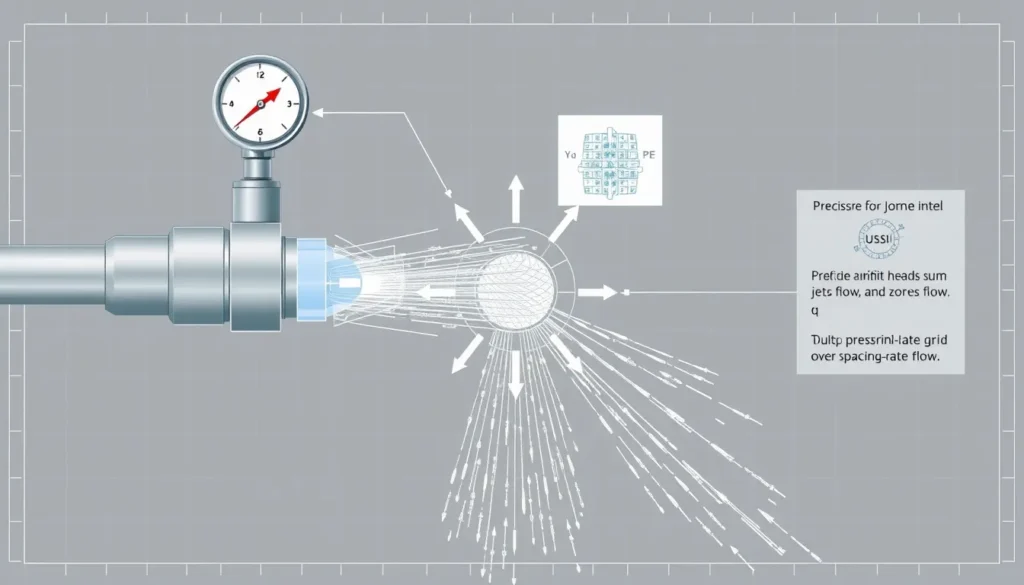
The physical idea is simple. Pressure energy upstream of the nozzle is converted to velocity as water accelerates through a small opening. The nozzle is not a perfect orifice: friction, vena contracta, and body geometry reduce the theoretical flow, which is why a discharge coefficient Cd appears. For a given pressure, doubling the orifice diameter roughly quadruples flow; increasing pressure raises flow only with the square root of pressure. That asymmetry is central to sprinkler selection and troubleshooting.
Why it matters: pump selection, zone sizing, mainline capacity, irrigation scheduling, and energy cost all depend on flow. A 10% error in nozzle diameter becomes about a 21% error in flow because diameter is squared. Overestimating pump duty can cause overpressure and wasted energy; underestimating it can leave the last sprinklers starved, reduce uniformity, and cause crop or turf stress. Flow also determines precipitation rate, runoff risk, and whether a pump can operate near its best efficiency point without cavitation or motor overload.

The Method — Derivation and Variants
Start with the standard orifice equation for incompressible flow: q = Cd A √(2 ΔP / ρ), where A is the orifice area, ΔP is the pressure drop across the nozzle, and ρ is water density. For a circular nozzle, A = π D2/4. In US customary units, with q in gpm, D in inches, and P in psi, the constants collapse to qs = 29.82 Cd D2 √P. With Cd near 0.96 for many straight-bore agricultural nozzles, the combined coefficient is about 28.6, so the field approximation qs ≈ 29 D2 √P is common. Manufacturer charts often use their own tested coefficient, so chart values should govern for a specific head.
For multiple nozzles on one head, sum the discharges at the same operating pressure: qhead = qmain + qspreader + … . For a zone, qzone = Σ qhead,i, excluding leaks and unauthorized losses. If a zone has N identical heads, qzone = N qhead. If heads differ, sum each head individually. This total is the flow the pump and mainline must supply at the required nozzle pressure, before adding any known leakage allowance.
In SI, use qs = 0.0667 Cd D2 √P with q in L/min, D in mm, and P in kPa for water near 20 °C. This is the same orifice equation with density and unit conversions absorbed. For a zone, the SI total is the sum in L/min. To convert, 1 US gpm = 3.785 L/min; 1 psi = 6.895 kPa; 1 in = 25.4 mm. Nozzle sizes are often nominal: some manufacturers number nozzles in 64ths of an inch, others in 128ths. Always convert the nominal number to actual diameter before calculating.
After flow, calculate precipitation rate if scheduling or runoff is the question. In US units, PR (in/h) = 96.3 Q / (Sp Sl), where Q is the flow for one head in gpm, and Sp and Sl are sprinkler and lateral spacing in feet. In SI, PR (mm/h) = 60 Q / (Sp Sl) for Q in L/min and spacing in metres for a single head pattern; for a whole zone, use the zone flow and wetted area consistently. These formulas assume uniform application over the spacing rectangle, which is a design approximation, not a substitute for a catch-can audit.
Worked Example
US customary example. A 1,280 ft side-roll has 32 double-nozzle impact sprinklers spaced 40 ft apart on the lateral, with a 60 ft set spacing. The nozzles are 3/16 in and 3/32 in, and the measured pressure at the sprinkler is 45 psi. Assume Cd is absorbed in the simplified coefficient 29. For the 3/16 in nozzle, D = 0.1875 in: q = 29 × √45 × 0.18752 = 29 × 6.708 × 0.03516 = 6.84 gpm. For the 3/32 in nozzle, D = 0.09375 in: q = 29 × 6.708 × 0.008789 = 1.71 gpm. The head flow is 6.84 + 1.71 = 8.55 gpm. The lateral total is 8.55 × 32 = 273.6 gpm. The average precipitation rate is PR = (96.3 × 8.55) / (40 × 60) = 823.4 / 2,400 = 0.34 in/h. This matches the typical field computation in the Hammond Conservancy tip sheet.
SI example. Use the same 45 psi pressure, converted to about 310 kPa, and the same 3/16 in nozzle, converted to 4.76 mm. Assume Cd = 0.96. Then q = 0.0667 × 0.96 × 4.762 × √310 = 0.0640 × 22.66 × 17.61 = 25.5 L/min. The 3/32 in nozzle is about 2.38 mm: q = 0.0640 × 5.66 × 17.61 = 6.38 L/min. The head flow is 31.9 L/min, or about 8.4 gpm, which is consistent within rounding and coefficient differences with the US result. The 32-head lateral total is about 1,021 L/min, or about 270 gpm. For scheduling, convert the zone flow to precipitation rate using the same spacing converted to metres; the result should be about 0.34 in/h or 8.6 mm/h.
Calculator
For a quick independent check, use the Washington State University Sprinkler Nozzle Flows calculator at https://irrigation.wsu.edu/calculators/sprinkler/nozzle-requirements. Enter pressure and nozzle diameter in the selected units and compare the result with the manufacturer chart. If the calculator and chart disagree, verify whether the chart uses pressure at the nozzle, a tested Cd, or a nominal nozzle size in 64ths or 128ths.
Reference Values & Typical Ranges
Use these values as screening aids, not as substitutes for manufacturer data. The discharge coefficient for a clean straight-bore agricultural nozzle is commonly near 0.96, but nozzle design, wear, and turbulence can shift it. Impact sprinklers often operate in the 30–60 psi range; spray heads and many landscape nozzles operate at lower pressures. The 45 psi example above is realistic for agricultural impact hardware. Always confirm the allowable pressure range for the exact head.
| Item | Typical value or range | Practical note |
|---|---|---|
| Discharge coefficient, Cd | 0.95–0.98; about 0.96 for many straight-bore nozzles | Use manufacturer value when available; wear changes the effective orifice. |
| Agricultural impact pressure | 30–60 psi (207–414 kPa) | 45 psi (310 kPa) is a common design example; confirm nozzle rating. |
| Landscape spray pressure | 15–30 psi (103–207 kPa) | Higher pressure may cause misting, drift, and poor uniformity. |
| 3/16 in nozzle at 45 psi | ≈6.8 gpm (≈25.5 L/min) | With Cd ≈ 0.96; simplified 29 coefficient gives similar result. |
| 3/32 in nozzle at 45 psi | ≈1.7 gpm (≈6.4 L/min) | Spreader or secondary nozzle; sum with the range nozzle. |
| Precipitation rate, agricultural example | ≈0.34 in/h (≈8.6 mm/h) | Depends on head flow and spacing; audit if runoff or dry spots occur. |
Sources for these screening values include the Hammond Conservancy District irrigation tip sheet; Eisenhauer et al., 2021; and LibreTexts, 11.3 Sprinkler Performance. Rules of thumb: flow scales with D2; a 20% larger diameter increases flow about 44%; a 20% pressure increase raises flow only about 10%; and total zone flow is the sum of all nozzles, not an average. These relationships follow directly from the orifice equation and are illustrated in the worked example from the LibreTexts sprinkler-performance chapter. For system design, keep pressure variation across the zone within the manufacturer’s recommendation, because flow and pattern degrade as pressure moves away from the design point.
Application Guidance
In real systems, nozzle flow is the starting point for pump and piping decisions. First calculate the flow of each head at its actual nozzle pressure, then sum by zone. Add a small allowance only for known leakage or future flushing; do not pad the nozzle formula itself. The pump must supply that flow at the pressure required at the most remote or highest sprinkler, plus friction and elevation. A pump selected only from average nozzle flow may be oversized or undersized once pressure variation, mainline losses, and simultaneous zones are included.
Nozzle wear is a field issue that the formula exposes: a worn brass or plastic orifice is larger than nominal, so measured flow can exceed the chart by several percent. Conversely, clogged or partially blocked nozzles reduce flow and distort the pattern. Low pressure causes large droplets and poor throw; excessive pressure creates fine mist, wind drift, and higher evaporation. For scheduling, convert calculated flow to precipitation rate and compare it with soil intake rate and crop demand. A catch-can audit is the best check because it captures wind, spacing, head tilt, and nozzle condition that a clean equation cannot.
When selecting a pump or zone layout, use manufacturer nozzle charts as the primary source and the orifice equation as a cross-check. If a system has multiple nozzle sizes, calculate each head separately or use a weighted average only when heads are truly identical in size and pressure. For variable-frequency or pressure-regulated systems, verify flow at the minimum and maximum expected pressure, not just the design point. This protects the pump from running far from its curve and helps maintain distribution uniformity.
Common Mistakes, Limits & Safety Notes
- Using pump pressure instead of nozzle pressure. Gauge pressure at the pump includes friction and elevation losses; the nozzle sees less. Use pressure at the sprinkler inlet or subtract verified losses.
- Mixing nominal and actual diameter. A No. 16 nozzle may mean 16/64 in, while another brand uses 128ths. Convert to decimal inches or millimetres before calculating.
- Forgetting that diameter is squared. A small measurement error in orifice diameter becomes a much larger flow error. Measure worn nozzles with a drill-bit set or caliper.
- Ignoring multiple nozzles. Impact and some spray heads have a range nozzle plus a spreader nozzle. Sum both; do not use only the larger one.
- Assuming constant Cd. The coefficient varies with nozzle geometry, Reynolds number, and wear. Manufacturer data override a generic 0.96.
- Unit mix-ups. Do not insert psi into the SI form, mm into the US form, or gpm where L/min is required. Convert pressure, diameter, and flow consistently.
- Treating theoretical flow as system flow. Leaks, evaporation, wind drift, and pressure variation mean measured system flow and application rate can differ from nozzle calculations.
- Using sprinkler-nozzle formulas for drip or open pipe. Emitters, leaks, and free discharge have different hydraulics and require their own relationships.
- Overpressurizing to increase throw. Excessive pressure can atomize the jet, increase drift, accelerate wear, and reduce uniformity rather than improve coverage.
- Safety and equipment limits. Isolate and depressurize lines before nozzle work; secure heads against blow-off; verify pump relief and electrical protections; and avoid deadheading a pump while testing flows.
FAQ
How do I calculate sprinkler nozzle flow?
Use q = 29.82 Cd D^2 sqrt(P) in US units, with q in gpm, D in inches, and P in psi at the nozzle. For SI, use q = 0.0667 Cd D^2 sqrt(P) with L/min, mm, and kPa. Use actual orifice diameter and a manufacturer or field-verified discharge coefficient, then sum all nozzles on the head and zone.
Should I use pressure at the pump or at the sprinkler?
Use pressure at the sprinkler inlet or nozzle, not pump discharge pressure. Friction losses in pipes, fittings, valves, and elevation change reduce pressure before the water reaches the nozzle. If only pump pressure is known, subtract verified friction and elevation losses or measure with a pitot gauge or pressure tap near the head.
Does doubling pressure double sprinkler flow?
No. Nozzle flow varies with the square root of pressure. Doubling pressure increases flow by a factor of about 1.41, or 41%, if everything else is unchanged. This is why changing nozzle diameter has a much stronger effect than raising pressure; diameter is squared in the equation.
How do I calculate total irrigation zone flow?
Calculate each sprinkler head flow at its actual nozzle pressure, sum all nozzles on each head, then add the head flows for all sprinklers operating in that zone. For identical heads, multiply one head flow by the number of heads. Add only known leakage allowances, and compare total zone flow with pump and mainline capacity.
What is precipitation rate and why calculate it?
Precipitation rate is the depth of water applied per hour, such as inches per hour or millimetres per hour. Calculate it from head flow and spacing using PR = 96.3 Q / (Sp Sl) in US units. It helps match irrigation to soil intake rate, crop demand, and runoff risk, and supports scheduling decisions.
How do 64ths and 128ths nozzle sizes work?
Some manufacturers number nozzles by orifice diameter in 64ths of an inch, others in 128ths. A No. 16 nozzle in 64ths is 16/64 in, or 0.25 in, while the same number in 128ths is 0.125 in. Always convert the nominal number to actual decimal diameter before using any flow formula.
Why does measured flow differ from the nozzle chart?
Measured flow can differ because of nozzle wear, clogging, actual pressure at the head, discharge-coefficient variation, and whether the chart uses nominal or drilled orifice size. Worn nozzles often flow more than rated; clogged nozzles flow less. Use a calibrated gauge and a pitot tube or catch-can test when accuracy matters.
Can I use nozzle flow calculations for drip irrigation?
No, not directly. Sprinkler nozzle formulas describe jet discharge from a fixed orifice at relatively high pressure. Drip emitters, micro-sprinklers, and open-pipe discharges use different hydraulic relationships, manufacturer flow curves, and clogging behaviour. Use emitter rated flow and system pressure data for drip design instead.
How do I convert gpm to L/min?
Multiply US gallons per minute by 3.785 to obtain litres per minute. For example, 8.55 gpm is about 32.4 L/min. When converting pressure, 1 psi equals 6.895 kPa, and 1 inch equals 25.4 mm. Keep the same unit system throughout the calculation to avoid large errors.
Leave a Reply