
Short Answer
Key Formula / Key Facts Box
Governing sizing formula for fixed-speed, single-pump duty:
Vmin = Tmax × Qp / 4
Detention check: td = Vactive / Qavg
| Symbol | Meaning | US unit | SI unit |
|---|---|---|---|
| Vmin | Minimum active volume between pump-on and pump-off levels | gal | m³ |
| Tmax | Maximum allowable cycle time = 60 / N | min | min |
| Qp | Pump rate over the active drawdown range | gpm | L/s or m³/s |
| Qi | Inflow rate to the wet well | gpm | L/s or m³/s |
| td | Detention time at the selected flow | min | min |
| N | Maximum permitted starts per hour per pump | starts/h | starts/h |
Plain-English restatement: For a fixed-speed pump, the smallest active wet-well volume that keeps the worst-case cycle at or below a chosen maximum cycle time is one-quarter of the product of that cycle time and the pump rate; then check that the same volume does not hold wastewater too long at average flow.

Overview — What It Is and Why It Matters
Scope: This article uses the most common encyclopedic meaning: the design of municipal and industrial lift-station wet wells, where active storage is the volume between controlled pump start and stop levels. It does not address clearwells or treatment basins except by analogy.
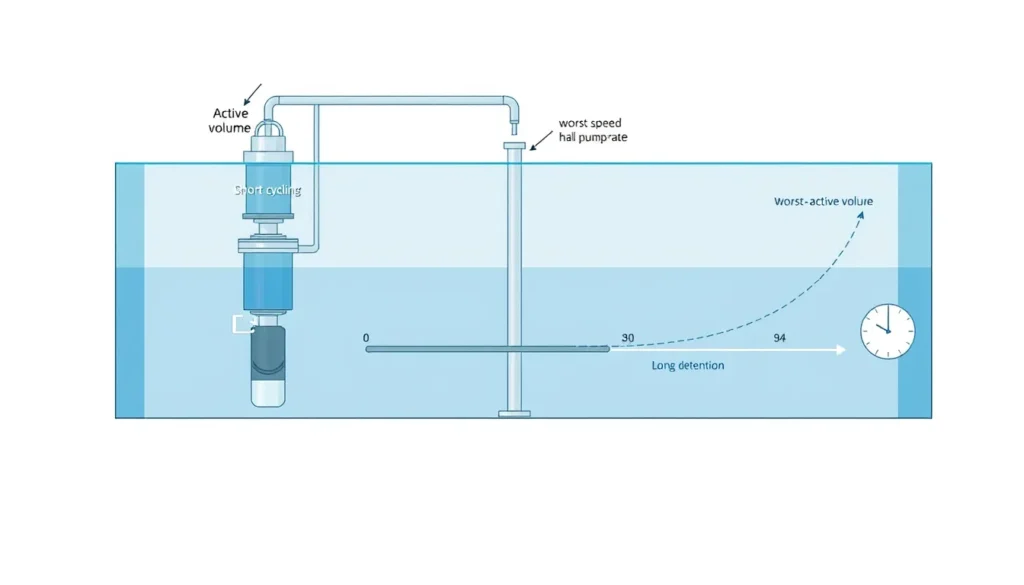
Wet Well Detention Time vs Pump Cycling: Balancing Two Design Goals is the central tension in lift-station wet-well sizing. Detention time is how long wastewater remains in the well before it is pumped out; pump cycling is how often a fixed-speed pump starts and stops. Active volume satisfies both concerns in opposite directions. Too little active volume causes short-cycling: the pump starts frequently, drawing high inrush current, heating the motor, wearing contactors and valves, and creating unsteady suction conditions. Too much active volume lowers the number of starts but increases retention time, allowing solids to settle and wastewater to turn septic.
In wastewater systems, septicity can generate hydrogen sulfide and other odorous gases. Hydrogen sulfide corrodes concrete above the waterline, damages electrical and mechanical equipment, and creates a serious confined-space hazard. The design goal is therefore not simply a bigger well or a smaller well; it is a well whose active volume is large enough for reliable pump cycling and small enough, or sufficiently mixed or controlled, to avoid excessive detention.
The Method — Derivation and Variants
For a single fixed-speed pump, let V be the active volume between pump-on and pump-off levels, Qp the pump rate, and Qi the inflow rate, with Qi < Qp. The well fills in V/Qi and draws down in V/(Qp − Qi). The total cycle time is:
Tcycle = V/Qi + V/(Qp − Qi) = V × Qp / [Qi × (Qp − Qi)]
The shortest cycle occurs at the worst-case inflow Qi = Qp/2. Substituting gives Tmin = 4V/Qp. Rearranging for a selected maximum cycle time gives the standard sizing relation:
Vmin = Tmax × Qp / 4
where Tmax = 60/N minutes when N is the maximum permitted starts per hour. The divisor 4 is not a safety factor; it is the mathematical consequence of the worst-case inflow being half the pump rate.
| Form | Minimum active volume | Detention check |
|---|---|---|
| US customary | Vgal = Tmin × Qgpm / 4 | td,min = Vgal / Qgpm |
| SI, flow in L/s | Vm³ = 0.015 × Tmin × QL/s | td,min = 16.667 × Vm³ / QL/s |
| SI, flow in m³/s | Vm³ = 15 × Tmin × Qm³/s | td,min = Vm³ / (60 × Qm³/s) |
For duplex stations with true alternation, an idealized minimum can be taken as Vmin = Tmax × Qp / 8 because each pump sees about half the cycles. Many design standards still require a single-pump worst-case check because one unit may be out of service. Variable-speed pumping can reduce required active volume, but it does not remove the detention constraint; low-flow turnover, mixing, and solids transport still require review.
Worked Example
US customary example. A fixed-speed lift station has one pump rated at Qp = 250 gpm, a permitted maximum of 6 starts per hour, average daily flow of 50,000 gpd (34.7 gpm), peak flow of 175 gpm, and a circular wet well 6 ft in diameter.
Step 1 — Convert starts to minimum cycle time: Tmax = 60/6 = 10 min.
Step 2 — Compute minimum active volume: Vmin = 10 × 250 / 4 = 625 gal.
Step 3 — Check worst-case cycling at Qi = 250/2 = 125 gpm: fill time = 625/125 = 5 min; drawdown time = 625/(250 − 125) = 5 min; total cycle = 10 min, as intended.
Step 4 — Check detention at average flow: 625/34.7 = 18.0 min, below the common 30-minute guidance. At peak flow, detention is 625/175 = 3.6 min.
Step 5 — Convert volume to level differential: area = π × 6²/4 = 28.27 ft²; gallons per foot = 28.27 × 7.481 = 211.5 gal/ft; level differential = 625/211.5 = 2.95 ft.
SI example. A comparable station has Qp = 15 L/s, 6 starts per hour, average flow 2.5 L/s, peak flow 10 L/s, and a 1.8 m diameter well.
Step 1 — Tmax = 60/6 = 10 min.
Step 2 — Vmin = 0.015 × 10 × 15 = 2.25 m³, or 2,250 L.
Step 3 — Worst-case inflow is 7.5 L/s; fill time = 2,250/7.5 = 300 s = 5 min; drawdown time = 2,250/(15 − 7.5) = 300 s = 5 min; total cycle = 10 min.
Step 4 — Detention at average flow = 2,250/2.5 = 900 s = 15 min. At peak flow = 2,250/10 = 225 s = 3.75 min.
Step 5 — Well area = π × 1.8²/4 = 2.545 m²; level differential = 2.25/2.545 = 0.884 m, or about 2.9 ft.
Both examples satisfy the cycle-time constraint and pass the common detention check. A designer would still verify manufacturer starts-per-hour limits, actual pump flow over the drawdown range, solids transport, and local regulatory requirements.
Calculator
For a quick check, use the Lift Station Wet-Well Volume and Cycle Time calculator. Enter pump rate, maximum starts per hour or minimum cycle time, well diameter, and inflow; then confirm that the calculated active volume also passes the detention check at average daily flow.
Reference Values & Typical Ranges
The following are common planning values; manufacturer ratings, local regulations, and the project design engineer govern.
| Parameter | Typical or acceptable range | Notes and sources |
|---|---|---|
| Maximum starts per hour | About 6 starts/h for small or fractional-horsepower pumps; about 4 starts/h for larger units; sometimes 3 starts/h for soft-start or VFD-controlled units | Ten States Standards §42.32; manufacturer motor and starter ratings govern |
| Minimum cycle time | 10 min at 6 starts/h; 15 min at 4 starts/h; 20 min at 3 starts/h | Use Tmax = 60/N |
| Maximum detention at average daily flow | 30 min recommended; 60 min commonly treated as an absolute upper bound | Ten States Standards §42.34; local sewer-use or design rules may be stricter |
| Worst-case inflow for fixed-speed single-pump cycling | 50% of pump rate, Qi = Qp/2 | Produces the minimum cycle time for a given active volume |
| Active-volume rule | V = T × Qp / 4 | Single-pump fixed-speed sizing; duplex ideal is /8 but verify single-pump case |
| Well geometry check | gallons per foot = area (ft²) × 7.481 | Confirm volume-versus-elevation from actual geometry; MDOT Chapter 10 and Jensen Infrastructure |
Application Guidance
Real lift-station inflows vary by hour and season, so the design calculation must bracket the operating range. The fixed-speed worst case is not average inflow; it is the inflow near half the pump rate. A station sized only for average daily flow may short-cycle during normal low-flow periods. Pump flow also changes as the wet well draws down because suction lift and system head change, so the average pump rate over the active range is more reliable than a nameplate rating.
Where detention and cycling conflict, simply enlarging the wet well is rarely the best answer. Options include selecting a pump that better matches low-flow conditions, adding a smaller jockey pump, using variable-speed control, staging multiple pumps, improving mixing or odor control, or reconfiguring the wet well. Duplex and triplex arrangements reduce starts per pump, but the design should still consider a single-pump failure or maintenance condition. VFDs can reduce cycling and allow smaller active volume, yet the wet well still needs adequate turnover to limit septicity and maintain solids transport.
Field judgment matters. Confirm float or transducer elevations, actual well geometry, submergence requirements, and clearance below the stop level. Accumulated grit, grease, and rags reduce effective volume over time, so maintenance access and cleanout provisions are part of the design. Operators should not try to cure cycling by raising the stop float, which shrinks active volume and usually makes short-cycling worse.
Common Mistakes, Limits & Safety Notes
- Sizing active volume from average inflow instead of the worst-case inflow near half the pump rate.
- Using total wet-well volume instead of active volume between pump start and stop levels.
- Mixing units, such as gpm with gpd, minutes with seconds, or gallons with cubic metres; the SI L/s form requires the 0.015 constant.
- Using nameplate pump flow rather than the average flow over the actual drawdown range.
- Over-crediting duplex or triplex alternation without checking a single-pump worst case.
- Assuming a VFD removes detention concerns; septicity, turnover, and low-speed solids transport still require review.
- Ignoring grit and solids accumulation, which reduces effective active volume and can clog pumps.
- Raising the stop float to reduce starts; this reduces active volume and often worsens cycling.
- Ignoring confined-space safety. Wet wells can contain hydrogen sulfide, methane, and oxygen-deficient atmospheres; never enter without testing, ventilation, and appropriate procedures.
- Treating the cycle-time formula as a complete design. It does not size pumps, force mains, ventilation, emergency storage, or corrosion protection.
Limits: The formula assumes a simple fixed-speed on/off pump with approximately constant pump rate and a single active volume. More complex controls, multiple pumps, variable inflow, and unusual well geometry require additional checks. Safety: Detention-related septicity is not only an odor issue; hydrogen sulfide corrosion and confined-space entry hazards can be life-safety concerns.
FAQ
What is wet well detention time?
Wet-well detention time is the average period wastewater remains in the active or operating volume before being pumped out. It is estimated as active volume divided by inflow, usually checked at average daily flow. Long detention can allow solids to settle and wastewater to become septic, producing odors and hydrogen sulfide that corrodes concrete and equipment.
How do you calculate the minimum active volume for a lift station?
For a fixed-speed single pump, first convert the maximum permitted starts per hour to a minimum cycle time: T = 60 / starts per hour. Then use V = T × Qp / 4, where Qp is pump rate in consistent units. This sizes for the worst-case inflow at half the pump rate. Always follow with a detention check.
Why is the worst-case inflow half the pump rate?
Cycle time is the sum of fill time and drawdown time. At very low inflow the well fills slowly; near pump rate it draws down slowly. The shortest cycle occurs when inflow equals half the pump rate, so a fixed-speed station cycles most often there. Sizing for average inflow can therefore produce short-cycling.
How many starts per hour can a pump safely have?
The limit is a motor and starter rating, not a universal hydraulic constant. Many small wastewater pumps allow about 6 starts per hour; larger motors often 4 starts per hour, and some soft-start or VFD units 3. Manufacturer data and local design standards govern; do not exceed the nameplate or approved limit.
Can a larger wet well solve short-cycling?
It can increase cycle time, but larger active volume also increases detention time. An oversized wet well may create septicity, odors, hydrogen sulfide corrosion, and solids settling. The better solution is often to match pump capacity to inflow, add a smaller jockey pump, use variable-speed control, or adjust operating levels rather than simply enlarging the well.
Does a VFD eliminate wet-well detention concerns?
No. A VFD can reduce on/off cycling and often allows smaller active storage, but wastewater still sits in the well during low-flow periods. The 30-minute detention guidance at average flow still applies, and low-speed pumping may not provide adequate solids transport. VFDs change the cycling constraint; they do not remove the septicity constraint.
How does duplex pump alternation affect wet-well sizing?
With perfect alternation, each pump sees roughly half the cycles, so an idealized minimum volume can be half the single-pump value: V = T × Qp / 8. However, many standards and good practice still check the single-pump worst case because one pump may be out of service for maintenance.
What happens if a wet well is too small?
A wet well that is too small has little active volume, so pumps start and stop frequently. Short-cycling raises starting current, heats motors, wears contactors and valves, and can cause premature failure. It may also create turbulence and poor pump suction conditions. The problem is often invisible until equipment fails, so sizing calculations belong at design.
How do I check detention time in an existing wet well?
Measure or confirm the active volume between pump start and stop levels, not the total well volume. Estimate average daily inflow from records or flow monitoring, then divide active volume by average flow in consistent units. Compare the result with the local limit, commonly 30 minutes at average flow with 60 minutes as an upper bound.
Leave a Reply