Short Answer
Key Formula / Key Facts Box
Field estimate: H_TDH = 1.13 V_inHg + 2.31 P_psi (US customary); Q = f_pump(H_TDH); H_TDH,dirty ≈ H_TDH,clean + ΔH_filter. Turnover check: Q_req = V_pool / (T × 60) in US gallons per minute.
| Symbol | Meaning | US unit | SI unit |
|---|---|---|---|
| H_TDH | Total dynamic head, the equivalent water-column resistance | ft | m |
| V_inHg | Suction vacuum gauge reading | inHg | kPa |
| P_psi | Filter or discharge pressure gauge reading | psi | kPa |
| Q | Pump flow rate at the operating point | gpm | L/min or m³/h |
| ΔH_filter | Added head caused by a dirty or loaded filter | ft | m |
| V_pool | Pool water volume | gal | m³ |
| T | Turnover time | h | h |
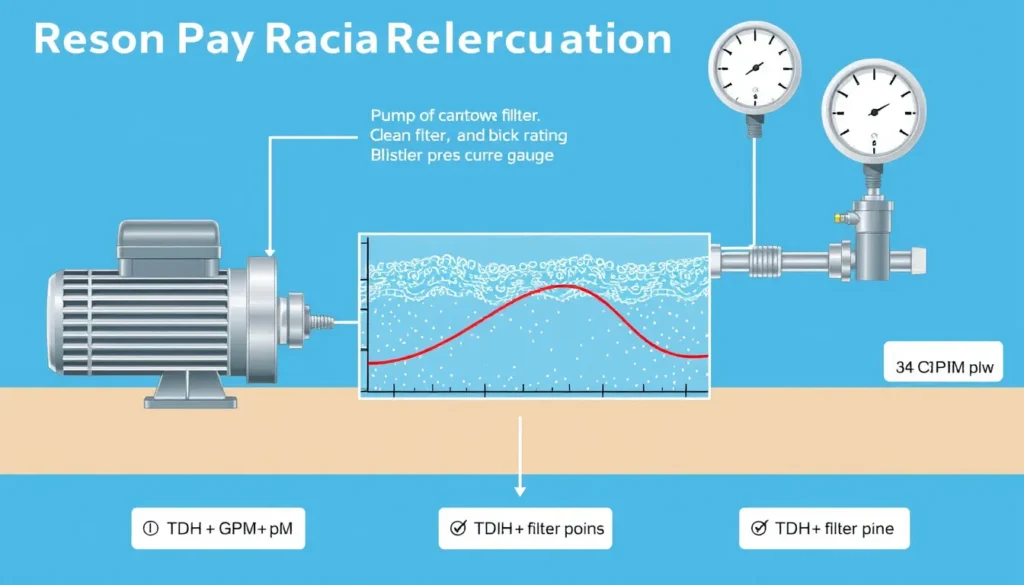
Plain-English restatement: Convert suction vacuum and filter pressure to equivalent water head, add them to estimate total dynamic head, read flow from the pump curve, then repeat after adding an allowance for a dirty filter.
Overview — What It Is and Why It Matters
This article covers how to estimate pool pump flow with clean and dirty filters in a residential or commercial recirculation system using gauge readings and manufacturer pump curves. The scope is centrifugal pool pumps paired with sand, diatomaceous earth (DE), or cartridge filters. It is an engineering estimate, not a laboratory flow measurement.
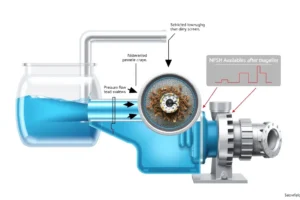
A pool pump does not produce a fixed gallon-per-minute value. It operates where its performance curve intersects the system-head curve. Total dynamic head (TDH) represents the combined resistance of suction piping, valves, fittings, the filter, heater, return piping, and elevation. When the filter is clean, resistance is lower and the operating point moves toward higher flow. As debris loads the filter, resistance rises, TDH increases, and flow decreases along the pump curve.
This distinction matters because a system can look adequate when clean and fail when dirty. If the dirty-filter flow falls below the minimum needed for turnover, heaters, sanitizers, or suction cleaners, water quality and equipment operation suffer. Conversely, if the clean-filter flow exceeds filter face-velocity limits or pipe-velocity limits, filtration efficiency drops and the system may be stressed. Oversized pumps are a common field problem because they push water through filters too quickly and waste energy.

The Method — Derivation and Variants
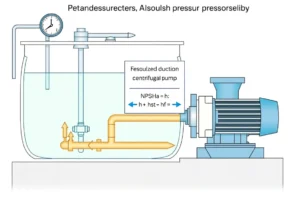
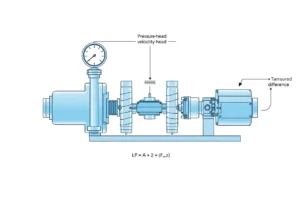
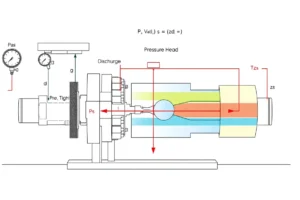
The gauge method treats measured pressure and vacuum as equivalent columns of water. In US customary units, 1 psi of pressure equals about 2.31 ft of water head, and 1 inHg of vacuum equals about 1.13 ft of water head. Therefore:
US customary: H_TDH (ft) = 1.13 × V_inHg + 2.31 × P_psi
SI using gauge units: H_TDH (m) = 0.344 × V_inHg + 0.704 × P_psi
SI using kPa: H_TDH (m) = [V_kPa + P_kPa] / 9.806
The constants convert pressure to head. In SI, 1 kPa equals about 0.10197 m of water; dividing kPa by 9.806 gives meters of water head. The gauge reading must be taken at a known pump speed and valve position. After calculating TDH, enter the pump manufacturer curve at that head and that speed to read Q. For a dirty filter, add an allowance ΔH_filter to the clean TDH, then read the new lower flow from the same curve. A published example uses a 23 ft (7.0 m) TDH change between clean and dirty filter modes; the actual value depends on filter type, loading, and system curve.
The clean-to-dirty shift can also be estimated from pressure rise: ΔH_filter (ft) ≈ 2.31 × ΔP_filter (psi). This is approximate because it treats filter loading as a discharge-side head change. The required turnover flow is checked separately:
US: Q_req (gpm) = V_pool (gal) / [T (h) × 60]
SI: Q_req (m³/h) = V_pool (m³) / T (h)
Variants include constant-speed pumps, variable-speed pumps, and flow-based controllers. A constant-speed pump follows its curve as head changes. A variable-speed pump changes its curve with speed, so RPM alone does not guarantee flow. A flow-based controller adjusts speed to hold a target flow as the filter loads, which is useful when clean and dirty TDH differ significantly.
Worked Example
US customary example. Assume a 150,000 gal pool with a 12 h turnover target. Required flow is Q_req = 150,000 / (12 × 60) = 208 gpm. A pump curve in the cited field example gives about 400 gpm at 60 ft TDH when clean and about 275 gpm at 83 ft TDH when dirty, a 23 ft TDH change. The clean condition exceeds the 208 gpm turnover requirement, and the dirty condition also remains above 208 gpm. However, the clean flow of 400 gpm may exceed filter limits: a high-rate sand filter at 15 gpm/ft² would need at least 400 / 15 = 26.7 ft² of filter area. If the installed filter is smaller, the pump speed or impeller must be reduced, or the filter enlarged. If the target were 6 h, Q_req = 150,000 / (6 × 60) = 417 gpm, and the clean flow of 400 gpm would already fall short.
SI example with the same system. Convert volume: 150,000 gal × 3.785 = 567,750 L ≈ 567.8 m³. For 12 h turnover, Q_req = 567.8 / 12 = 47.3 m³/h. Clean flow = 400 gpm × 0.2271 ≈ 90.8 m³/h; dirty flow = 275 gpm × 0.2271 ≈ 62.5 m³/h. Heads are 60 ft = 18.3 m and 83 ft = 25.3 m, so ΔH_filter ≈ 7.0 m. The dirty flow still exceeds 47.3 m³/h. At a 6 h target, Q_req = 567.8 / 6 = 94.6 m³/h, so even the clean flow of 90.8 m³/h is insufficient.
For a field gauge check, if the suction vacuum is 6 inHg and the filter pressure is 7 psi, H_TDH = 6 × 1.13 + 7 × 2.31 = 6.78 + 16.17 = 22.95 ft ≈ 23 ft. Adding a 23 ft dirty-filter allowance gives about 46 ft. Read the pump curve at 46 ft and the same speed to estimate dirty-filter flow; do not reuse the clean-filter flow.
Calculator
Use a total dynamic head calculator such as pumpcalcs.com/calculators/total-dynamic-head/ to convert gauge readings into head. Then apply the pump manufacturer performance curve for the actual pump model and speed to estimate flow. For turnover, calculate Q_req from pool volume and target hours before comparing it with clean and dirty operating points.
Reference Values & Typical Ranges
| Parameter | Typical or acceptable value | Notes and source |
|---|---|---|
| Residential turnover | 8–12 h minimum; 6–8 h for better clarity | Common industry guidance summarized by Hackett (2026) and Watt (2021). |
| Commercial turnover example | 6 h | Watt (2021) uses a 150,000 gal commercial example requiring about 416 gpm. |
| High-rate sand face velocity | 15 gpm/ft² ≈ 611 L/min/m² | Maximum filtration-rate guidance from Watt (2021, 2019). |
| DE face velocity | 1–2 gpm/ft² ≈ 41–82 L/min/m² | Watt (2021, 2019). |
| Cartridge face velocity | 0.375 gpm/ft² ≈ 15 L/min/m² | Watt (2021, 2019). |
| Clean-to-dirty TDH shift | 23 ft ≈ 7.0 m in cited example | Watt (2021); actual shift varies with filter loading. |
| Pipe velocity rule of thumb | 8 ft/s suction; 10 ft/s return | InyoPools (2026) maximum recommended velocity guidance. |
| 2-inch plumbing flow | Do not exceed about 75 gpm | Service Industry News (2025) system-limit example. |
| Field pump-curve example | 7 psi + 6 inHg ≈ 23 ft TDH; about 43 gpm at 2,200 rpm | Service Industry News (2025). |
Application Guidance
Always evaluate two operating endpoints: clean-filter maximum flow and dirty-filter minimum flow. The clean endpoint must not exceed filter face-velocity limits, pipe-velocity limits, heater limits, or manufacturer maximum flow. The dirty endpoint must still satisfy turnover and the minimum flow required by heaters, sanitizers, skimmers, and suction-side cleaners. If the same pump cannot satisfy both, use a variable-speed pump with flow control, reduce maximum speed, enlarge the filter, or revise the piping.
Field judgment is essential. Log the clean filter pressure after every backwash or cartridge cleaning. A rising pressure trend indicates loading, but the absolute pressure value is system-specific. Check valve positions, solar heater diversion, water features, and cleaner operation because each adds head and shifts the operating point. Do not assume that a pump set to a given RPM delivers a fixed flow; as the filter gets dirty, the same RPM produces less flow unless a flow controller compensates.
Backwash requirements also matter for sand and DE filters. The pump and backwash plumbing must meet the manufacturer’s backwash flow requirement, not merely the normal filtration flow. For replacement or upgrade work, measure TDH first, read the existing pump curve, then compare clean and dirty flows against filter and equipment limits before selecting a new pump or filter.
Common Mistakes, Limits & Safety Notes
- Designing only for the clean filter. This misses the lower dirty-filter flow and can cause under-turnover, poor heating, or cleaner failure.
- Designing only for the dirty filter. This can allow excessive clean-filter flow that exceeds filter face velocity or pipe velocity.
- Adding psi and inHg directly. Vacuum and pressure use different units; convert both to feet or meters of head before adding.
- Assuming RPM equals flow. A variable-speed pump at a fixed RPM loses flow as system head rises.
- Ignoring filter and pipe limits. Clean-filter flow may exceed the filter area, heater, or 8–10 ft/s pipe-velocity rule of thumb.
- Oversizing the pump. Excessive flow can reduce filtration effectiveness, waste energy, and stress equipment.
- Forgetting backwash flow. Sand and DE filters need sufficient backwash rate to clean the media bed.
- Neglecting accessory minimum flows. Heaters, suction cleaners, and sanitizing systems may require more flow than turnover alone.
- Using a dirty ΔH value without checking the curve. The 23 ft example is illustrative; actual added head depends on filter type and loading.
- Safety: isolate power before installing gauges, relieve trapped pressure, avoid deadheading the pump, and follow manufacturer limits for pressure and flow.
Limits of the method include gauge calibration error, impeller wear, trimmed impellers, inaccurate pump curves, and changing valve positions. The estimate is only as good as the measured TDH and the curve used. For critical commercial systems, verify with a temporary or permanent flow meter.
FAQ
How can I estimate pool pump flow without a flow meter?
Measure suction vacuum in inHg and filter pressure in psi at a known pump speed, then calculate TDH with H = 1.13V + 2.31P. Enter that head on the manufacturer pump curve for the same speed to read flow. Clean the filter first for a baseline, then add a dirty-filter head allowance and read the new lower flow.
What is a normal clean filter pressure?
There is no universal value. Record the baseline after cleaning or backwashing at normal pump speed. Many residential systems run roughly 10–20 psi clean, but plumbing, elevation, filter type, and pump speed change the reading. A rise of about 8–10 psi above baseline is a common cleaning trigger; follow manufacturer guidance and log readings.
How much flow is lost when the filter gets dirty?
It depends on the system curve and filter loading. A published example shifts from 400 gpm at 60 ft clean to 275 gpm at 83 ft dirty, a 125 gpm drop with 23 ft added head. The loss is larger on steep pump curves and smaller on flat curves; always read the actual pump curve.
Should I size the pump for clean or dirty filter flow?
Size for both. The system must tolerate clean-filter maximum flow without exceeding filter, pipe, or heater limits, and it must still deliver minimum turnover and equipment flow when dirty. If one pump cannot do both, reduce speed, add flow control, enlarge the filter, or change the pump.
Can filter pressure alone tell me GPM?
Not directly. Pressure is only the discharge-side head; you also need suction vacuum, elevation, and the pump curve. Filter pressure is useful for trend monitoring, but converting psi to gpm requires the complete TDH and the correct pump performance curve.
Does a variable-speed pump hold flow as the filter gets dirty?
Only if it has flow control or you manually increase speed. A fixed-speed setting follows the pump curve and loses flow as head rises. Flow-based controls adjust speed to maintain target GPM, preserving turnover as the filter loads.
How often should I clean the pool filter?
Clean or backwash when pressure rises about 8–10 psi above the clean baseline, when turnover drops below target, or per manufacturer instructions. Cartridge filters may need cleaning every few weeks in heavy use; sand and DE backwash intervals depend on loading. Log baseline pressure after each cleaning.
What is the difference between TDH and filter pressure?
Filter pressure is one component of TDH, measured at the filter in psi. TDH is total equivalent head including suction vacuum, discharge pressure, and elevation. Convert pressure and vacuum to feet or meters, add them, then use the pump curve to estimate flow.
Leave a Reply