Short Answer
Key Formula / Key Facts Box
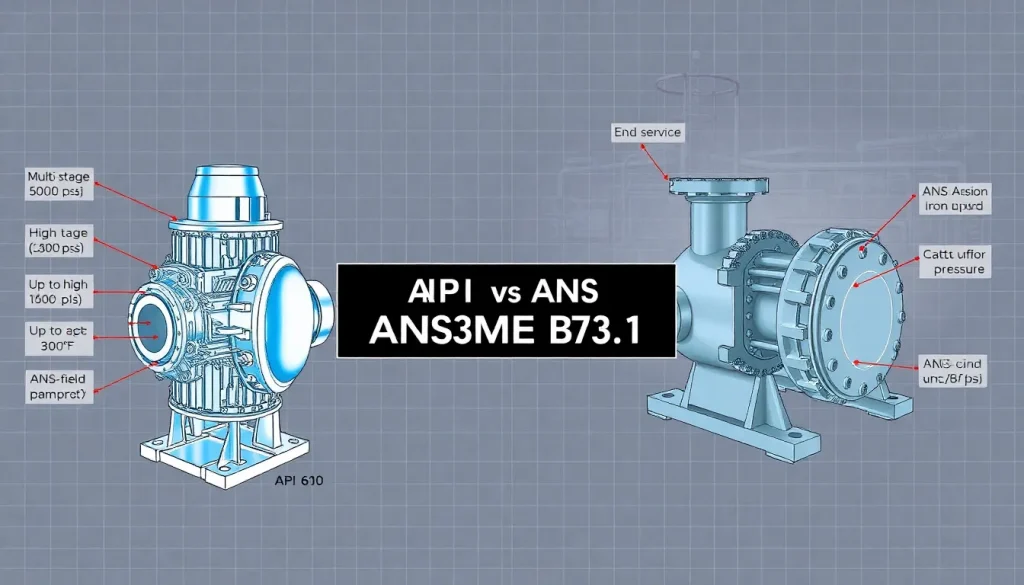
| Item | API 610 | ANSI/ASME B73.1 |
|---|---|---|
| Governing Body | American Petroleum Institute (API) | American Society of Mechanical Engineers (ASME) / American National Standards Institute (ANSI) |
| Primary Pump Types | Centrifugal pumps for the petroleum, petrochemical, and natural‑gas industries (including vertical, horizontal, and multistage) | General‑purpose centrifugal pumps for water, wastewater, and allied services (including end‑suction, split‑case, and inline) |
| Design Pressure (max) | Up to 5 000 psi (≈34.5 MPa) | Up to 300 psi (≈2.07 MPa) |
| Temperature Range | -40 °F to +600 °F (‑40 °C to +316 °C) | -20 °F to +250 °F (‑29 °C to +121 °C) |
| Design Speed | Up to 12 000 rpm (typically 1 800–6 000 rpm) | Up to 3 600 rpm (typically 1 500–3 600 rpm) |
| Typical Application Sectors | Refining, offshore platforms, gas‑processing, chemical plants | Municipal water, HVAC, cooling‑tower recirculation, light‑industrial processes |
In plain English, API 610 governs high‑pressure, high‑temperature centrifugal pumps used in oil‑and‑gas environments, while ANSI/ASME B73.1 addresses lower‑pressure, general‑purpose pumps for water‑based services.
Overview — What It Is and Why It Matters
Both API 610 and ANSI/ASME B73.1 are consensus standards that prescribe design, material, testing, and documentation requirements for centrifugal pumps. API 610 is tailored to the rigorous demands of the petroleum and petrochemical sectors, where pumps must tolerate extreme pressures, temperatures, and aggressive media. ANSI/ASME B73.1, by contrast, serves the broader water‑service market, emphasizing reliability, ease of maintenance, and cost‑effectiveness.
Choosing the correct standard is not a bureaucratic exercise; it directly influences safety margins, warranty eligibility, and regulatory compliance. Mis‑applying API 610 to a low‑pressure water pump can inflate capital cost unnecessarily, while using B73.1 for a high‑temperature refinery pump can lead to premature failure, catastrophic leaks, and environmental penalties.
The Method — Derivation and Variants
Both standards derive their design equations from the basic centrifugal pump energy equation:
ΔP = ρ·g·H_T
where ΔP is the total dynamic head expressed as pressure, ρ is fluid density, g is gravitational acceleration, and H_T is the total head in feet (or metres). API 610 expands this baseline with additional safety factors for:
- Design pressure class (DP) – a factor of 1.5 × maximum allowable working pressure (MAWP) for API‑classed pumps.
- Temperature‑dependent material strength reductions (e.g., ASME Section II material allowances).
- Vibration‑and‑bearing endurance factors derived from API 617 for auxiliary equipment.
ANSI/ASME B73.1 retains the same fundamental equation but applies a simpler pressure‑factor of 1.25 × MAWP and limits temperature corrections to the range covered by standard carbon‑steel and stainless‑steel grades.
Both standards provide US‑customary (psi, ft‑lb) and SI (MPa, m) tables. The conversion is straightforward: 1 psi ≈ 6.895 kPa, 1 ft ≈ 0.3048 m.
Worked Example
Scenario 1 – API 610 (US units)
A refinery needs a vertical multistage pump to deliver 5 000 bbl/h of 80 °F crude oil (ρ ≈ 53 lb/ft³) at a total dynamic head of 1 200 ft. The maximum system pressure is 2 200 psi.
- Convert flow to ft³/s: 5 000 bbl/h × 5.614 ft³/bbl ÷ 3 600 s ≈ 7.79 ft³/s.
- Apply API 610 pressure factor: Design pressure = 1.5 × 2 200 psi = 3 300 psi.
- Determine required impeller power (ignoring efficiency): P = ΔP·Q / (550) = (3 300 psi × 144 in²/ft²)·7.79 ft³/s ÷ 550 ≈ 6 560 hp.
- Assuming a realistic efficiency of 78 %, motor rating = 6 560 hp ÷ 0.78 ≈ 8 410 hp.
The designer would select an API 610‑certified pump with a motor in the 8 500 hp class, ensuring the material grade (e.g., API‑5L X65) meets the 2 200 psi service.
Scenario 2 – ANSI/ASME B73.1 (SI units)
A municipal water utility requires a horizontal end‑suction pump to move 2 000 m³/h of water (ρ = 1 000 kg/m³) to a reservoir 30 m higher. The system pressure does not exceed 150 kPa.
- Flow rate Q = 2 000 m³/h ÷ 3 600 s/h = 0.556 m³/s.
- Design pressure factor: 1.25 × 150 kPa = 187.5 kPa.
- Total head H_T = 30 m (ignoring friction for simplicity).
- Power required (ideal): P = ρ·g·H_T·Q = 1 000 kg/m³·9.81 m/s²·30 m·0.556 m³/s ≈ 163 kW.
- Assuming 70 % hydraulic efficiency, motor rating ≈ 163 kW ÷ 0.70 ≈ 233 kW (≈ 315 hp).
The resulting pump would be selected from the ANSI/ASME B73.1 catalog, typically a cast‑iron end‑suction model rated for 200 kPa design pressure.
Calculator
For rapid sizing, use the online pump‑head calculator: http://pumpcalcs.com/calculators/total-dynamic-head/
Reference Values & Typical Ranges
- Design pressure (API 610): 1 000 psi – 5 000 psi (7 – 34 MPa).
- Design pressure (ANSI/ASME B73.1): 50 psi – 300 psi (0.35 – 2.07 MPa).
- Maximum temperature (API 610): up to 600 °F (316 °C).
- Maximum temperature (ANSI/ASME B73.1): up to 250 °F (121 °C).
- Typical efficiency: API 610 – 70 % to 85 %; B73.1 – 60 % to 78 %.
- Speed ranges: API 610 – 1 800 to 12 000 rpm; B73.1 – 1 500 to 3 600 rpm.
Application Guidance
When deciding which standard to follow, ask:
- Is the pump handling hydrocarbon‑based, high‑temperature media? → API 610.
- Is the service water‑based, with modest pressures and temperatures? → ANSI/ASME B73.1.
- Does the project require certification for insurance or regulatory bodies (e.g., API‑certified offshore platform)? → API 610.
- Is the equipment to be supplied to a municipal utility that references ASME‑B73.1 in its procurement specs? → B73.1.
Field‑judgment adjustments include derating materials for sour service, adding extra NPSH margin for cavitation‑prone liquids, and selecting higher‑efficiency impellers when operating near the design point.
Common Mistakes, Limits & Safety Notes
- Unit confusion: Mixing psi with bar or ft³/h with m³/s leads to 10–30 % sizing errors.
- Applying the wrong pressure factor: Using the 1.5 × MAWP factor from API 610 for a B73.1 pump inflates cost; conversely, under‑factorizing an API pump compromises safety.
- Neglecting temperature‑dependent material strength: Selecting a carbon‑steel shaft rated for 300 °F in a 500 °F service violates API 610 material allowances.
- Oversimplifying head loss: Ignoring pipe friction, fittings, and inlet/outlet losses can underestimate required pump power by up to 25 %.
- Certification mismatch: Supplying a B73.1‑labeled pump for an API‑specified project can cause contract breach and insurance denial.
- Exceeding speed limits: Running a B73.1 pump above 3 600 rpm may cause excessive bearing wear and violate the standard’s dynamic balance requirements.
- Safety factor complacency: Reducing the API 610 pressure factor to save cost eliminates the built‑in 50 % safety margin that protects against pressure spikes.
FAQ
When should I use API 610 instead of ANSI/ASME B73.1?
Use API 610 when the pump will handle hydrocarbon‑based fluids, operate above 300 psi, or be installed in a refinery, offshore platform, or petrochemical plant where API certification is required by contract or regulation.
Can a pump certified to API 610 be used for water service?
Yes, an API 610 pump can serve water applications, but it may be over‑engineered and more expensive. In such cases, specifying B73.1 is usually more cost‑effective.
What are the key material differences between the two standards?
API 610 permits high‑strength alloy steels, duplex stainless, and exotic alloys for high‑temperature, sour service. B73.1 primarily references carbon‑steel (ASTM A216) and standard stainless‑steel (ASTM A351) suitable for up to 250 °F.
How does the pressure safety factor differ?
API 610 applies a design factor of 1.5 × MAWP, while ANSI/ASME B73.1 uses 1.25 × MAWP. The higher factor in API 610 provides a larger margin for pressure transients common in oil‑gas processes.
Is there a difference in testing requirements?
API 610 requires type‑testing for performance, hydrostatic burst, and endurance at elevated temperatures. B73.1 mandates hydrostatic testing and performance verification at normal temperature but has less stringent endurance testing.
Can I convert a B73.1‑certified pump to meet API 610?
Conversion is not practical; it would require redesign of the casing, impeller, shaft, and material upgrades, effectively creating a new API‑compliant pump.
What documentation is required for each standard?
API 610 demands a full design data package, material certificates, test reports, and compliance declaration. B73.1 requires a data sheet, material list, and a pressure‑test certificate.
Do both standards address cavitation?
Yes, both include NPSH requirements, but API 610 provides more detailed guidance for high‑speed, high‑head pumps where cavitation risk is greater.
Leave a Reply