
Short Answer
Key Formula / Key Facts Box
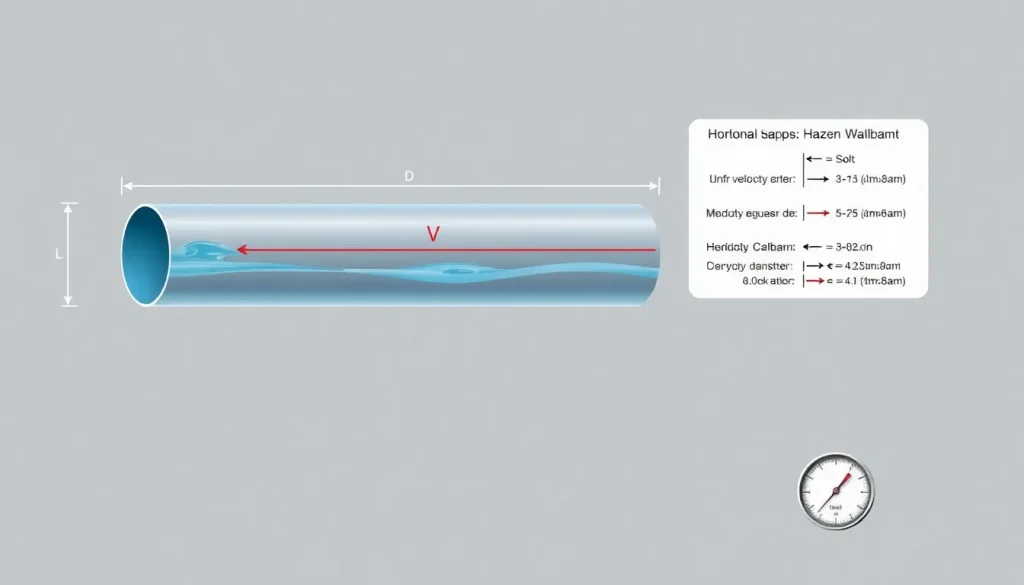
Darcy–Weisbach friction‑loss equation
h_f = f frac{L}{D} frac{V^{2}}{2g}
| Symbol | Meaning | US Unit | SI Unit |
|---|---|---|---|
| h_f | Friction head loss | ft | m |
| f | Darcy friction factor (dimensionless) | – | – |
| L | Pipe length | ft | m |
| D | Pipe internal diameter | in or ft | mm or m |
| V | Average fluid velocity | ft/s | m/s |
| g | Acceleration due to gravity | 32.174 ft/s² | 9.80665 m/s² |
In plain English: the head loss equals the friction factor multiplied by the length‑to‑diameter ratio and the kinetic‑energy term V²/2g.
Overview — What It Is and Why It Matters
Friction loss in pipe quantifies the energy that a fluid permanently dissipates as heat while flowing through a conduit. The loss appears as a drop in pressure (or head) and must be accounted for when sizing pumps, selecting pipe diameters, or predicting system performance. Under‑estimating friction can lead to insufficient pump head, cavitation, or premature motor overload; over‑estimating inflates capital cost by oversizing equipment.
The Method — Derivation and Variants
The Darcy–Weisbach equation originates from an energy‑balance applied to a differential pipe element. Starting with Bernoulli’s equation and adding a shear‑stress term τ_w = (f ρ V²)/8, integration over length L yields the familiar form shown above. Two common ways to obtain the friction factor f are:
- Moody chart (or Colebrook‑White equation) – applicable for turbulent flow in rough or smooth pipes; requires Reynolds number Re and relative roughness ε/D.
- Hazen‑Williams formula – an empirical shortcut used mainly in the United States for water at 60 °F; expressed as h_f = 10.67 L Q^{1.852} / (C^{1.852} D^{4.87}) where Q is flow rate (gpm) and C is the Hazen‑Williams coefficient.
Both US‑customary and SI versions are shown below.
| Form | Equation (US) | Equation (SI) |
|---|---|---|
| Darcy–Weisbach | h_f (ft) = f (L/D) (V²/2g) | h_f (m) = f (L/D) (V²/2g) |
| Hazen‑Williams | h_f (ft) = 4.52 L Q^{1.85} / (C^{1.85} D^{4.87}) | h_f (m) = 10.67 L Q^{1.852} / (C^{1.852} D^{4.87}) |
The Darcy–Weisbach form is universal; Hazen‑Williams is limited to water‑like liquids, temperatures 40‑75 °F, and Reynolds numbers > 10 000.
Worked Example
Example 1 – US customary units (water at 60 °F)
Design a 500 gpm water system that runs 800 ft through 4‑in schedule‑40 steel pipe (ID = 4.026 in). The pipe is new (ε ≈ 0.00015 in). Determine the friction head loss using the Darcy–Weisbach method.
- Convert flow to velocity:
Q = 500 gpm = 500 / 448.831 = 1.114 ft³/s.
Area A = π D²/4 = π (4.026 in / 12)²/4 = 0.354 ft².
V = Q/A = 1.114 / 0.354 = 3.15 ft/s. - Calculate Reynolds number (water at 60 °F, ρ = 62.4 lb/ft³, μ = 1.12 × 10⁻⁵ lb·s/ft²):
Re = (ρ V D)/μ = (62.4 × 3.15 × 0.3355)/1.12e‑5 ≈ 5.9 × 10⁵ (turbulent). - Relative roughness ε/D = 0.00015 in / 4.026 in = 3.73 × 10⁻⁵.
- Use the Colebrook‑White equation (iterative) → f ≈ 0.019.
- Apply Darcy–Weisbach:
h_f = f (L/D) (V²/2g) = 0.019 × (800 ft / 0.3355 ft) × (3.15² / (2 × 32.174)) ≈ 0.019 × 2386 × 0.154 ≈ 6.9 ft.
Result: ≈ 7 ft of friction head loss.
Example 2 – SI units (industrial oil)
A loop transports 0.12 m³/s of mineral oil (μ = 0.025 Pa·s, ρ = 870 kg/m³) through 150 m of 0.1 m‑ID carbon‑steel pipe (ε = 0.045 mm). Compute friction loss using Darcy–Weisbach.
- Velocity: V = Q / A = 0.12 / (π (0.1)²/4) = 0.12 / 0.00785 = 15.3 m/s.
- Re = ρ V D/μ = 870 × 15.3 × 0.1 / 0.025 ≈ 5.34 × 10⁵ (turbulent).
- Relative roughness ε/D = 0.045 mm / 100 mm = 4.5 × 10⁻⁴.
- Colebrook‑White gives f ≈ 0.022.
- h_f = f (L/D) (V²/2g) = 0.022 × (150/0.1) × (15.3² / (2 × 9.80665)) ≈ 0.022 × 1500 × 11.96 ≈ 395 m.
Result: ≈ 400 m of head loss, illustrating the dramatic impact of high‑viscosity liquids at high velocity.
Calculator
For quick verification, use an online friction‑loss calculator: http://pumpcalcs.com/calculators/total-dynamic-head/
Reference Values & Typical Ranges
- Absolute roughness ε (new commercial steel) ≈ 0.045 mm (0.0018 in).
- Hazen‑Williams C‑values: new cast iron ≈ 130, new PVC ≈ 150, old steel ≈ 100.
- Typical Reynolds number for water in residential pipe: 10⁴ – 10⁶ (turbulent).
- Acceptable friction‑factor range for turbulent flow in smooth pipes: 0.008 – 0.03.
- Rule of thumb: keep friction loss < 10 % of total dynamic head for efficient pump operation.
Application Guidance
When sizing a pump, add calculated friction loss to elevation head, static pressure, and any minor‑loss coefficients (K) for valves, elbows, and reducers. In long runs, consider using a larger diameter to reduce the L/D term dramatically. For high‑viscosity fluids, prefer the Darcy–Weisbach method; Hazen‑Williams will under‑predict loss. Field measurements of pressure drop can be used to back‑calculate an effective f‑value for aging pipe.
Common Mistakes, Limits & Safety Notes
- Mixing US and SI units in a single calculation – always convert before substitution.
- Using Hazen‑Williams for gases, oils, or temperatures outside 40‑75 °F – results can be off by > 30 %.
- Neglecting minor‑loss coefficients (K) for elbows, valves, and reducers.
- Assuming a constant f for all flow regimes; f varies with Re and roughness.
- Ignoring pipe aging; roughness can increase up to threefold after decades.
- Overlooking safety factors – excessive head loss may cause cavitation, vibration, and seal failure.
FAQ
Why is the Darcy–Weisbach equation preferred over Hazen‑Williams for oil pipelines?
The Darcy–Weisbach formulation accounts for fluid viscosity and density, making it accurate for any liquid, including high‑viscosity oils. Hazen‑Williams was derived empirically for water at moderate temperatures and can under‑predict loss for oils by 30 % or more.
Can I use the same friction factor for laminar and turbulent flow?
No. In laminar flow (Re < 2000) the friction factor is f = 64/Re. In turbulent flow the factor depends on roughness and Reynolds number and must be obtained from the Colebrook‑White equation or Moody chart.
How do I include fittings and valves in the friction‑loss calculation?
Each fitting has a minor‑loss coefficient K. Convert K to head loss using h_K = K V²/(2g) and add all such terms to the Darcy‑Weisbach head loss for the straight pipe.
What unit conversion factor should I use for gallons per minute to cubic feet per second?
1 gpm = 0.002228 ft³/s (or divide by 448.831). Use this factor when converting US flow rates for the velocity calculation.
Is pipe aging significant for friction loss?
Yes. Corrosion, scale, and internal deposits increase the effective roughness ε, which raises the Darcy friction factor and therefore the head loss. Periodic inspection and cleaning can restore the original performance.
When is it acceptable to neglect friction loss in a pump‑selection calculation?
Only when the pipe run is extremely short (L < 5 ft) or the diameter is very large relative to flow, resulting in a loss less than 1 % of the total dynamic head. Otherwise it must be included.
How do temperature changes affect friction loss?
Temperature alters fluid viscosity and density; higher temperature usually reduces viscosity, lowering Reynolds number and the friction factor. However, thermal expansion may change pipe diameter slightly, influencing the L/D ratio.
What safety factor should I apply to the calculated friction loss?
A common practice is to add 10‑15 % to the calculated head loss to accommodate uncertainties such as roughness variation, future scaling, and measurement errors.



Leave a Reply