Short Answer
Key Formula / Key Facts Box
Maximum Theoretical Suction Lift
hmax = (Patm – Pv) / (ρ·g)
| Symbol | Meaning | US Unit | SI Unit |
|---|---|---|---|
| Patm | Atmospheric pressure at the installation site | psi | kPa |
| Pv | Vapor pressure of the pumped liquid at operating temperature | psi | kPa |
| ρ | Liquid density | lb/ft³ | kg/m³ |
| g | Acceleration due to gravity | 32.174 ft/s² | 9.80665 m/s² |
| hmax | Maximum theoretical suction lift (vertical distance) | ft | m |
Plain English: The highest you can lift a liquid by suction equals the pressure difference between the surrounding air and the liquid’s vapor pressure, divided by the liquid’s weight per unit volume.
Overview — What It Is and Why It Matters
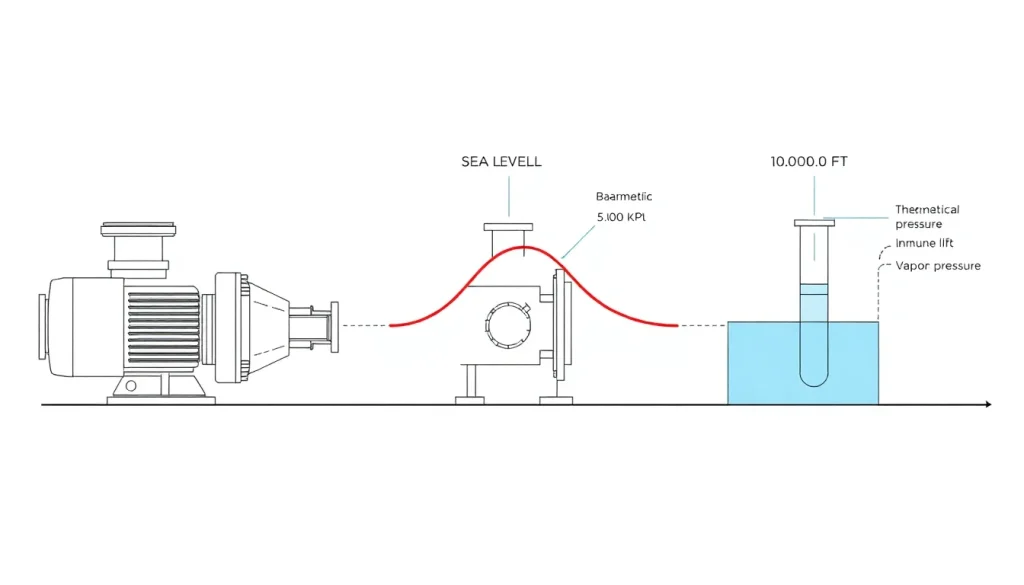
Atmospheric pressure is the force per unit area exerted by the weight of the air column above a point on Earth’s surface. At sea level the pressure is approximately 101.3 kPa (14.7 psi). As altitude increases, the air mass above the point diminishes, and the pressure drops roughly 1 inHg (3.4 kPa) for every 1,000 ft (305 m). Pumps that rely on suction—most centrifugal pumps and many positive‑displacement designs—cannot raise a liquid higher than the pressure differential that atmospheric pressure can provide.
If a pump is asked to lift water beyond this limit, the inlet pressure falls below the liquid’s vapor pressure, causing cavitation, loss of flow, and possible mechanical damage. Accurate estimation of the available suction head is therefore a prerequisite for reliable pump selection, system layout, and safety compliance.
The Method — Derivation and Variants
Starting from the basic definition of pressure,
P = F/A = ρ·g·h,
where h is the height of a static fluid column, we rearrange to express height as pressure divided by weight density:
h = P / (ρ·g).
In a suction system the pressure at the pump inlet is the ambient atmospheric pressure reduced by the vapor pressure of the liquid (because the liquid will begin to boil when its absolute pressure equals its vapor pressure). Substituting gives the governing expression shown in the Key Facts Box:
hmax = (Patm – Pv) / (ρ·g).
Two common variants appear in practice:
- US‑Customary form: hmax (ft) = (Patm (psi) – Pv (psi)) / (ρ (lb/ft³) × 0.0318). The constant 0.0318 results from converting 32.174 ft/s² to psi·ft³/lb.
- SI form: hmax (m) = (Patm (kPa) – Pv (kPa)) / (ρ (kg/m³) × 9.80665). No extra conversion factor is needed because the SI units are coherent.
The formula assumes steady, incompressible flow, negligible friction losses in the suction line, and a liquid temperature that determines Pv. When friction or elevation changes are significant, the usable suction head is reduced further by adding the friction loss (Δhf) and any static lift (Δz) to the right‑hand side of the equation.
Worked Example
Example 1 – US Customary (Water at 68 °F, sea‑level installation)
- Atmospheric pressure, Patm = 14.7 psi (standard sea‑level).
- Vapor pressure of water at 68 °F ≈ 0.36 psi.
- Density of water ≈ 62.4 lb/ft³.
- g = 32.174 ft/s² → weight factor = ρ·g = 62.4 × 32.174 = 2,006 lb/ft².
- Apply the US‑customary form: hmax = (14.7 – 0.36) / (62.4 × 0.0318) ≈ 10.3 ft.
The theoretical limit is about 10.3 ft of vertical lift. In practice, designers subtract 1–2 ft to accommodate suction‑line friction, leaving a safe suction lift of 8–9 ft.
Example 2 – SI (Water at 20 °C, installation at 2,000 m altitude)
- Standard sea‑level pressure = 101.325 kPa. At 2,000 m the pressure ≈ 79.5 kPa (ISA atmosphere).
- Vapor pressure of water at 20 °C = 2.34 kPa.
- Density of water at 20 °C = 998 kg/m³.
- g = 9.80665 m/s².
- hmax = (79.5 – 2.34) / (998 × 9.80665) ≈ 7.8 m (≈ 25.6 ft).
Thus, at 2 km altitude the maximum suction lift for water drops from ~10.3 m to ~7.8 m. Again, a design allowance of 0.5–1.0 m for friction is typical.
Calculator
For quick on‑line computation use the free tool at http://pumpcalcs.com/calculators/total-dynamic-head/. Enter atmospheric pressure, vapor pressure, fluid density, and the calculator returns hmax in the units of your choice.
Reference Values & Typical Ranges
| Altitude (ft) | Atmospheric Pressure | Typical Max Suction Lift for Water (ft) |
|---|---|---|
| 0 (sea level) | 14.7 psi (101.3 kPa) | ≈10.3 ft |
| 2,000 | 13.0 psi (89.7 kPa) | ≈9.0 ft |
| 5,000 | 10.5 psi (72.4 kPa) | ≈7.2 ft |
| 10,000 | 8.4 psi (58.0 kPa) | ≈5.5 ft |
| 15,000 | 6.8 psi (46.9 kPa) | ≈4.0 ft |
Key rules of thumb (ANSI/HI 9.6.7):
- Never design a suction lift greater than 80 % of the theoretical hmax.
- For liquids other than water, replace ρ with the actual density and adjust Pv for temperature.
- At altitudes above 10,000 ft, centrifugal pumps are rarely suitable for suction service; consider positive‑displacement or pressurized feed.
Application Guidance
When sizing a pump, start with the theoretical suction lift from the formula, then subtract:
- Static lift (vertical distance from liquid surface to pump centerline).
- Friction losses in the suction pipe (use Darcy‑Weisbach or Hazen‑Williams).
- Losses due to fittings, valves, and filters.
The remaining figure is the Net Positive Suction Head Available (NPSHA). Compare NPSHA to the pump’s NPSH Required (NPSHR) from the manufacturer’s curve; a safety margin of at least 1 m (3 ft) is recommended.
High‑altitude installations often employ:
- Short, large‑diameter suction lines to minimise friction.
- Pre‑pressurised feed tanks or booster pumps.
- Low‑vapor‑pressure liquids (e.g., glycol‑water mixtures) to raise Pv margin.
n
Common Mistakes, Limits & Safety Notes
- Ignoring altitude. Using sea‑level pressure for a mountain plant over‑estimates suction lift by up to 30 %.
- Mixing US and SI units. Substituting psi for kPa (or vice‑versa) without conversion yields nonsensical h values.
- Neglecting vapor pressure temperature dependence. Hotter liquids have higher Pv, reducing hmax.
- Assuming frictionless suction. Real piping adds 10‑30 % loss; omitting it can cause cavitation.
- Using the formula for gases. The equation applies to incompressible liquids; gases require compressible‑flow analysis.
- Exceeding 80 % of theoretical lift. Even with low friction, cavitation risk grows sharply near the limit.
- Failing to provide a safety margin. A 1‑ft (0.3 m) margin protects against pressure spikes and altitude variations.
- Over‑looking pump‑shaft sealing. Suction lift creates a pressure differential across seals; inadequate sealing can cause leakage and hazardous exposure.
FAQ
Why does a pump’s suction lift decrease at higher altitudes?
Atmospheric pressure provides the driving force for suction. As altitude rises, the air column above the pump becomes lighter, lowering P_atm. With a smaller pressure differential between the atmosphere and the liquid’s vapor pressure, the maximum vertical lift (h_max) diminishes.
Can I use a centrifugal pump to lift water more than 10 ft at sea level?
Not reliably. The theoretical limit for water at 68 °F is about 10.3 ft, but friction, fittings, and a safety margin reduce the practical limit to roughly 8–9 ft. Exceeding this often leads to cavitation.
How does fluid temperature affect suction lift?
Higher temperature raises the liquid’s vapor pressure (P_v). Because h_max = (P_atm – P_v)/(ρg), an increase in P_v directly reduces the available head, meaning hot water lifts less than cold water under the same atmospheric conditions.
Is the suction‑lift formula applicable to oil?
Yes, but replace water density and vapor pressure with those of the specific oil at operating temperature. Oils usually have lower vapor pressures, which can increase h_max, but they also have higher densities, which reduces the head per unit pressure.
What safety margin should I apply to NPSHA versus NPSHR?
Industry practice adds at least 0.3 m (1 ft) or 10 % of the NPSHR value, whichever is greater, to ensure reliable operation under transient conditions and minor pressure fluctuations.
Do suction‑lift calculations need to consider humidity?
Humidity slightly changes atmospheric pressure (by a few hundredths of a kPa) and can affect vapor pressure of water. For most engineering applications the effect is negligible, but high‑precision systems (e.g., laboratory pumps) may incorporate humidity corrections.
Can I use the same formula for gases?
No. Gases are compressible, so the simple hydrostatic relationship P = ρg h does not hold. Suction calculations for gases require compressible‑flow equations and often involve volumetric flow rates rather than static head.
Why do manufacturers quote NPSHR at a specific flow rate?
NPSHR varies with flow because higher velocities increase friction and local pressure drops inside the impeller. The quoted value is usually the minimum NPSH required to avoid cavitation at the pump’s best‑efficiency point.
Leave a Reply