Short Answer
Key Formula / Key Facts Box
Primary slurry‑pump power equation
P = (ρ_m · Q · g · H) / η
| Symbol | Meaning | US Unit | SI Unit | Plain‑English |
|---|---|---|---|---|
| ρ_m | Mixture density | lb/ft³ | kg/m³ | mass per unit volume of slurry |
| Q | Volumetric flow | ft³/s | m³/s | how much fluid moves per second |
| g | Acceleration due to gravity | 32.174 ft/s² | 9.81 m/s² | gravity that converts head to pressure |
| H | Total dynamic head | ft | m | energy height the pump must add |
| η | Overall efficiency (hydraulic × mechanical) | — | — | fraction of input power turned into fluid energy |
| k | Wear coefficient (empirical) | — | — | captures extra power loss caused by abrasive particles |
| C | Solids concentration (mass fraction) | — | — | percentage of solids in the slurry |
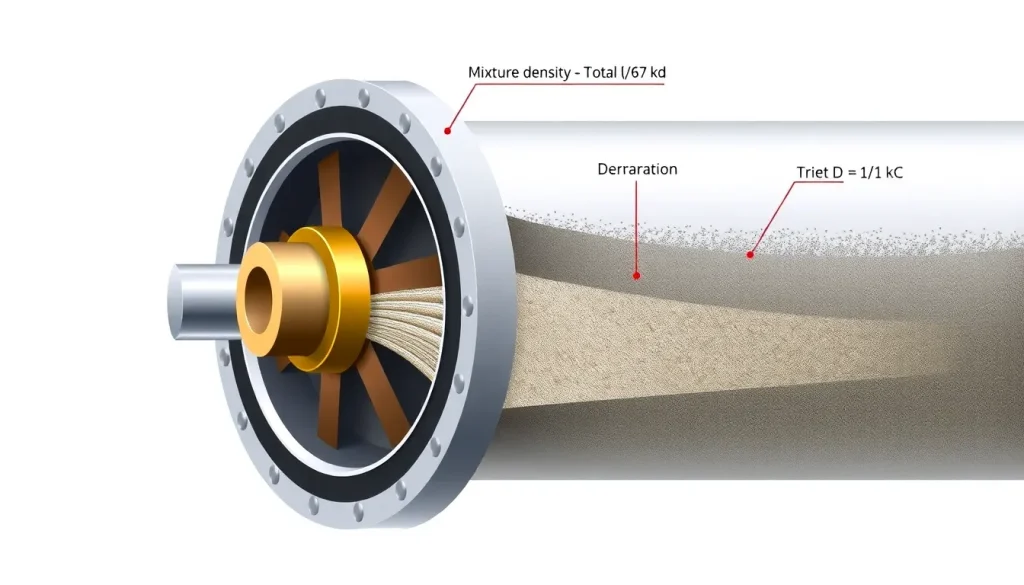
Derating factor for abrasive wear: D = 1 / (1 + k·C). Multiply the pump’s nominal power by D to obtain the allowable operating power for a given solids load.
Overview — What It Is and Why It Matters
Slurry pumps move mixtures of liquid and solid particles that are often abrasive, dense, and non‑Newtonian. The presence of solids raises the mixture density, increases frictional losses, and accelerates wear on impellers, seals, and volutes. Selecting a pump without accounting for these effects can lead to excessive power consumption, premature component failure, and costly downtime. Engineers therefore apply derating curves, wear‑rate models, and solids‑handling guidelines to ensure the pump operates within its safe envelope while delivering the required flow and head.
The Method — Derivation and Variants
Starting from the basic hydraulic power definition:
[P_h = rho_f Q g H]
where (rho_f) is the fluid density. For a slurry the effective density (rho_m) is a weighted average of liquid and solid densities:
[rho_m = (1-phi)rho_f + phirho_s]
(phi) is the volumetric solids fraction (often approximated by mass fraction (C) when densities are similar). Substituting (rho_m) into the hydraulic power expression gives the first‑principle power requirement. Real‑world pumps, however, lose additional power to abrasive erosion; an empirical wear coefficient (k) is introduced:
[P_{total}=frac{rho_m Q g H}{eta}left(1+kCright)]
Rearranging yields the derating factor D shown earlier. Two common variants exist:
- US‑customary form: (P) in hp, (Q) in ft³/s, (H) in ft, (rho) in lb/ft³, (g=32.174) ft/s².
- SI form: (P) in kW, (Q) in m³/s, (H) in m, (rho) in kg/m³, (g=9.81) m/s².
The coefficient (k) is typically derived from pump‑manufacturer test data and depends on particle hardness, size distribution, and impact velocity. For mild abrasives (e.g., sand 0.2‑0.5 mm) (k) may be 0.02–0.05; for hard quartz or metal chips it can exceed 0.15.
Worked Example
Example 1 – US Units
A mining operation needs to pump 500 gal/min of a 30 % by mass sand‑in‑water slurry (ρ_f = 62.4 lb/ft³, ρ_s = 165 lb/ft³). Required head is 150 ft, pump efficiency 70 % and the wear coefficient from the vendor is k = 0.04.
- Convert flow: 500 gal/min ÷ 7.48 = 66.9 ft³/min = 1.115 ft³/s.
- Calculate mixture density:
(C = 0.30) (mass fraction). Approximate volumetric fraction (phi approx C) because ρ_s ≈ 2.6 ρ_f.
(rho_m = (1-0.30)·62.4 + 0.30·165 = 43.68 + 49.5 = 93.2) lb/ft³. - Hydraulic power: (P_h = rho_m Q g H / η)
= 93.2·1.115·32.174·150 / 0.70 ≈ 7,080 hp. - Derating factor: D = 1 / (1 + 0.04·0.30) = 1 / 1.012 ≈ 0.988.
- Allowable motor power: 7,080 hp × 0.988 ≈ 6,995 hp (≈ 5.2 MW). Select the next standard size, e.g., 7,500 hp.
Example 2 – SI Units
A mineral processing plant must move 0.12 m³/s of a 25 % by mass iron‑oxide slurry (ρ_f = 1000 kg/m³, ρ_s = 3500 kg/m³). Required head is 45 m, η = 0.68, k = 0.06.
- Mixture density: (rho_m = (1-0.25)·1000 + 0.25·3500 = 750 + 875 = 1,625) kg/m³.
- Hydraulic power: (P_h = ρ_m Q g H / η = 1625·0.12·9.81·45 / 0.68 ≈ 1,184 kW.
- Derating factor: D = 1 / (1 + 0.06·0.25) = 1 / 1.015 ≈ 0.985.
- Allowable motor rating: 1,184 kW × 0.985 ≈ 1,166 kW (≈ 1.57 MW). Choose a 1.6 MW motor.
Calculator
For quick sizing, use an online slurry‑pump calculator such as PumpCalcs Total Dynamic Head Calculator. Input flow, head, slurry density, and wear coefficient to obtain derated power.
Reference Values & Typical Ranges
- Solids concentration (C): 0–60 % by mass for most industrial slurries; >70 % requires positive‑displacement designs.
- Particle size (D₅₀): 0.05–5 mm typical; wear sharply increases for D₅₀ > 2 mm.
- Wear coefficient (k): 0.01–0.04 for soft minerals, 0.05–0.15 for quartz‑rich, >0.15 for metallic chips.
- Derating factor (D): 0.90–1.00 for low‑abrasive streams; values below 0.80 signal the need for special wear‑resistant impellers.
- Efficiency loss due to solids: 2–8 % absolute for 10–30 % solids, up to 15 % for >50 % solids.
Application Guidance
When evaluating a slurry‑pump candidate, follow this checklist:
- Define slurry properties: density, solids mass fraction, particle size distribution, hardness (Mohs).
- Calculate mixture density using the weighted‑average formula.
- Determine required head including suction lift, pipeline friction (use the Darcy‑Weisbach equation with a slurry‑specific friction factor), and discharge pressure.
- Apply wear coefficient from the pump vendor’s abrasive‑wear curves; adjust for particle size if needed.
- Derate the pump’s nominal power and verify that the selected motor can sustain the reduced rating.
- Select wear‑resistant materials (e.g., rubber‑lined volutes, hardened steel or duplex alloys for impellers) based on the predicted abrasive impact energy.
- Plan for maintenance: install bypass lines for cleaning, schedule periodic inspection of wear plates, and consider a second‑stage pump for high‑solids recirculation.
Field‑judgment adjustments are common: if the slurry exhibits thixotropic behavior, increase the friction factor by 10–20 %; if the solids are angular, raise k by 25 %.
Common Mistakes, Limits & Safety Notes
- **Ignoring mixture density** – using only liquid density underestimates power and motor size.
- **Applying a generic k value** – wear coefficients vary with particle hardness; using a low value for hard quartz can cause catastrophic impeller erosion.
- **Mixing US and SI units** – a common source of 10–30 % error; always convert before substitution.
- **Over‑derating** – selecting a pump far larger than required raises capital cost and can cause cavitation due to low NPSH.
- **Neglecting suction head losses** – slurry pipelines have higher friction; omitting them leads to insufficient head.
- **Exceeding the wear‑limit of the material** – running a standard stainless‑steel impeller with hard abrasives beyond the recommended D (<0.90) accelerates failure.
- **Assuming steady‑state flow** – slurries often surge; transient spikes can momentarily raise head and wear rates.
- **Skipping NPSH verification** – high‑solids slurries reduce vapor pressure but increase friction; ensure NPSHr < NPSHa.
- **Improper sealing** – abrasive particles can damage mechanical seals; consider seal‑oil flushing or double‑seal arrangements.
- **Under‑estimating maintenance downtime** – plan for wear‑plate replacement; neglect leads to unplanned shutdowns.
FAQ
How do I choose the correct wear‑resistant impeller material?
Start with the slurry’s particle hardness (Mohs scale) and size. For particles <2 mm and hardness ≤6, hardened carbon steel with a tungsten carbide coating is often sufficient. For harder or larger particles, duplex stainless or high‑chrome alloys are recommended, and you should verify the manufacturer’s wear‑limit chart.
Can I use a standard centrifugal pump for a 50 % solids slurry?
Only if the pump is specifically rated for high‑solids service. At 50 % solids, the mixture density and friction losses double, and most standard impellers exceed their wear limits. A positive‑displacement pump or a specially designed high‑solids centrifugal pump is usually required.
What is the impact of particle shape on wear coefficient k?
Angular or elongated particles generate higher impact forces on the impeller, increasing k by roughly 20–30 % compared with rounded particles of the same size and hardness. Adjust the vendor‑provided k accordingly or request test data for the specific particle morphology.
Why does pump efficiency drop when solids are added?
Solids increase slurry density, raising hydraulic power for the same flow and head. They also cause additional turbulence and blockage in the impeller passages, which reduces hydraulic efficiency. The net effect is typically a 2–8 % absolute efficiency loss for 10–30 % solids.
Do I need to recalculate NPSH when pumping slurries?
Yes. Although slurries have higher density (which raises NPSHa), the increased friction losses in the suction line reduce the available head. Re‑evaluate NPSHa using the slurry‑specific friction factor and ensure it exceeds the pump’s NPSHr by at least 0.5 m (1.5 ft).
How often should wear plates be inspected?
Inspection frequency depends on the wear coefficient and operating hours. A common practice is to schedule visual checks every 500 operating hours for k > 0.08, and every 1,000 hours for lower‑k applications. Replace plates before the calculated wear depth reaches 20 % of the original thickness.


Leave a Reply