Short Answer
Key Formula / Key Facts Box
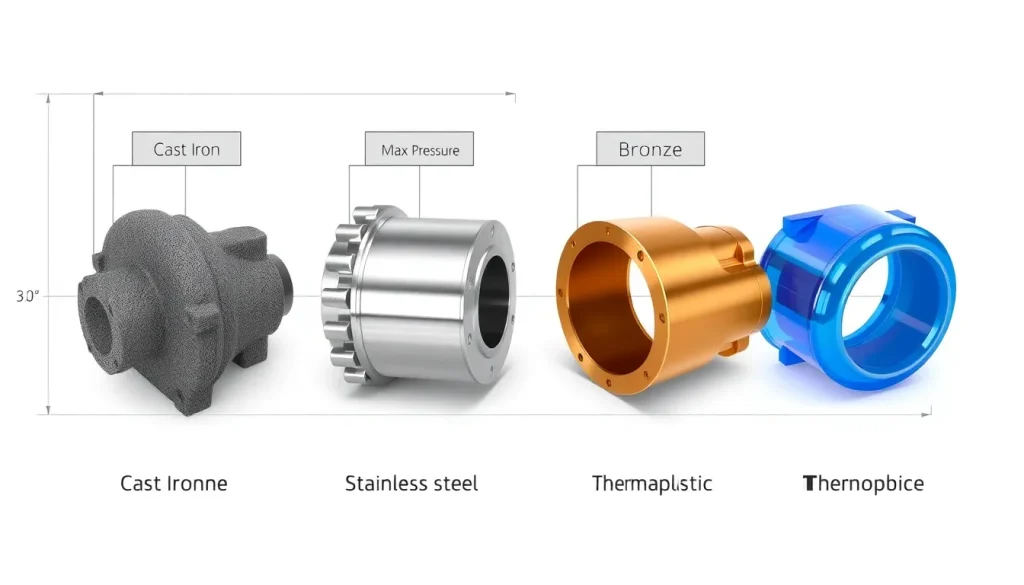
| Material | Max Pressure | Temp. Range | Corrosion Resistance | Typical Cost Index | Density |
|---|---|---|---|---|---|
| Cast Iron (Gray) | 150 psi (1.0 MPa) | -20 °F to 250 °F (‑29 °C to 121 °C) | Good in neutral water; poor in acids | 1.0 (baseline) | 490 lb/ft³ (7,850 kg/m³) |
| Stainless Steel (304/316) | 600 psi (4.1 MPa) | -40 °F to 800 °F (‑40 °C to 427 °C) | Excellent in oxidizing and many corrosive media | 3–5× cast iron | 490 lb/ft³ (7,850 kg/m³) |
| Bronze (Cu‑Sn‑Pb) | 300 psi (2.1 MPa) | -20 °F to 300 °F (‑29 °C to 149 °C) | Very good in seawater and mild acids | 2–3× cast iron | 560 lb/ft³ (8,970 kg/m³) |
| Thermoplastic (PVDF, PTFE, PPS) | 400 psi (2.8 MPa) | -40 °F to 500 °F (‑40 °C to 260 °C) | Outstanding chemical inertness; limited mechanical strength | 4–6× cast iron | 70 lb/ft³ (1,120 kg/m³) |
Overview — What It Is and Why It Matters
Pump material of construction (MOC) defines the alloy or polymer from which the pump casing, impeller, shaft, and internal seals are fabricated. The MOC directly influences mechanical strength, resistance to corrosion or erosion, temperature capability, and overall lifecycle cost. Selecting an inappropriate material can lead to premature wear, catastrophic failure, loss of efficiency, and safety hazards such as leaks or ruptures under pressure.
The Method — Derivation and Variants
There is no single governing equation for material selection; instead, engineers evaluate the material against a set of design criteria derived from the pump’s operating envelope. The decision matrix can be expressed as a weighted score:
Score = w₁·(Pₘₐₓ/Pₑₓₚ) + w₂·(Tₘₐₓ/Tₑₓₚ) + w₃·(Cᵣₑₛᵢₛₜ) – w₄·(Cost Index)
where:
| Symbol | Meaning | US Unit | SI Unit |
|---|---|---|---|
| Pₘₐₓ | Maximum allowable pressure of material | psi | MPa |
| Pₑₓₚ | Expected operating pressure | psi | MPa |
| Tₘₐₓ | Maximum temperature rating | °F | °C |
| Tₑₓₚ | Expected operating temperature | °F | °C |
| Cᵣₑₛᵢₛₜ | Qualitative corrosion‑resistance factor (1‑5) | – | – |
| Cost Index | Relative material cost (baseline = cast iron) | – | – |
Weights (w₁‑w₄) are assigned by the design engineer based on project priorities. The formula is used in both US‑customary and SI forms; only unit conversion changes the numeric values of P and T.
Worked Example
Example 1 – US Units (Cast Iron Selection)
Design a 150 gpm centrifugal pump to move water at 120 psi and 180 °F. Candidate materials: Cast iron (Pₘₐₓ = 150 psi, Tₘₐₓ = 250 °F, Cᵣₑₛᵢₛₜ = 2, Cost = 1) and Bronze (Pₘₐₓ = 300 psi, Tₘₐₓ = 300 °F, Cᵣₑₛᵢₛₜ = 4, Cost = 2.5). Assume equal weights w₁ = w₂ = w₃ = w₄ = 0.25.
- Compute ratios: Pₘₐₓ/Pₑₓₚ = 150/120 = 1.25 (cast iron), 300/120 = 2.5 (bronze).
- Temperature ratio: Tₘₐₓ/Tₑₓₚ = 250/180 = 1.39 (cast iron), 300/180 = 1.67 (bronze).
- Insert values into Score:
- Cast iron Score = 0.25·1.25 + 0.25·1.39 + 0.25·2 – 0.25·1 = 0.3125 + 0.3475 + 0.5 – 0.25 = 0.91.
- Bronze Score = 0.25·2.5 + 0.25·1.67 + 0.25·4 – 0.25·2.5 = 0.625 + 0.4175 + 1.0 – 0.625 = 1.4175.
- Higher score indicates better suitability; bronze is selected despite higher cost because its superior corrosion factor outweighs the modest price penalty.
Example 2 – SI Units (Stainless Steel Selection)
A chemical plant requires a 30 m³/h pump handling 0.5 MPa at 60 °C in a mildly acidic medium. Candidate materials: Stainless steel 316 (Pₘₐₓ = 4.1 MPa, Tₘₐₓ = 427 °C, Cᵣₑₛᵢₛₜ = 5, Cost = 4) and PVDF thermoplastic (Pₘₐₓ = 2.8 MPa, Tₘₐₓ = 260 °C, Cᵣₑₛᵢₛₜ = 5, Cost = 5). Weights: w₁ = 0.4, w₂ = 0.2, w₃ = 0.3, w₄ = 0.1.
- Pressure ratios: 4.1/0.5 = 8.2 (SS), 2.8/0.5 = 5.6 (PVDF).
- Temperature ratios: 427/60 = 7.12 (SS), 260/60 = 4.33 (PVDF).
- Scores:
- SS Score = 0.4·8.2 + 0.2·7.12 + 0.3·5 – 0.1·4 = 3.28 + 1.424 + 1.5 – 0.4 = 5.804.
- PVDF Score = 0.4·5.6 + 0.2·4.33 + 0.3·5 – 0.1·5 = 2.24 + 0.866 + 1.5 – 0.5 = 4.106.
- Stainless steel 316 provides the higher overall suitability, especially for the high pressure and temperature envelope.
Calculator
For quick scoring of material suitability, use the online tool: Pump Material Selection Calculator.
Reference Values & Typical Ranges
- Cast Iron: Pressure up to 150 psi (1 MPa); temperature −20 °F to 250 °F (‑29 °C to 121 °C); excellent wear resistance for slurry.
- Stainless Steel (304/316): Pressure 400–600 psi (2.8–4.1 MPa); temperature −40 °F to 800 °F (‑40 °C to 427 °C); preferred for corrosive chemicals, food, and pharmaceutical.
- Bronze (Cu‑Sn‑Pb): Pressure 250–300 psi (1.7–2.1 MPa); temperature −20 °F to 300 °F (‑29 °C to 149 °C); ideal for seawater, oil‑water emulsions, and low‑speed service.
- Thermoplastics (PVDF, PTFE, PPS): Pressure 300–400 psi (2.1–2.8 MPa); temperature −40 °F to 500 °F (‑40 °C to 260 °C); used when aggressive chemicals or sanitary requirements dominate.
Application Guidance
When selecting pump MOC, follow this hierarchy:
- Fluid Compatibility: Use a corrosion‑resistance chart (e.g., NACE/ASTM) to rule out materials that will be attacked.
- Mechanical Demands: Verify that the material’s allowable stress at the design temperature exceeds the combined static and dynamic loads.
- Regulatory & Sanitary Requirements: Food‑grade pumps often mandate stainless steel or approved thermoplastics.
- Cost & Lifecycle: Factor in acquisition cost, expected maintenance frequency, and downtime expenses.
- Fabrication & Repairability: Cast iron can be easily welded in the field; thermoplastics may require specialized bonding.
Field‑judgment adjustments include increasing safety factors for abrasive slurries or applying protective linings (e.g., rubber or epoxy) to extend the service life of a less‑resistant base material.
Common Mistakes, Limits & Safety Notes
- Assuming pressure rating alone guarantees safety – ignore temperature‑dependent strength reductions.
- Mixing US and SI units in the scoring equation, which yields erroneous scores.
- Neglecting the effect of high‑velocity impeller wear on bronze; bronze is prone to cavitation damage.
- Choosing thermoplastics for high‑temperature steam service – most polymers exceed their glass‑transition temperature.
- Overlooking galvanic corrosion when dissimilar metals are coupled in the pump train.
- Discounting the impact of water‑hammer transients; sudden pressure spikes can exceed static design limits.
- Failing to verify certification compliance (ANSI/ISO 2858 for pump casings, ASTM A216 for cast iron).
- Using cost index as the sole driver – low‑cost cast iron may incur higher total‑ownership cost due to corrosion.
- Ignoring weld‑metal degradation in stainless‑steel pumps; improper welding can create sensitization.
- Installing a pump without providing adequate clearance for thermal expansion, especially for thermoplastics.
FAQ
Can I use cast iron pumps for acidic chemicals?
Cast iron has limited resistance to acids; it is suitable only for neutral or mildly alkaline water. For strong acids, stainless steel or a compatible thermoplastic should be used to avoid rapid corrosion.
Why are stainless‑steel pumps more expensive than bronze?
Stainless steel contains alloying elements like chromium and molybdenum that give superior corrosion resistance and higher temperature capability. The manufacturing processes (e.g., precision welding) also add cost, making stainless steel 3–5 times pricier than cast iron.
What temperature limits apply to PVDF pump bodies?
Polyvinylidene fluoride (PVDF) maintains mechanical integrity up to about 260 °C (500 °F). Above this, polymer softening and loss of dimensional stability can cause leakage or failure.
Is cavitation a concern for bronze pumps?
Yes. Bronze is softer than steel and can be pitted by cavitation erosion, especially at high suction specific speeds. Proper NPSH design and low‑speed operation mitigate this risk.
Do I need a special lining for abrasive slurries in cast‑iron pumps?
Applying a rubber or ceramic liner extends service life by protecting the cast‑iron casing from abrasive wear, reducing maintenance intervals and preventing premature failure.
How do I convert the pressure rating from psi to MPa?
Multiply the pressure in psi by 0.0068948 to obtain MPa (e.g., 150 psi × 0.0068948 = 1.034 MPa). Use the same factor when converting material pressure limits for the scoring equation.
Can I weld stainless‑steel pump casings on site?
Stainless‑steel welding requires careful control of heat input and filler metal to avoid sensitization, which can reduce corrosion resistance. Certified welding procedures and post‑weld passivation are essential.
What are the typical maintenance intervals for bronze pumps?
Bronze pumps in water service generally require inspection every 6–12 months, with bearing lubrication and occasional impeller cleaning. In aggressive media, intervals may shorten to 3–6 months.
Leave a Reply