Short Answer
Key Formula / Key Facts Box
Cavitation Number (σ)
σ = frac{p_{in}-p_{v}}{tfrac{1}{2},rho V^{2}}
| Symbol | Meaning | US Unit | SI Unit | Plain‑English Restatement |
|---|---|---|---|---|
| σ | Cavitation number | – | – | Dimensionless measure of how close the inlet pressure is to the vapor pressure. |
| p_{in} | Inlet absolute pressure | psi | Pa | Pressure seen by the pump suction side. |
| p_{v} | Fluid vapor pressure at operating temperature | psi | Pa | Pressure at which the liquid turns to vapor. |
| ρ | Fluid density | lb/ft³ | kg/m³ | Mass per unit volume of the pumped fluid. |
| V | Characteristic velocity (usually tip speed) | ft/s | m/s | Speed of fluid relative to the impeller. |
When σ falls below a critical value (≈0.2 for water at 68°F), cavitation bubbles form and collapse, producing a distinct broadband “gravel‑like” noise.
Overview — What It Is and Why It Matters
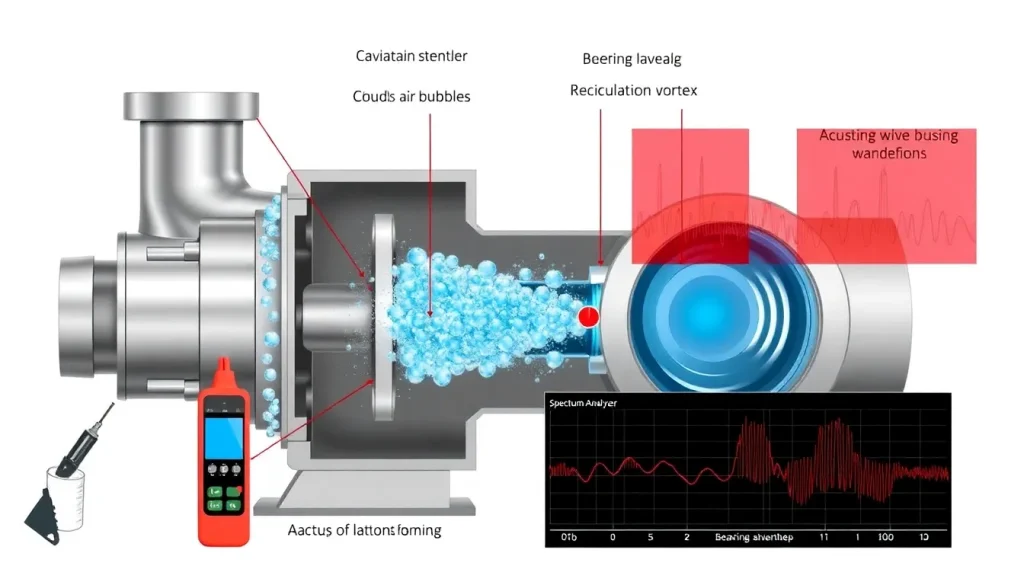
Pumps generate sound for three primary reasons: hydraulic phenomena (cavitation, air entrainment, recirculation) and mechanical sources (bearing wear, shaft mis‑alignment). Mis‑identifying the source can lead to unnecessary part replacement, unplanned downtime, or catastrophic failure. Cavitation erodes metal, air pockets reduce net positive suction head (NPSH) margin, recirculation creates low‑efficiency flow loops, and bearing defects accelerate bearing wear and can cause shaft breakage. Understanding the acoustic signature of each condition enables targeted corrective action and extends pump life.
The Method — Derivation and Variants
The foundational metric for cavitation assessment is the Cavitation Number (σ). It derives from Bernoulli’s equation applied between a reference point in the fluid and the point where vapor bubbles may form. In US customary form:
σ = (p_{in} – p_{v}) / (0.5 × ρ × V²) [psi / (psi)]
In SI units the same expression is:
σ = (p_{in} – p_{v}) / (0.5 × ρ × V²) [Pa / Pa]
Because the numerator and denominator share the same pressure units, σ remains dimensionless regardless of the unit system. Variants replace V with the impeller tip speed (U = π D N) or with the flow velocity (Q/A). Selecting the appropriate velocity aligns the σ calculation with the dominant flow region where bubbles are likely to appear.
Air‑entrainment diagnostics often use the Air Fraction (α), defined as the volumetric ratio of gas to liquid measured by a venturi or ultrasonic sensor:
α = V_{air} / (V_{air}+V_{liquid})
Recirculation intensity is expressed by a Recirculation Ratio (RR) = Q_{recirc} / Q_{design}. A high RR (>0.1) usually indicates internal flow path blockage or impeller‑blade misuse.
Mechanical bearing noise is quantified by vibration velocity (mm/s) or acceleration (g) at specific frequencies (usually 2× shaft speed for bearing mesh). The ISO 10816 standard provides severity zones for these measurements.
Worked Example
Example 1 – US Customary (Cavitation Diagnosis)
Given a 10 in. centrifugal pump delivering 1,200 gpm of water at 68°F. Suction pressure = 20 psi (absolute). Vapor pressure of water at 68°F = 0.5 psi. Impeller diameter D = 10 in., speed N = 3,600 rpm.
- Calculate tip speed: U = π D N / 12 = π × 10 in × 3,600 rpm / 12 = 9,424 ft/min = 157 ft/s.
- Water density ρ = 62.4 lb/ft³.
- σ = (20 – 0.5) / (0.5 × 62.4 × 157²) = 19.5 / (0.5 × 62.4 × 24,649) = 19.5 / 768,000 ≈ 2.5 × 10⁻⁵.
- Critical σ for water ≈ 0.2. Since σ << 0.2, cavitation is imminent. The pump will emit a high‑frequency “gravel” tone and show a drop in head.
Example 2 – SI (Air Entrainment & Bearing Vibration)
A 150 kW, 0.75 m diameter pump runs at 1,800 rpm delivering 30 m³/h of glycol (ρ = 1,150 kg/m³). A venturi sensor reads an air fraction α = 0.08 (8 %). Bearing vibration measured at 2× shaft speed (60 Hz) shows velocity = 0.9 mm/s.
- Air fraction indicates significant entrainment; typical acceptable α < 0.02 for sealed systems.
- ISO 10816 Zone B (0.71–1.8 mm/s) suggests a warning condition for bearings.
- Combined diagnosis: the pump’s suction line likely has a leak or high‑velocity restriction causing air draw‑in, while bearing wear is approaching a failure threshold.
Calculator
Use an online cavitation number calculator to verify field calculations: http://pumpcalcs.com/calculators/total-dynamic-head/
Reference Values & Typical Ranges
- Cavitation Number (σ): 0.3–0.5 – safe margin; <0.2 – high cavitation risk.
- Air Fraction (α): ≤0.02 for closed‑loop; 0.02–0.05 indicates minor entrainment; >0.05 requires corrective action.
- Recirculation Ratio (RR): ≤0.05 – normal; 0.05–0.10 – efficiency loss; >0.10 – likely blockage or impeller damage.
- Bearing Vibration Velocity (ISO 10816): Zone A ≤0.71 mm/s (healthy), Zone B 0.71–1.80 mm/s (warning), Zone C >1.80 mm/s (danger).
- Acoustic Signature Frequency: Cavitation – broadband 20 kHz–100 kHz; Air bubbles – “click” at 1–5 kHz; Bearing mesh – multiples of shaft speed (e.g., 2×N).
Application Guidance
When a pump begins to emit a new sound, follow a systematic triage:
- Listen for frequency content. Use a handheld acoustic meter or smartphone FFT app. Broadband high‑frequency hiss points to cavitation; distinct low‑frequency “pops” suggest air bubbles; tonal peaks at shaft‑speed multiples indicate bearing or impeller mesh.
- Measure suction pressure and temperature. Compute σ. If σ < 0.2, increase NPSH margin by raising suction tank, reducing flow, or installing a booster.
- Check for air entrainment. Inspect suction line for leaks, vented fittings, or high‑velocity restrictions. Install air‑bleed valves if α > 0.02.
- Evaluate recirculation. Perform a flow‑visualization (smoke or dye) inside the volute; high‑speed CFD can identify stagnant zones. Clean debris or replace worn impeller.
- Inspect bearings. Run a vibration analysis. If velocity exceeds Zone B, lubricate or replace bearings before catastrophic failure.
Adjust pump speed or trim impeller only after confirming the root cause; otherwise you may mask the symptom while the underlying damage progresses.
Common Mistakes, Limits & Safety Notes
- Mixing US and SI units in σ. The numerator and denominator must share the same pressure unit; otherwise σ is meaningless.
- Using flow velocity instead of tip speed for σ. Tip speed reflects the highest local velocity where cavitation initiates; using average flow under‑estimates risk.
- Ignoring temperature‑dependent vapor pressure. p_v changes rapidly with temperature; a 10 °F rise can double p_v for water.
- Assuming all high‑frequency noise is cavitation. Bearing wear, motor electrical noise, and flow‑induced turbulence can produce similar spectra.
- Over‑relying on a single sensor. Combine acoustic, pressure, and vibration data for a robust diagnosis.
- Neglecting safety when cavitation is severe. Imploding bubbles can cause pitting that leads to sudden rupture; wear‑protective gear and lock‑out/tag‑out procedures are mandatory.
- Applying σ to non‑Newtonian fluids without correction. Viscosity variations alter the effective density term; use modified cavitation criteria (e.g., Reynolds‑based σ).
- Exceeding the valid range of the vibration standard. ISO 10816 is calibrated for machinery up to 200 kW; larger pumps may need ISO 7919.
FAQ
Why does my pump sound like gravel when it starts to cavitate?
Cavitation creates thousands of microscopic vapor bubbles that collapse violently, emitting a broadband high‑frequency hiss often described as gravel or stone‑crushing noise. The collapse releases shock waves that couple into the pump housing, producing the characteristic sound.
Can air entrainment be mistaken for cavitation?
Yes, both generate high‑frequency noise, but air bubbles tend to produce distinct “click” or popping sounds at lower frequencies (1–5 kHz) and are usually accompanied by a measurable increase in the air fraction (α). Cavitation noise is broadband and persists even when suction pressure is stable.
What vibration frequency indicates bearing problems versus impeller mesh?
Bearing mesh frequencies appear at multiples of the shaft speed (usually 2×N for ball bearings). Impeller blade‑pass frequencies are also multiples of N but correspond to the number of blades (B×N). Comparing the spectral peaks to known gear and bearing frequencies helps isolate the source.
How much can I increase pump speed to overcome cavitation?
Increasing speed raises the tip velocity, which actually *lowers* σ (making cavitation worse). The proper remedy is to raise suction pressure, lower temperature, or reduce flow to increase the NPSH margin.
Is a small recirculation vortex always harmful?
A minor vortex can be benign, but if the recirculation ratio exceeds about 0.05, it reduces hydraulic efficiency, raises power consumption, and can exacerbate wear on the impeller and volute. Persistent recirculation often signals blockage or impeller damage.
What safety precautions should I take when cavitation is severe?
Severe cavitation can cause rapid metal pitting and eventual rupture. Implement lock‑out/tag‑out, wear protective eyewear, and avoid adjusting flow until the pump is shut down, inspected, and the NPSH margin restored.
Do I need a separate sensor for air entrainment detection?
Many modern venturi flow meters include an air‑fraction output. If not, an ultrasonic gas‑liquid discriminator can be installed on the suction line to quantify α without interrupting operation.
Why does my pump noise increase after a bearing replacement?
New bearings may be improperly lubricated, mis‑aligned, or have higher clearance, leading to increased vibration. Verify lubrication, axial alignment, and run a vibration baseline test to confirm the bearings are installed correctly.
Leave a Reply