Short Answer
Key Formula / Key Facts Box
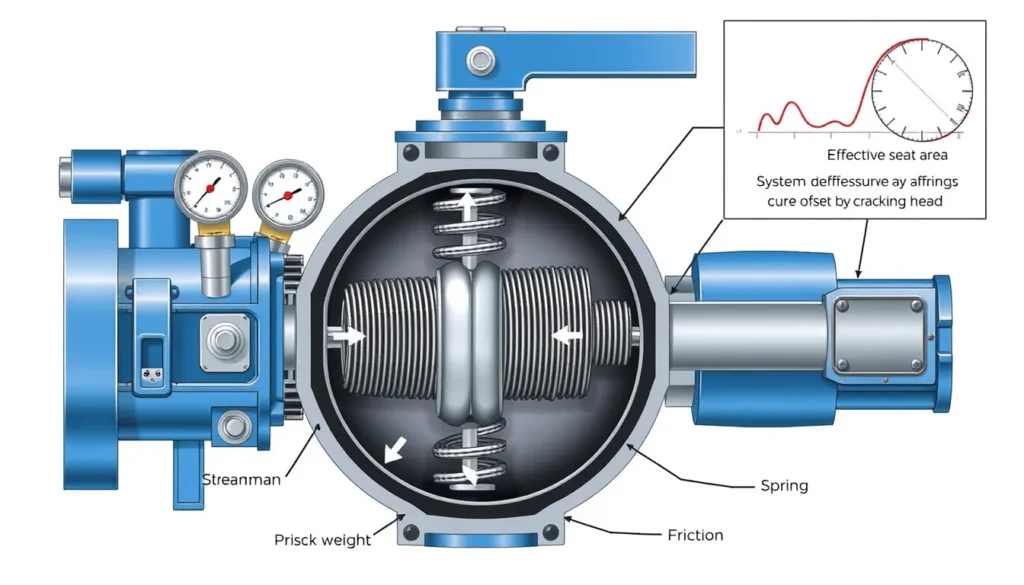
Governing relationship: ΔPcrack = (Fs + Ff + Fw) / Aeff; equivalent head: Hcrack = ΔPcrack / (ρg).
| Symbol | Meaning | US unit | SI unit |
|---|---|---|---|
| ΔPcrack | Differential pressure at which the check valve begins to open | psi | kPa or bar |
| Fs | Spring preload force | lbf | N |
| Ff | Friction and seal resistance | lbf | N |
| Fw | Equivalent weight or gravity component of the closure element | lbf | N |
| Aeff | Effective seat or disc area acted on by pressure | in2 | mm2 or m2 |
| Hcrack | Equivalent pump head required to crack the valve | ft | m |
| ρ | Fluid density | lb/ft3 | kg/m3 |
| g | Gravitational acceleration | ft/s2 | m/s2 |
Plain-English restatement: A check valve begins to open only when the upstream-to-downstream pressure difference is large enough to overcome spring, friction, and weight forces divided by the effective disc area; that differential is paid for by pump head.
Overview — What It Is and Why It Matters
In this article, check valve cracking pressure has the most common encyclopedic meaning: the minimum upstream-to-downstream differential pressure required to move the closure element from the closed position to the first open position. It is not the reseating pressure and it is not the pressure drop at the design flow rate. Those are three separate data-sheet values: cracking pressure, reseating or closing pressure, and permanent pressure loss at rated flow.
Physically, the pump must first produce enough discharge pressure to overcome the check valve spring, seal friction, and closure weight before forward flow can start. Once the valve has lifted, the pressure loss through the valve is governed by its flow coefficient and the actual flow rate. This distinction matters in pump sizing because a valve with a low cracking pressure can still have a substantial pressure drop at design flow, and a valve with a high cracking pressure can prevent a low-head pump from establishing flow at startup or at minimum speed.

Cracking pressure matters most in low-head centrifugal pumps, variable-speed drives, parallel pump installations, intermittent duty, self-priming or suction-lift systems where check valves are used, and any pump discharge system with high downstream static pressure. It also matters in spring-loaded inline check valves, where the spring is selected deliberately, and in swing checks, where gravity and orientation influence opening and closing. If the value is ignored, the pump may appear unable to prime, may operate at a shifted point on its curve, may chatter at low flow, may fail to close on trip, or may waste energy holding a valve barely open.
The Method — Derivation and Variants
The basic derivation is a static force balance at the instant of opening. The pressure force on the disc must equal or exceed the resisting forces: spring preload, friction and seal resistance, and the equivalent weight or gravity component of the closure element. Therefore, for an axial spring-loaded check valve, ΔPcrack = (Fs + Ff + Fw) / Aeff. The published cracking pressure is usually a bench value for water or air at a stated temperature; confirm it for the actual fluid, trim, and orientation.
In US customary form, pressure in psi equals force in lbf divided by area in square inches: ΔPpsi = Flbf / Ain2. The equivalent head for a liquid is Hft = 2.31 ΔPpsi / SG, where SG is specific gravity relative to water at the reference condition. In SI form, ΔPPa = FN / Am2, and Hm = ΔPPa / (ρg). A convenient water approximation is Hm ≈ 10.2 ΔPbar / SG, or Hm ≈ ΔPkPa / (9.81 SG).
Variants arise from valve type. A spring-loaded lift or inline check has a predictable axial force balance and a relatively repeatable cracking pressure. A swing check is dominated by hinge geometry, disc mass, and orientation; its equivalent closing force should be obtained from the manufacturer or from a geometry-specific torque balance, not from a simple weight divided by area guess. A dual-plate or tilting-disc check uses springs and linkage effects. In gas or steam service, density at the actual pressure and temperature must be used for head conversion, and compressibility may require manufacturer correction. In all cases, the pump-sizing check is the same: compare the minimum available differential pressure at the worst operating condition with the cracking pressure, then separately verify the full-flow pressure drop and closure behavior.
Worked Example
US customary example. A water pump discharges through a spring-loaded check valve. Assumptions: effective disc area Aeff = 3.0 in2; spring preload Fs = 9 lbf; friction and seal resistance Ff = 2 lbf; equivalent closure weight Fw = 1 lbf; water SG = 1.0. Step 1: sum the resisting forces, 9 + 2 + 1 = 12 lbf. Step 2: divide by area, ΔPcrack = 12 lbf / 3.0 in2 = 4.0 psi. Step 3: convert to head, Hcrack = 2.31 × 4.0 / 1.0 = 9.24 ft. If the pump at minimum speed produces 32 psig discharge and the downstream pressure is 26 psig, the available differential is 6 psi, so the valve opens. If downstream pressure rises to 30 psig, the available differential is only 2 psi, so the valve remains closed and no forward flow is established until the pump head rises or the downstream pressure falls.
SI example. A water system uses a spring-loaded check valve with Aeff = 500 mm2 = 0.0005 m2; Fs = 30 N; Ff = 8 N; Fw = 2 N; ρ = 1000 kg/m3; g = 9.81 m/s2. Step 1: total resisting force = 40 N. Step 2: ΔPcrack = 40 N / 0.0005 m2 = 80,000 Pa = 80 kPa = 0.80 bar. Step 3: Hcrack = 80,000 / (1000 × 9.81) = 8.15 m. If the minimum pump differential is 0.60 bar, the valve will not open; if it is 1.0 bar, the valve opens with about 0.20 bar margin. The 0.80 bar cracking pressure is roughly 8.15 m of water head, so it is significant for a low-head circulator and negligible for a high-head boiler feed pump.
Calculator
Use the Total Dynamic Head calculator to combine static head, friction loss, and valve losses when building the pump system curve. For cracking pressure itself, use the force-balance equation above or the valve manufacturer’s certified spring data; then add the cracking head only to the low-flow or startup check, and use the full-flow pressure drop at the design point.
Reference Values & Typical Ranges
Typical values should be treated as starting points, not guarantees. Cracking pressure depends on valve type, spring selection, size, trim, orientation, and fluid. Hammond Valve lists representative values near 0.25 psig for swing checks, 0.5 psig for spring-loaded lift checks, and 0.25 to 0.5 psig for silent checks. TG Valve reports that many water and oil check valves crack between about 0.5 and 5 psi, while steam service often requires higher settings. Atlantic Valves notes that inline spring-loaded check valves commonly span about 0.1 to 1 bar depending on spring preload.
| Item | Typical value or rule | Practical note |
|---|---|---|
| Swing check, clean water | About 0.25 psig in representative catalog data | Gravity and orientation strongly affect opening and closing |
| Spring-loaded lift check | About 0.5 psig in representative catalog data | More repeatable, but verify spring for actual service |
| Silent or inline check | About 0.1 to 1 bar common range | Higher spring helps closure but adds pump head |
| General water and oil service | About 0.5 to 5 psi cracking | Match to minimum flow and available differential |
| Steam service | Often higher; consult manufacturer | Density, temperature, and compressibility change the head conversion |
| Full-lift velocity in water | Often about 0.6 to 1.2 m/s; inline stability may need 1.5 to 2.0 m/s | Low velocity from oversizing can cause chatter and wear |
| Cracking versus design flow | 0.05 bar crack can coexist with 0.20 bar design-flow drop | Select on both opening and full-flow pressure loss |
Useful rules of thumb: keep cracking pressure below the minimum available differential at the lowest expected pump speed or startup condition, with a practical margin; never choose the lowest available cracking pressure without checking full-lift velocity and reseating behavior; convert pressure to head using the actual specific gravity; and remember that 1 psi is about 2.31 ft of water while 1 bar is about 10.2 m of water. A 0.3 bar cracking pressure is therefore about 3.06 m of water head, which can be a large fraction of a low-head pump’s available head.
Application Guidance
In pump sizing, build the system curve at the worst low-flow condition, not only at the best efficiency point. The pump must generate enough differential pressure to overcome downstream static pressure plus the check valve cracking threshold before flow begins. After flow starts, the operating point is set by the pump curve and the system curve, which should include the check valve’s full-flow pressure loss, strainer loss, fittings, and control-valve authority. For parallel pumps, each check valve must open reliably when its pump starts and close promptly when that pump stops; cracking pressure and spring selection influence sequencing, reverse-flow protection, and water hammer.
For variable-speed or intermittent duty, check the minimum speed condition. A valve that is fine at full speed may never open at low speed if the available differential falls below the cracking pressure. For low-head circulators, prefer a low-cracking, low-loss check valve only after confirming stable full-lift velocity and acceptable closure. For high-static-head systems, cracking pressure is usually a small part of total head, but closure speed and non-slam behavior become more important. For vertical piping, confirm orientation limits: upward flow can assist closure in many inline designs, while downward flow can be unreliable for gravity-dependent swing checks unless the manufacturer permits it. In gas, steam, slurry, or viscous service, use manufacturer-specific data and account for density, temperature, solids, and fouling.
Common Mistakes, Limits & Safety Notes
- Confusing cracking pressure with design-flow pressure drop. The first is an opening threshold; the second is a flow-dependent loss. Selecting on cracking pressure alone can produce an undersized or high-loss installation.
- Choosing the lowest available cracking pressure without checking stability. A very light spring may chatter near shutoff or low flow, damaging the seat and guide.
- Sizing by line size only. Check valve Cv, effective area, and minimum full-lift velocity matter more than matching the pipe diameter.
- Forgetting specific gravity and unit conversions. A 0.3 bar threshold is about 3.06 m of water, but the head changes for oil, brine, or process fluids.
- Ignoring minimum pump differential. If the pump cannot exceed downstream pressure plus cracking pressure at startup or minimum speed, no flow will establish.
- Oversizing the valve. Low velocity can leave the disc hovering, causing chatter, wear, and premature failure; a slightly smaller valve with adequate velocity may perform better.
- Assuming published cracking pressure is exact. Spring preload, elastomer friction, temperature, wear, and manufacturing tolerance cause scatter; use certified data and field verification where critical.
- Neglecting closure and water hammer. A valve that opens well may close slowly or slam on pump trip; check reseating pressure, closure time, and non-slam requirements.
- Using a check valve as a maintenance isolation device. It is an automatic backflow preventer, not a lockout or positive isolation point; follow safety procedures and standards such as API 594, API 598, and ASME B16.34 where applicable.
FAQ
Does check valve cracking pressure add to pump head?
Yes, but only as an opening threshold. The pump must develop enough differential pressure to overcome downstream pressure plus cracking pressure before flow starts. At design flow, use the valve’s full-flow pressure drop instead. For low-head pumps, even a few psi or a fraction of a bar can be a large share of available head.
What happens if check valve cracking pressure is too high?
The pump may not open the valve at startup, minimum speed, or low-flow conditions. Flow can be delayed or prevented, the pump may run near shutoff, and energy is wasted holding pressure against a closed valve. High cracking pressure can also shift the operating point and cause instability in low-head systems.
What happens if cracking pressure is too low?
A very low spring load can let the disc hover or chatter when flow is unstable near shutoff. That accelerates seat and guide wear and may produce noise. Low cracking pressure is not automatically better; it must be matched to minimum flow, full-lift velocity, closing behavior, and backflow risk.
Is cracking pressure the same as pressure drop?
No. Cracking pressure is the differential at which the valve first opens. Pressure drop is the loss through the valve at a specified flow rate. A valve can crack at 0.05 bar and still drop 0.20 bar at design flow, so both values belong on the data sheet and in the pump-sizing calculation.
How do I calculate check valve cracking pressure?
For a spring-loaded axial valve, sum spring preload, friction, and equivalent closure weight, then divide by effective disc area. Convert the result to head with H = delta P divided by rho g, or the shortcut H in feet equals 2.31 times pressure in psi divided by specific gravity. For swing checks, use manufacturer data or a geometry-specific torque balance rather than a simple area formula.
How does cracking pressure affect VFD or low-speed pump operation?
At reduced speed, pump differential pressure falls. If the available differential drops below the check valve cracking pressure, the valve will not open and flow will stop or remain unstable. Size the valve and spring for the minimum speed condition, then verify full-flow pressure drop and closure at maximum speed.
Does pipe size determine check valve size?
Not by itself. Line size is only a starting point. Check valve size must also satisfy Cv, pressure drop, and minimum full-lift velocity. An oversized valve can run partially open at low velocity, causing chatter and wear. Confirm performance at minimum, normal, and maximum flow using manufacturer data.
What cracking pressure is typical for water check valves?
Many water and oil check valves crack between about 0.5 and 5 psi, while representative swing, lift, and silent checks can be lower, often near 0.25 to 0.5 psig in catalog data. Inline spring-loaded valves commonly span about 0.1 to 1 bar. Always verify the actual spring and service conditions with the manufacturer.
Leave a Reply