Short Answer
Key Formula / Key Facts Box
Required Net Positive Suction Head (NPSHR)
$$text{NPSH}_R = frac{P_s – P_v}{rho g} + h_f + h_s$$
| Symbol | Meaning | US unit | SI unit | Plain‑English restatement |
|---|---|---|---|---|
| (text{NPSH}_R) | Required net positive suction head | ft | m | Head needed to keep the liquid from vaporising at the impeller inlet. |
| (P_s) | Suction absolute pressure | psi | Pa | Pressure acting on the fluid at the pump inlet. |
| (P_v) | Vapor pressure of the liquid at the operating temperature | psi | Pa | Pressure at which the liquid begins to boil. |
| (rho) | Fluid density | lb/ft³ | kg/m³ | Mass per unit volume of the pumped fluid. |
| (g) | Acceleration due to gravity | 32.174 ft/s² | 9.81 m/s² | Standard earth gravity. |
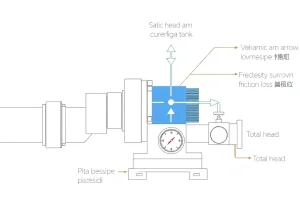
| (h_f) | Friction loss in the suction line | ft | m | Head lost because of pipe friction before the impeller. |
| (h_s) | Static head (positive if source above pump) | ft | m | Elevation difference between liquid source and pump centreline. |
Rule of thumb: Provide a safety margin of at least 2 ft (0.6 m) between NPSHR and the available NPSH (NPSHA).
Overview — What It Is and Why It Matters
Cavitation is the rapid formation and violent collapse of vapor bubbles in a liquid when the local static pressure falls below the fluid’s saturation pressure. In centrifugal pumps the most vulnerable location is the impeller eye, where the velocity head is highest and static pressure is lowest. When bubbles implode they generate micro‑jets and shock waves that erode metal, pit blade surfaces, and can damage seals, bearings, and volutes.
From an engineering perspective cavitation reduces hydraulic efficiency (typically 5–15 % loss), raises vibration and acoustic noise, and shortens service life. In extreme cases the damage can cause sudden pump shutdown, loss of process continuity, and safety hazards for personnel working near high‑speed machinery.
The Method — Derivation and Variants
The governing expression for NPSHR is derived from Bernoulli’s equation applied between a free liquid surface (or tank) and the impeller inlet, with an added term for viscous losses:
$$frac{P}{rho g}+frac{V^{2}}{2g}+z = text{constant}$$
Subtracting the kinetic‑energy term at the impeller eye and rearranging yields the required head to keep the fluid from vaporising, which is the NPSHR formula shown above.
Two common unit systems are used:
- US‑customary: $$text{NPSH}_R,text{(ft)} = frac{(P_s-P_v),text{(psi)}times144}{rho,text{(lb/ft³)},g} + h_f + h_s$$ where 144 converts psi to psf.
- SI: $$text{NPSH}_R,text{(m)} = frac{P_s-P_v}{rho g}+h_f+h_s$$ with pressure in pascals, density in kg/m³, and g in m/s².
Special variants address particular fluids or pump configurations:
- Compressible fluids: Replace vapor pressure with the saturation pressure at the operating temperature.
- High‑viscosity liquids: Multiply the friction term (h_f) by a viscosity correction factor (commonly 1.1–1.3).
- Multistage pumps: Compute NPSHR for each stage; the first stage governs because it sees the lowest inlet pressure.
Worked Example
Example 1 – US Customary Units
A 5‑in. centrifugal pump delivers 300 gpm of water from a tank positioned 6 ft above the pump centreline. The suction line is 30 ft of 4‑in. Schedule 40 steel with a friction loss of 4 ft. Water temperature is 80 °F (vapor pressure 0.5 psi). Determine the required NPSH and decide whether a pump with NPSHR=8 ft is acceptable.
- Fluid density ρ ≈ 62.4 lb/ft³.
- Static head (h_s = +6) ft (source above pump).
- Friction loss (h_f = 4) ft (given).
- Convert static head to pressure: (6,ft × ρg/144 = 6×62.4×32.174/144 ≈ 8.4) psi.
- Absolute suction pressure: atmospheric (14.7 psi) + 8.4 psi = 23.1 psi.
- Vapor pressure (P_v = 0.5) psi.
- Apply the US formula: (text{NPSH}_R = frac{23.1-0.5}{62.4×32.174/144}+4+6 ≈ 1.62+10 = 11.6) ft.
The required NPSH (11.6 ft) exceeds the pump’s rating (8 ft); cavitation is likely. Remedies include raising the liquid level, increasing pipe diameter, or selecting a pump with a lower NPSHR.
Example 2 – SI Units
The same system expressed metrically: flow 19 m³/h, suction elevation 1.8 m, friction loss 1.2 m, water temperature 27 °C (vapor pressure 0.023 MPa). Atmospheric pressure 0.1013 MPa, density 998 kg/m³.
- Static head (h_s = 1.8) m.
- Friction loss (h_f = 1.2) m.
- Atmospheric head: (P_{atm}/(ρg) = 0.1013×10^6/(998×9.81) ≈ 10.3) m.
- Vapor‑pressure head: (0.023×10^6/(998×9.81) ≈ 2.35) m.
- (text{NPSH}_R = (10.3-2.35)+1.2+1.8 ≈ 10.95) m.
If the selected pump lists NPSHR=8 m, the margin is insufficient and cavitation risk remains. The same corrective actions as in Example 1 apply.
Calculator
For rapid verification use an online NPSH calculator: NPSH Required Calculator.
Reference Values & Typical Ranges
- Water at 20 °C: Vapor pressure ≈ 0.02 psi (0.001 bar); typical NPSHR for standard centrifugal pumps 5–15 ft (1.5–4.5 m).
- Heavy oils (ρ≈850 kg/m³, viscosity ≈100 cSt): NPSHR can exceed 20 ft (6 m) because of higher friction and lower vapor pressure.
- Safety margin: NPSHA – NPSHR ≥ 2 ft (0.6 m) for continuous duty, ≥ 3 ft (0.9 m) for intermittent service.
- Cavitation index (σ): σ = NPSHA/NPSHR. Values σ ≥ 0.2 are generally safe; σ < 0.1 indicates imminent damage.
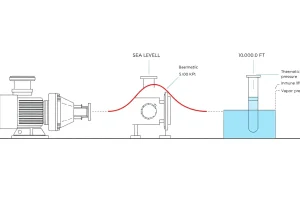
- Altitude effect: At 5,000 ft elevation atmospheric pressure drops to ~12 psi, reducing NPSHA by ~2 ft for water.
Sources: API 610, ANSI/HI 4.2‑2016, IEC 60034‑3, and Cameron (2018) “Pump Handbook”.
Application Guidance
When selecting or evaluating a pump, follow these practical steps:
- Measure suction pressure at the inlet: Use a calibrated gauge directly on the pump flange; tank‑level gauges are insufficient.
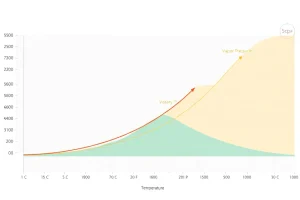
- Account for temperature rise: Fluid heating in the suction line raises vapor pressure; update (P_v) accordingly.
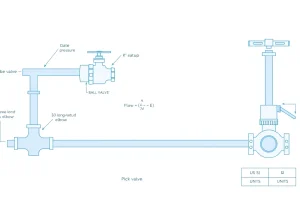
- Minimise suction‑line losses: Keep the pipe short, use the largest feasible diameter, and limit elbows, valves, and filters.
- Consider suction‑recirculation or booster pumps: These raise inlet pressure without redesigning the main pump.
- Select impeller geometry wisely: Low‑specific‑speed, large‑eye designs generate lower velocity spikes and are more cavitation‑resistant.
- Retrofit vigilance: Worn or rough impeller surfaces increase local velocity, effectively lowering NPSHA. Replace or re‑machine promptly.
Common Mistakes, Limits & Safety Notes
- Mixing unit systems: Entering psi into a formula that expects kPa produces erroneous NPSH values.
- Neglecting vapor‑pressure changes with temperature: A 20 °F rise can double water’s vapor pressure, eroding the safety margin.
- Using NPSHR instead of NPSHA for selection: The required value is a pump characteristic; the available value depends on the system.
- Omitting fittings losses: Each elbow, valve, or filter typically adds 0.1–0.3 ft (0.03–0.1 m) of head; ignoring them understates (h_f).
- Assuming only the impeller is at risk: Cavitation can also erode volutes, wear rings, seal faces, and bearing housings.
- Operating with a low cavitation index (σ): Continuous duty with σ < 0.2 accelerates wear; short bursts may be permissible with close monitoring.
- Relying solely on vibration monitoring: High‑frequency acoustic emissions often appear before vibration exceeds detection thresholds.
- Ignoring altitude effects: At high elevations atmospheric pressure drops, reducing NPSHA dramatically.
- Increasing pump speed to gain head: Higher RPM raises inlet velocity, further decreasing pressure and increasing cavitation propensity.
- Safety hazard: Imploding bubbles generate localized pressure spikes >10 MPa; ensure protective guarding and avoid contact with rotating impellers.
FAQ
What are the first physical signs that cavitation is occurring in a pump?
Early signs include a high‑pitched whining noise, a sudden rise in vibration amplitude at frequencies above 10 kHz, and a noticeable drop in flow rate while head remains constant.
How does fluid temperature influence cavitation risk?
Higher temperature raises the liquid’s vapor pressure, reducing the pressure margin between suction pressure and vapor pressure; therefore NPSH_A decreases and cavitation risk increases.
Can a booster pump eliminate cavitation in the main pump?
A booster (suction) pump can raise the inlet pressure, increasing NPSH_A. If sized correctly, it can provide the required safety margin, but the booster itself must also be protected from cavitation.
Why is cavitation more common in high‑speed pumps?
Increasing rotational speed raises the impeller’s peripheral velocity, which lowers the static pressure at the eye. The larger pressure drop makes it easier for the pressure to fall below vapor pressure.
Is it acceptable to operate a pump with NPSH_A only slightly above NPSH_R for short periods?
For intermittent duty, a margin as low as 0.5 ft may be tolerated, but continuous operation should maintain at least a 2 ft (0.6 m) margin to avoid accelerated wear.
How do altitude and atmospheric pressure affect NPSH calculations?
At higher elevations atmospheric pressure falls, directly reducing the available suction head. Designers must recalculate NPSH_A using the local barometric pressure to ensure the margin remains adequate.
What maintenance actions help prevent cavitation?
Regularly inspect and polish impeller eyes, replace worn wear rings, clean suction strainers, and verify that suction piping remains free of restrictions that could increase friction loss.
Can cavitation occur in positive‑displacement pumps?
Yes, although less common, positive‑displacement pumps can experience cavitation if the inlet pressure drops below vapor pressure, especially in high‑viscosity fluids or when suction line losses are high.
Leave a Reply