Short Answer
Key Formula / Key Facts Box
Governing practical formula, US customary units (ft): TDH ≈ Hstatic + L/10 + Nf + Hfilter + Hother
Governing practical formula, SI units (m): TDH ≈ Hstatic + 0.10L + 0.30Nf + Hfilter + Hother
| Symbol | Meaning | US unit | SI unit |
|---|---|---|---|
| TDH | Total dynamic head the pump must overcome | ft | m |
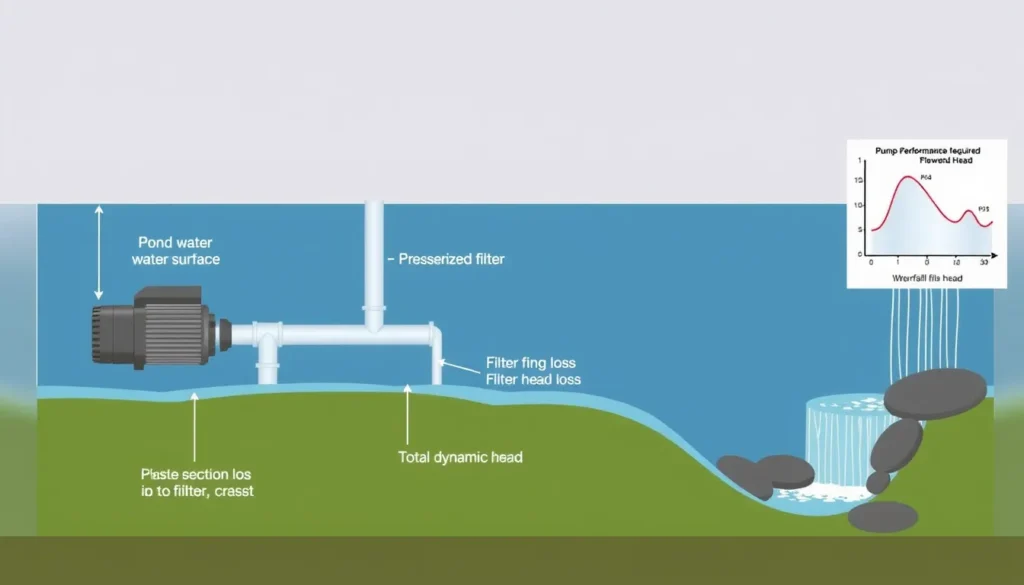
| Hstatic | Vertical rise from pond water surface to waterfall or filter discharge water level | ft | m |
| L | Total pipe or hose length in the circuit | ft | m |
| Nf | Number of equivalent fittings such as elbows, valves, tees, and adapters | count | count |
| Hfilter | Head loss across filter, UV unit, heater, check valve, or other equipment | ft | m |
| Hother | Other estimated losses, including discharge velocity and miscellaneous restrictions | ft | m |
Plain English: Add the height the water must rise to the losses caused by pipe, fittings, filter, and discharge; then select a pump that delivers the required flow at that total head.
Overview — What It Is and Why It Matters
Scope and disambiguation: in pond and water-garden practice, pump head usually means total dynamic head, or TDH. It is the equivalent height of water that a pump must overcome to move a specified flow from the pond surface to the waterfall outlet, filter return, or both. It is not the same as the maximum head printed on a pump nameplate, which is the shutoff head at zero flow. TDH combines static head, friction head from pipe and fittings, and equipment head from filters, UV clarifiers, check valves, and discharge hardware.

Physically, a pump adds energy to water. Some of that energy raises the water to a higher elevation; some is consumed by turbulence and viscous friction in the pipe, fittings, filter media, and valves. In a pond system, the pump must also provide enough residual energy to produce the desired waterfall appearance and turnover through the filter. If head is underestimated, the selected pump may deliver far less flow than expected, the waterfall may look weak, and the filter may not receive its design turnover. If head is overestimated, the pump may be oversized, noisy, energy-hungry, and prone to bypassing filter media or overwhelming a small waterfall.
Estimating pond pump head is therefore a system-design task, not merely a pump-shopping task. The correct selection point is the flow required by the waterfall and filtration system at the estimated operating head. The estimate should be checked against the manufacturer pump performance curve, because a pump that delivers 3,000 GPH at zero head may deliver only half that flow at 10 or 15 ft of head.
The Method — Derivation and Variants
The formal basis is the steady-flow energy equation for water. For a pump taking water from an open pond and discharging to an open waterfall or filter outlet, the required pump head can be written as TDH = Δz + (p2 – p1)/γ + (v22 – v12)/(2g) + hL. Here Δz is the elevation difference, p is pressure, γ is specific weight, v is velocity, g is gravitational acceleration, and hL is total head loss. When both ends are open to atmosphere and the pond surface velocity is negligible, the pressure terms cancel and TDH is approximately the static rise plus discharge velocity head plus all friction and equipment losses.
The friction term has two parts. Major loss in straight pipe can be calculated with Darcy-Weisbach as hf = f(L/D)(v2/2g), or with Hazen-Williams tables for water at normal temperatures. Minor loss from fittings and valves is hm = ΣK(v2/2g), where K depends on the fitting type and size. Equipment loss, such as a pressurized filter, UV unit, or check valve, is usually taken from manufacturer data or estimated from field experience. Because these detailed calculations require flow rate, internal diameter, pipe material, and fitting K values, many pond designers use a simplified field method for preliminary sizing.
The common simplified method adds about 1 ft of head for every 10 ft of pipe and about 1 ft of head for each fitting, then adds static lift and filter or equipment head. In SI units the same rule is about 0.30 m per 3.05 m of pipe and about 0.30 m per fitting. These constants are empirical allowances, not universal physical constants. They work reasonably for modest flexible-pipe pond systems at typical water-garden flows, but they can underestimate loss when pipe is small, flow is high, the run is long, or many restrictive fittings are used.
| Form | Expression | When it applies |
|---|---|---|
| US customary simplified | TDHft ≈ Δzft + Lft/10 + Nf(1 ft) + Hfilter,ft + Hother,ft | Preliminary sizing for short flexible-pipe pond systems with moderate flow |
| SI simplified | TDHm ≈ Δzm + 0.10Lm + 0.30Nf + Hfilter,m + Hother,m | Same preliminary estimate using metric dimensions |
| Detailed energy method | TDH = Δz + hf + hm + hequipment + hdischarge | Long runs, rigid PVC, high flow, undersized pipe, multiple filters, or professional design |
Worked Example
US customary example. A pond has a 24 in wide waterfall. Using a common ecosystem baseline of 125 GPH per inch of width gives a target flow of 24 × 125 = 3,000 GPH. The waterfall crest is 4 ft above the pond water surface. The pipe run is 20 ft of 1.5 in flexible PVC with two 90 degree elbows. A pressurized filter adds an estimated 6 ft of head when clean. Assume discharge velocity head is small and is covered by the fitting and miscellaneous allowance.
Step 1, static head: Hstatic = 4 ft. Step 2, pipe friction: L/10 = 20/10 = 2 ft. Step 3, fittings: Nf = 2, so 2 × 1 = 2 ft. Step 4, filter: Hfilter = 6 ft. Add the terms: TDH ≈ 4 + 2 + 2 + 6 = 14 ft. The pump must therefore be selected to deliver about 3,000 GPH at 14 ft of head, not 3,000 GPH at zero head. If the filter were a non-pressurized waterfall filter with negligible measurable head, the estimate would be about 8 ft and the pump selection would change substantially.
SI example. The same system in metric units has a 1.22 m vertical lift, 6.10 m of pipe, two fittings, and a filter head of 1.83 m. Use TDH ≈ 1.22 + 0.10(6.10) + 0.30(2) + 1.83. The terms are 1.22 m static, 0.61 m pipe friction, 0.60 m fittings, and 1.83 m filter, giving TDH ≈ 4.26 m. As a check, 14 ft × 0.3048 = 4.27 m, so the US and SI estimates agree within rounding. If the filter becomes dirty and its loss rises to 10 ft, the US estimate becomes 18 ft, and the pump must be checked at that higher head.
Calculator
For a preliminary check, use an online Total Dynamic Head Calculator. Enter the design flow rate, static lift, pipe length and diameter, fitting count, and filter or equipment losses. Treat the output as an estimate and confirm the final selection on the pump manufacturer performance curve. Manufacturer-specific pond calculators can also be useful when they use the same pipe and filter assumptions as the installed system.
Reference Values & Typical Ranges
| Quantity | Typical value or rule | Practical note | Source |
|---|---|---|---|
| Static head | Measure from pond water surface to the highest discharge water level | Use vertical elevation, not total pipe length | Aquascape Knowledge Base |
| Pipe friction allowance | About 1 ft per 10 ft of pipe, or 0.30 m per 3.05 m | Simplified field rule; may underestimate small pipe or high flow | Aquascape Knowledge Base; Aquascape Pump Selection Guide |
| Fitting allowance | About 1 ft per fitting, or 0.30 m per fitting | Valves, tees, and restrictive adapters can exceed this allowance | Aquascape Knowledge Base |
| Pressurized filter | About 5 to 10 ft, or 1.5 to 3.0 m | Use the dirty-filter value for design margin | Everything-Ponds Head Pressure Wizard |
| Waterfall filter | Often negligible measurable head | Use manufacturer data if available | Everything-Ponds Head Pressure Wizard |
| Waterfall flow | 50 GPH per inch gentle, 100 GPH per inch average, 125 to 200 GPH per inch strong | A 24 in waterfall at 125 GPH per inch needs about 3,000 GPH | Conservation Technology; Aquascape Pump Selection Guide |
| Pond turnover | At least one pond volume per hour for ecosystem ponds | Choose the greater of filtration flow and waterfall flow | Aquascape Pump Selection Guide |
| Simple-design friction target | Keep friction head below about 2 ft where practical | Choose larger pipe if friction exceeds this target | Conservation Technology |
Application Guidance
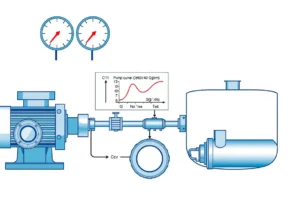
In real pond systems, head and flow are coupled. A centrifugal pond pump produces its highest flow at low head and its lowest flow at shutoff head. The operating point is where the pump curve intersects the system curve. That is why the estimate must be made at the desired flow rate. A pump should be selected so the required flow occurs near the middle or best-efficiency region of its curve, not at the extreme left near shutoff or at the extreme right near runout. Operating near shutoff can cause overheating and poor reliability; operating near runout can overload some motors and reduce filter effectiveness.
Filters change the system curve over time. A clean pressurized filter may add 5 ft of head, but a loaded filter may add 10 ft or more. Design for the dirty condition, or provide enough pump margin and a maintenance schedule to keep flow above the minimum. Waterfall filters, by contrast, often add little measurable head because they discharge freely, but their inlet piping, weir, and media can still create losses. UV clarifiers, heaters, check valves, and small-diameter spray fittings should be counted as equipment losses rather than ignored.
Field judgment should focus on reducing unnecessary loss. Use larger pipe where possible, minimize elbows, use long-radius sweeps instead of tight elbows, keep suction screens clean, and avoid collapsing flexible hose. For external pumps, add suction lift and suction-line friction to the head estimate; for submersible pumps, suction lift is avoided but the pump still sees losses from its screen and volute. Balance multiple outlets with valves, and remember that throttling a valve increases head and reduces flow. A valve can trim flow for tuning, but it should not be used to compensate for badly undersized pipe.
Common Mistakes, Limits & Safety Notes
- Using the pump maximum head as the design head. Maximum head is the shutoff point at zero flow and is not the operating point.
- Using zero-head maximum flow as the expected flow. A pump rated at 3,000 GPH at 0 ft may deliver much less at 10 to 15 ft.
- Forgetting filter, UV, check-valve, heater, and spray-head losses. These can add several feet of head.
- Measuring only horizontal pipe length while ignoring vertical lift, or measuring pipe length instead of vertical elevation for static head.
- Mixing units, such as GPH with GPM, feet with meters, or inches with millimeters, without conversion.
- Applying the 1 ft per 10 ft rule to long runs, small pipe, or high flow where friction rises steeply.
- Treating every fitting as exactly 1 ft when large valves, tees, and restrictive adapters may differ significantly.
- Designing for a clean filter only. A dirty filter raises head and lowers flow, sometimes enough to starve the waterfall.
- Ignoring the suction side of external pumps, including lift, pipe friction, and clogged strainers.
- Safety consequences include electrical shock near water, drowning risk, pump tip-over, hose failure, and backflow. Use GFCI protection, secure equipment, follow manufacturer instructions, and provide freeze or dry-run protection where required.
FAQ
What is total dynamic head on a pond pump?
Total dynamic head is the total equivalent height a pump must overcome to move water at a required flow. It includes vertical lift from the pond surface to the discharge, friction loss in pipe and fittings, and losses through filters or other equipment. It is the value used with a pump performance curve to select an operating point.
How do I calculate head height for a waterfall?
Measure the vertical distance from the pond water surface to the waterfall crest or discharge water level. Add an allowance for pipe friction, about 1 ft per 10 ft of pipe, plus about 1 ft per fitting, and add any filter or equipment head. Use a detailed friction calculation for long runs, small pipe, or high flow.
Does a filter add head pressure?
Yes, most filters add head pressure. A pressurized filter commonly adds about 5 to 10 ft depending on media and how dirty it is. Waterfall filters often add little measurable head, but their inlet piping and media can still create some loss. Use manufacturer data or field measurements when available.
Is 1 foot per 10 feet of pipe accurate enough?
It is a reasonable preliminary rule for short flexible-pipe pond systems at moderate flow, but it is not exact. Friction rises with flow rate and falls with larger pipe diameter. Small pipe, long runs, many fittings, and high flow can make actual head much higher, so use a detailed calculator or table for those cases.
Should I size a pump by gallons per hour or by head?
You need both. First determine the required flow from pond turnover and waterfall width. Then estimate the total dynamic head at that flow. Select a pump whose performance curve delivers the required flow at the estimated head, not a pump chosen only by its maximum gallons-per-hour rating.
What size pipe reduces head loss?
Larger pipe generally reduces friction head, but it must match pump connections and flow velocity. Many pond designs try to keep friction head below about 2 ft in simple systems. If the simplified estimate shows excessive friction, increasing pipe diameter or reducing fittings is usually more effective than buying a larger pump.
How much flow do I need for a waterfall?
A common baseline is about 125 GPH per inch of waterfall width for an ecosystem pond, with 50 GPH per inch giving a gentle flow and 200 GPH per inch giving a strong flow. For a 24 in wide waterfall, that baseline is about 3,000 GPH. Verify against the filter turnover requirement.
Can I use a pump with more head than I need?
A pump with excess head capability may be throttled or trimmed, but oversizing can cause noise, energy waste, filter bypass, and excessive flow. It is usually better to choose a pump near the required operating point and use valves or adjustable speed controls only for tuning. Always check the pump curve at the actual system head.
How do I account for fittings in a head estimate?
In a simplified estimate, add about 1 ft of head per fitting, or 0.30 m per fitting. This covers elbows, valves, tees, and adapters approximately. For a more accurate result, use equivalent-length tables or K-values for each fitting, especially when valves, tight elbows, or many fittings are present.
What if my pond pump is above water level?
For an external pump above water level, add the suction lift from the pond surface to the pump inlet and include suction-pipe friction losses. These add to the total head. A submersible pump avoids suction lift, but its intake screen and volute still create losses and must be kept clean.
Leave a Reply