
Short Answer
Key Formula / Key Facts Box
Governing relations: Pshaft = ρgQH/ηp; Ev = Pshaft/Qhourly; for homologous points Q∝N or D, H∝N² or D², and P∝N³ or D³ approximately.
| Symbol | Meaning | US unit | SI unit |
|---|---|---|---|
| Q | volumetric flow | gpm | m³/s or L/s |
| H | head | ft | m |
| ηp | pump efficiency | decimal | decimal |
| Pshaft | shaft power | hp | kW |
| Ev | shaft energy per delivered volume | kWh/1000 gal | kWh/m³ |
Plain English: Energy per delivered volume is shaft power divided by flow rate; reducing head with a VFD or trim saves energy only when the system actually needs less head.
Overview — What It Is and Why It Matters
VFD vs impeller trim vs throttling: a worked energy comparison is a method for evaluating three common ways to make an oversized or fixed-speed centrifugal pump meet a lower flow. Here, VFD means an electronic variable-frequency drive controlling an AC motor; impeller trim means machining the impeller to a smaller diameter; throttling means adding discharge-valve resistance. The scope is steady, continuous-duty centrifugal pump energy use with water-like liquids. Positive-displacement pumps, highly viscous fluids, and transient startup cases require different treatment.
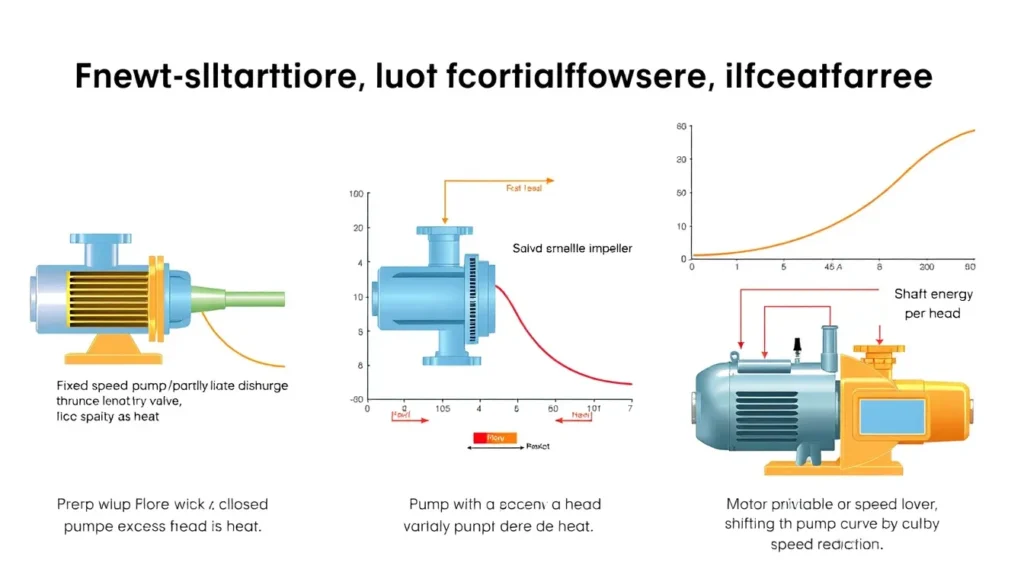
Throttling keeps the pump running at fixed speed and forces the operating point up the pump curve by adding system resistance. The pump generates more head than the process needs, and the valve converts the excess head into heat. Impeller trimming lowers the entire pump curve by reducing tip speed, while a VFD lowers the curve by reducing speed. Both can remove excess head instead of burning it in a valve, but they differ in flexibility, efficiency correction, capital cost, and mechanical limits.

This matters because pump energy is often dominated by a small number of large, long-running machines. A valve that looks inexpensive can consume excess head every hour for years. A VFD that looks efficient can disappoint in a high-static-head system where speed turndown is limited. A trimmed impeller may be the lowest-energy fixed-duty solution, but it is permanent and can reduce efficiency or NPSH margin if the trim is too large. The correct comparison uses actual pump curves, system curves, motor and drive efficiencies, annual hours, and lifecycle costs.
The Method — Derivation and Variants
The operating point is where the pump head-capacity curve intersects the system curve. A simple system curve is Hsys = Hstatic + KQ², where Hstatic is the fixed lift or pressure head and KQ² represents friction and fittings. Throttling adds a valve loss Hvalve = KvQ², so the fixed-speed pump must supply Hsys plus Hvalve. Trimming and speed control change the pump curve instead of adding a loss.
For clean water, shaft power follows Pshaft = ρgQH/ηp. In US customary form, Php = QgpmHftSG/(3960ηp), where SG is specific gravity relative to water and 3960 contains unit conversions and water density. In SI form, PkW = ρQm³/sgHm/(1000ηp), or PkW = ρQm³/hgHm/(3.6×10⁶ηp). For a convenient L/s form with water density near 1000 kg/m³, PkW ≈ 0.00981QL/sHm/ηp.
| Quantity | US customary form | SI form |
|---|---|---|
| Shaft power | Php = QH SG/(3960ηp) | PkW = ρgQH/(1000ηp) |
| Energy per delivered volume | Ev = PkW/(0.06Qgpm) kWh/1000 gal | Ev = PkW/Qm³/h kWh/m³ |
| Affinity laws | Q∝N or D; H∝N² or D²; P∝N³ or D³ | Q∝N or D; H∝N² or D²; P∝N³ or D³ |
The affinity laws are exact for geometrically similar operating points with speed changes, and approximate for small impeller trims. For real trims, manufacturers apply correction factors because flow, head, efficiency, and NPSH do not scale perfectly. For VFDs, the cubic power relation applies to homologous pump points, not directly to electrical input. Static head, pump efficiency away from the best efficiency point, motor efficiency, drive efficiency, harmonics, filters, and cooling all affect actual electrical savings.
Worked Example
Example 1 — SI metric treatment duty. A pump must deliver 12 L/s into a system requiring 23.01 m at that flow. An unrestricted 160 mm impeller would run at about 13.17 L/s and 23.60 m. Compare throttling, trimming, and VFD control. Assume water, SG = 1.0, motor efficiency 88%, VFD efficiency 97%, 300 m³/day, and electricity at A$0.30/kWh. The illustrative pump data follow a published comparison [1].
For the throttled case, the valve adds 2.35 m. The pump operates at 12 L/s and 25.36 m with pump efficiency 73.6%. Shaft power is P = 0.00981 × 12 × 25.36 / 0.736 = 4.05 kW. Flow is 12 × 3.6 = 43.2 m³/h, so shaft energy is 4.05 / 43.2 = 0.0937 kWh/m³. Including motor efficiency, annual energy is 0.0937 × 109,500 / 0.88 = 11,660 kWh, and annual cost is A$3,499.
For the trimmed impeller, the curve is lowered to pass through 12 L/s at 23.01 m. Efficiency is taken as 73.9%. Shaft power is P = 0.00981 × 12 × 23.01 / 0.739 = 3.66 kW, giving 3.66 / 43.2 = 0.0847 kWh/m³. Annual energy is 0.0847 × 109,500 / 0.88 = 10,540 kWh, and annual cost is A$3,162. For the VFD at 96.5% speed, the hydraulic duty is the same as the trim, but drive losses apply: 0.0847 / 0.97 = 0.0873 kWh/m³. Annual cost is about A$3,260. In this case, trim uses the least energy for fixed duty; VFD is close and adjustable; throttling costs the most.
Example 2 — US customary units. A pump delivers 500 gpm at 120 ft of head with SG = 1.0 and pump efficiency 70%. Shaft power is P = 500 × 120 × 1.0 / (3960 × 0.70) = 21.6 hp, or 16.1 kW. Shaft energy per 1000 gal is 16.1 / (0.06 × 500) = 0.537 kWh/1000 gal. In SI, 500 gpm = 31.55 L/s and 120 ft = 36.58 m; P = 0.00981 × 31.55 × 36.58 / 0.70 = 16.1 kW. The two unit systems agree. If motor efficiency is 92% and VFD efficiency is 97%, electrical input at this duty is 16.1 / 0.92 = 17.5 kW without the VFD and 17.5 / 0.97 = 18.0 kW with the VFD at the same hydraulic point; savings must come from reducing speed at lower-flow duties, not from adding a drive alone.
Calculator
Use the PumpCalcs total dynamic head calculator at http://pumpcalcs.com/calculators/total-dynamic-head/ to estimate system head from static lift, friction, and fittings. Then compare pump power at each required duty using Pshaft = ρgQH/ηp and apply motor and drive efficiencies separately. For speed changes, pair the system curve with the affinity laws rather than assuming flow falls linearly with speed.
Reference Values & Typical Ranges
| Parameter or rule | Typical range or guidance | Source note |
|---|---|---|
| Centrifugal pump BEP efficiency | About 50–85% for clean water, depending on specific speed, size, and type | Use manufacturer curve; see [2], [4] |
| VFD efficiency | About 95–98% at normal load; lower at light load; include motor, filter, and cooling losses | Screening values; see [1], [4] |
| Motor efficiency | Often about 85–95% for industrial induction motors; verify nameplate and load point | Use motor data; see [4] |
| Impeller trim | Small trims may follow affinity laws approximately; larger trims need OEM correction and approval | Do not exceed manufacturer limits; see [2] |
| Throttling penalty | Valve consumes excess head; a 10% flow cut can raise shaft energy by several percent in low-static systems | Case-specific; see [1], [5] |
| Bypass penalty | Usually high because recirculated flow is still pumped; mainly for minimum-flow protection | See [1], [5] |
| High static head | Limits VFD turndown and energy savings; minimum speed may be needed to overcome static lift | See [4], [5] |
| Minimum continuous flow | Respect pump manufacturer minimum flow; may require bypass or recirculation protection | See [4], [5] |
These are screening values, not guarantees. The final comparison should use the supplied pump curve at the actual impeller diameter, the tested VFD and motor efficiency at the actual speed and load, and the installed system curve. A useful rule of thumb is that VFD savings are largest in friction-dominated systems with long operating hours and significant flow variation; trim is strongest for a fixed reduced duty; throttling is best reserved for occasional control or where simplicity dominates.
Application Guidance
In real systems, first separate static head from friction. If most head is static lift, reducing speed quickly reaches a point where the pump can no longer lift the fluid, so VFD energy savings are limited. If most head is friction, reducing speed lowers both flow and head substantially, and the cubic affinity relation can produce large savings at lower flows. Throttling behaves like adding friction at fixed speed, so it can always reduce flow, but it does so by wasting head.
For a fixed, known reduced duty with many operating hours, impeller trim can be the most direct energy measure. It has no drive losses and no controls, but it is permanent. Confirm the manufacturer’s minimum diameter, efficiency correction, NPSH margin, shaft stress, and minimum flow. For variable duty, frequent start-stop, or uncertain future demand, a VFD usually offers better flexibility. Include the cost of electrical work, harmonic mitigation, cooling, controls, and maintenance. For occasional flow reduction, a throttling valve may still be acceptable because its capital cost is low and its operating hours at the throttled condition may be short.
Common Mistakes, Limits & Safety Notes
- Comparing only pump shaft power and ignoring motor, VFD, filter, transformer, and cooling losses. Electrical input is what the utility bills.
- Applying P∝N³ directly to a system with static head. The cube law applies to homologous pump points, not automatically to the operating point after the system curve is imposed.
- Assuming a VFD always saves energy. At the same flow and head, a VFD adds losses; savings require a lower required head or flow.
- Using the affinity laws for large impeller trims without manufacturer correction. Efficiency, NPSH, and hydraulic balance can change significantly.
- Ignoring the valve differential head in a throttled system. That head is real energy converted to heat and noise.
- Mixing US and SI units in one calculation, especially gpm with m³/h or ft with m. Convert before using 3960 or 0.00981 forms.
- Overlooking minimum continuous stable flow, temperature rise, and recirculation. A VFD or trim can move operation away from the best efficiency point.
- Neglecting low-speed motor cooling, shaft critical speeds, seal behavior, and drive carrier-frequency limits when applying a VFD.
- Trimming an impeller without checking mechanical integrity, balance, and OEM approval. A failed trim can cause vibration, cavitation, or premature seal failure.
- Making a safety or lifecycle decision from energy alone. Deadhead pressure, overpressure protection, cavitation margin, and emergency operation must be evaluated.
FAQ
Is a VFD always more energy-efficient than throttling a pump?
No. It depends on the system curve. A VFD is most attractive in friction-dominated systems with variable flow and long hours. With high static head, speed turndown is limited and drive losses may offset savings. Compare electrical input at each actual duty point, including motor and drive efficiency, maintenance, and installed cost.
How much energy can impeller trimming save compared with throttling?
It can save the excess head a throttle valve would burn. In the worked example, trim lowered shaft energy from about 0.0937 to 0.0847 kWh/m³, roughly 10%, and annual cost from A$3,499 to A$3,162. Actual savings depend on the pump curve, trim amount, efficiency correction, and operating hours.
Can I use the affinity laws to predict VFD flow?
Only with the system curve. The affinity laws scale the pump head-capacity curve for speed changes, but the operating flow is where the new pump curve crosses the system curve. With static head, flow does not fall in direct proportion to speed, and a minimum speed may be needed to overcome static lift.
What is the difference between impeller trim and VFD speed reduction?
Both lower the pump curve. Trim changes impeller diameter permanently and can reduce efficiency, especially with large trims. A VFD changes speed continuously, often preserving efficiency better, but adds drive losses, controls, cooling, and capital cost. Trim may suit fixed low duty; VFD suits variable duty.
How do I know if throttling is wasting energy?
Measure or calculate the valve differential head at the required flow. If the valve drops significant head while the pump runs at fixed speed, that head is converted to heat. Compare pump input power at the throttled point with a trimmed or slowed pump meeting the same flow and system head.
What typical VFD efficiency should I use?
A modern PWM VFD often has 95–98% efficiency at normal load, but efficiency falls at light load. Also include motor efficiency, harmonic losses, filters, and cooling. Use manufacturer data at the actual speed and load; a generic 97% is only a screening assumption.
Does trimming an impeller affect NPSH and minimum flow?
Yes. Large trims can alter NPSH required, efficiency, and hydraulic balance. Manufacturer approval and corrected curves are needed. Check minimum continuous stable flow, recirculation, shaft deflection, and seal or bearing life. Do not trim beyond OEM limits or assume affinity laws are exact.
When is a bypass better than throttling or a VFD?
A bypass is usually not an energy-saving flow-control method because recirculated flow is still pumped. It is mainly for minimum-flow protection, temperature-rise control, or startup. For steady flow reduction, throttling, trim, or VFD usually uses less energy, but minimum-flow and safety requirements govern.


Leave a Reply