This calculator determines the head loss caused by a pipe fitting or valve. Enter any three of head loss, flow rate, actual pipe inside diameter, and loss factor K to calculate the fourth.
The formulas
The minor-loss relation is HL = K · V²/(2g), where V = Q/A and the circular pipe area is A = πD²/4. Head loss is expressed as length of the flowing fluid, so the calculation does not require fluid density or specific gravity.
Solve in any direction
- Head loss (HL) — the energy loss through the fitting or valve at the specified flow.
- Flow rate (Q) — the flow corresponding to a known loss, diameter, and K factor.
- Pipe inside diameter (D) — the diameter consistent with the known flow, loss, and K factor.
- Loss factor (K) — the resistance coefficient implied by a known operating point.
Use actual inside diameter
D is the pipe’s actual internal diameter, not merely its nominal pipe size. Because velocity varies with 1/D² and head loss with 1/D⁴ at fixed flow and K, even a modest diameter error can materially change the answer.
Combining fittings
For several fittings in the same pipe diameter carrying the same flow, add their coefficients and enter ΣK. The combined loss is HL = ΣK · V²/(2g). If the components have different diameters or velocities, calculate each group separately and add the resulting head losses.
K-factor references
The Goulds Pump Manual TECH-C-2 presents two classic resistance-coefficient chart groups, reproduced from the Hydraulic Institute Pipe Friction Manual. Current Hydraulic Institute versions are available as typical K factors for fittings (Chart 1) and typical K factors for valves and additional fittings (Chart 2). The surrounding method and cautions are in the HI Data Tool minor-loss reference.
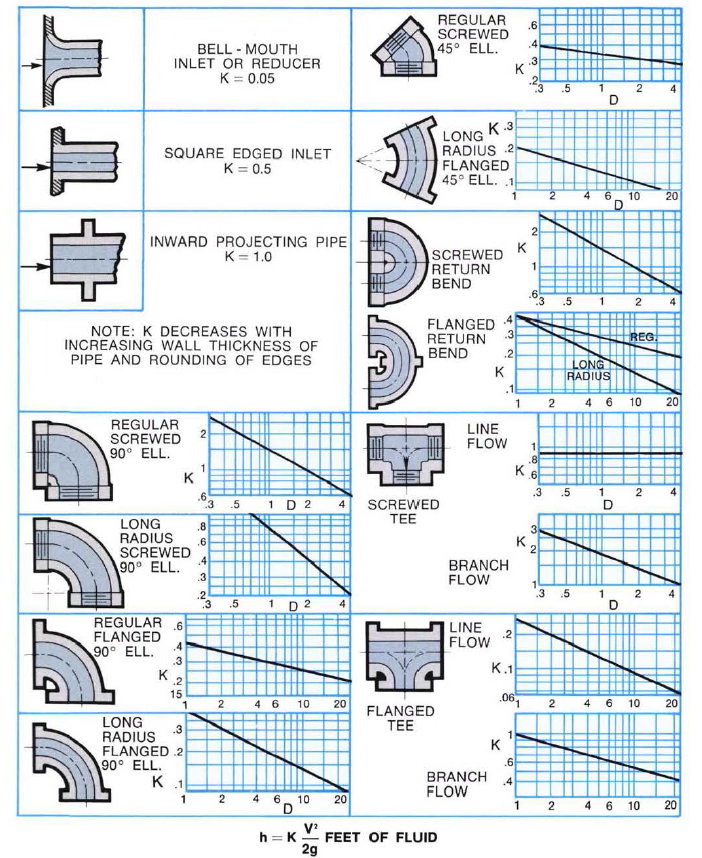
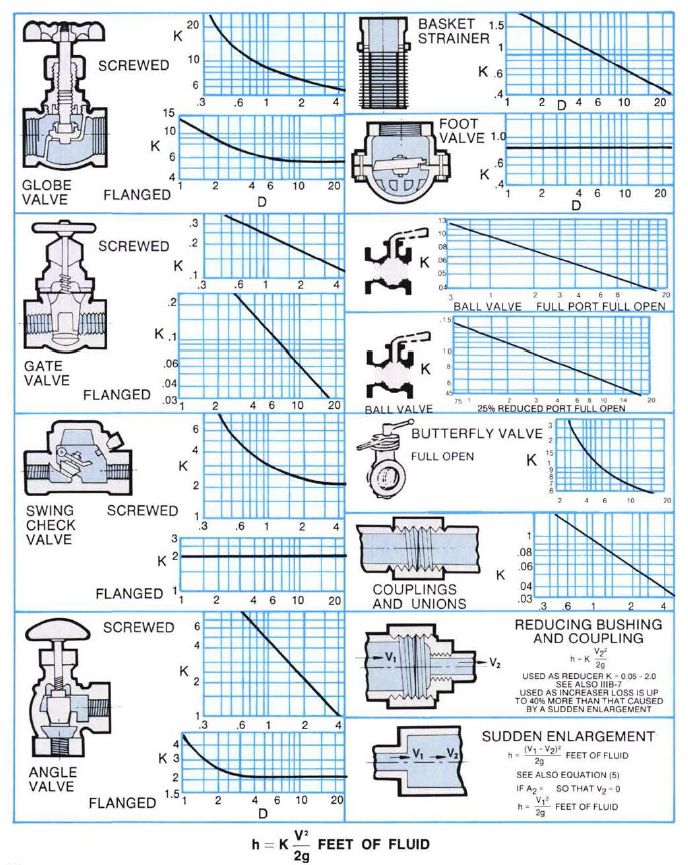
Published K values are estimates. They vary with nominal size, thread or flange construction, bend radius, Reynolds number, valve design, and valve opening. Use manufacturer data for a specific valve or fitting whenever available; partially closed control valves require operating-position data rather than a fully-open table value.
Worked example
At 500 gpm through a 6 in inside diameter, velocity is approximately 5.67 ft/s and velocity head is 0.500 ft. A standard 90-degree elbow represented by K = 0.9 therefore produces about 0.450 ft of head loss (0.137 m).