Short Answer
Key Formula / Key Facts Box
Liquid control-valve sizing equation (US customary):
Q = Cv × √(ΔP / SG)
Rearranged: Cv = Q √(SG / ΔP) and ΔP = SG (Q / Cv)2.
SI form: Q = Kv √(ΔP / SG), where Q is m³/h and ΔP is bar; Cv ≈ 1.156 Kv.

| Symbol | Meaning | US unit | SI unit |
|---|---|---|---|
| Q | Liquid flow rate | US gpm | m³/h |
| Cv | Valve flow coefficient (US) | gpm/psi0.5 | Equivalent Kv: m³/h/bar0.5 |
| SG | Specific gravity relative to water | dimensionless | dimensionless |
| ΔP | Pressure drop across valve (P1 – P2) | psi | bar |
Plain English: For water (SG ≈ 1), Cv = 1 passes about 1 US gpm with 1 psi across the valve; flow rises with the square root of pressure drop, not linearly.
Overview — What It Is and Why It Matters
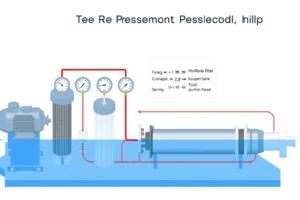
Control-valve Cv is a capacity index that converts a required flow and a valve pressure drop into a single hydraulic number. In a pump system, the valve is not an isolated orifice: the pump supplies head, piping and equipment consume head, and the control valve absorbs the remaining pressure difference needed to hold downstream pressure or flow. The phrase control valve Cv to pressure drop therefore describes a coupled calculation, not a one-way table lookup.
The scope here is single-phase, incompressible liquid sizing using the common ISA-style Cv equation, with a worked pump-system example in US customary and SI units. The valve pressure drop ΔP is always inlet pressure minus outlet pressure across the valve. If the valve is sized from the pump discharge pressure alone, or if the pump curve is ignored, the calculated Cv can be badly wrong. An undersized valve may fail to reach design flow; an oversized valve may run nearly closed, amplify disturbances, cavitate, or wear trim rapidly.
Cv matters because it connects three decisions: pump selection, pipe/equipment pressure-drop allocation, and control-loop stability. Manufacturer tables give rated Cv at full open, but the required Cv changes with flow and with the installed pump curve. Good practice checks Cv at maximum flow, minimum flow, and the normal operating point.
The Method — Derivation and Variants
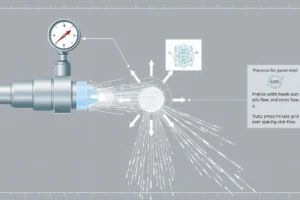
The Cv equation comes from the orifice relation Q = Cd A √(2ΔP/ρ). Rather than list Cd, area, and density separately, the valve industry absorbs them into an empirical coefficient. By definition, Cv is the number of US gallons per minute of water at about 60°F that passes through a valve in one minute at a pressure drop of 1 psi. That definition produces the working liquid equation:
Q = Cv √(ΔP / SG)
For sizing, rearrange to Cv = Q √(SG / ΔP). For predicting pressure drop at a known Cv, use ΔP = SG (Q / Cv)2. The US form uses Q in US gpm and ΔP in psi. The SI form uses Kv, defined as m³/h of water at 1 bar pressure drop: Q = Kv √(ΔP / SG), with Q in m³/h and ΔP in bar. The conversion is Cv ≈ 1.156 Kv or Kv ≈ 0.865 Cv.
| Variant | Equation | Units | When it applies |
|---|---|---|---|
| US Cv | Cv = Q √(SG / ΔP) | gpm, psi | North American vendor data and many legacy drawings |
| SI Kv | Kv = Q √(SG / ΔP) | m³/h, bar | Metric projects and IEC/ISO-style data sheets |
The basic equation assumes turbulent, single-phase liquid flow with no flashing or choked flow. Real sizing may apply a piping geometry factor Fp for reducers and fittings and a Reynolds number factor FR for viscous liquids; both are often taken as 1.0 for a first-pass water check. For pump systems, solve the valve equation together with the pump curve and system curve. The valve does not set ΔP independently: at each flow, ΔPvalve = Pdischarge – Pdownstream – ΔPline/equipment.
Worked Example
Scenario (US customary): A centrifugal pump supplies water at 60°F (SG = 1.0) to a process. At the maximum required flow of 200 gpm, the pump discharge pressure is 100 psig, and the control valve must hold the downstream pressure at 80 psig. Line losses are neglected for this first check; Fp = FR = 1.0; the liquid is non-flashing and non-cavitating.
Step 1 — valve pressure drop: ΔP = P1 – P2 = 100 – 80 = 20 psi.
Step 2 — required Cv: Cv = Q √(SG / ΔP) = 200 √(1.0 / 20) = 200 / 4.472 = 44.7, rounded to 45.
Step 3 — selection check: A valve with rated Cv near 45 at full open is a starting point; the designer must confirm actuator thrust, rangeability, and operation at turndown. From the pump curve in the source example, at 100 gpm the pump discharge rises to about 150 psig, so ΔP = 70 psi and required Cv = 100 √(1/70) = 12.0. At 50 gpm, discharge is about 170 psig, ΔP = 90 psi, and required Cv = 50 √(1/90) = 5.3. The valve must therefore have a rated Cv above 45 while still controlling at Cv values near 5 to 12.
Scenario (SI split): Convert the same maximum-flow case: Q = 200 gpm × 0.2271 = 45.4 m³/h; ΔP = 20 psi × 0.06895 = 1.379 bar. Required Kv = 45.4 √(1.0 / 1.379) = 38.7. Converting back, Cv = 1.156 × 38.7 = 44.7, matching the US result.
Second pressure-drop allocation: If a line restriction is added and only 4 psi is assigned across the valve at 200 gpm, the US calculation gives Cv = 200 √(1/4) = 100. In SI, 4 psi = 0.2758 bar, so Kv = 45.4 √(1/0.2758) = 86.5 and Cv = 1.156 × 86.5 = 100. This shows why the chosen valve pressure drop, not the pump pressure alone, controls the calculated Cv.
Calculator
Use a liquid Cv calculator that accepts US gpm and psi, or m³/h and bar, and returns Cv and Kv: Frictionless Calc — Liquid Valve Cv Worked Example. For pump-system head checks, compare the result with the pump curve and the allocated line/equipment pressure drops.
Reference Values & Typical Ranges
| Item | Typical guidance or value | Source basis |
|---|---|---|
| Cv definition | 1 US gpm of water at 1 psi drop | Gilman (2026); Frictionless Calc |
| Cv to Kv | Cv ≈ 1.156 Kv; Kv ≈ 0.865 Cv | Frictionless Calc |
| Screening valve ΔP | About one-third of total system ΔP at maximum flow | Gilman (2026) |
| Turndown check | 4:1 to 5:1 is a common control-valve sizing range | Gilman (2026) |
| Water SG | 1.00 at 60°F; 0.827 at 450°F | Gilman (2026) |
| Installed characteristic | Line restriction pulls linear trim toward quick-open and equal-percentage trim toward linear | Pro-Quip/Valtek (Source 1) |
- Use actual ΔP across the valve, not pump discharge pressure or total pump head.
- Check the valve at maximum, normal, and minimum flow; the required Cv falls as flow falls, but the pump head may rise.
- For viscous liquids, include FR; for reducers or expanders, include Fp; for flashing or cavitating service, use the appropriate ISA/IEC liquid sizing checks.
Application Guidance
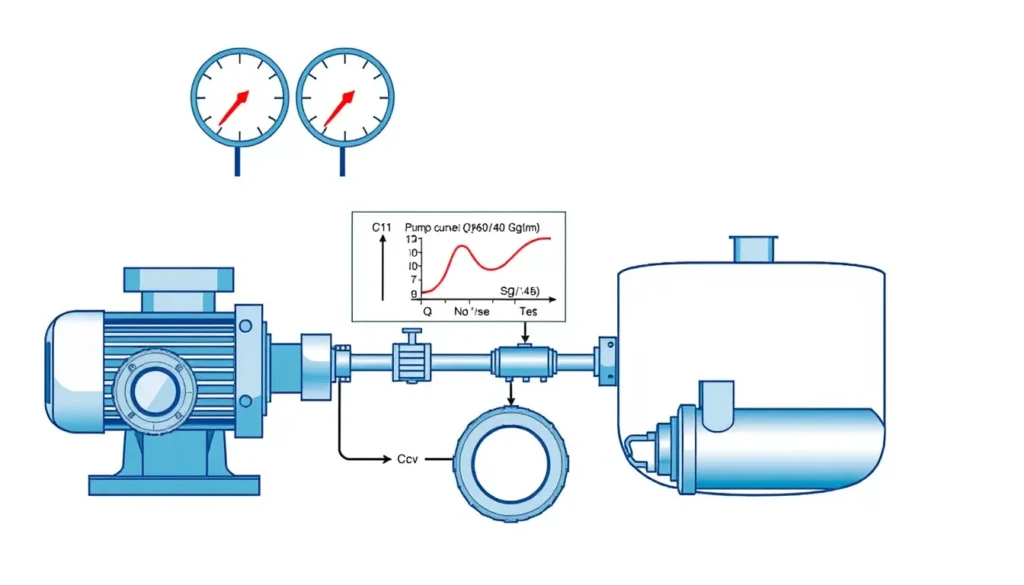
In a real pump system, the valve and pump share a single operating point. A throttling valve adds resistance; its Cv sets how much flow passes for a given valve ΔP, but that ΔP is itself a function of flow. Start with the pump curve, subtract fixed and variable system losses, and allocate the remaining pressure to the control valve. The allocation should leave enough valve ΔP at maximum flow for controllability, yet not so much that energy is wasted or cavitation risk rises. The common one-third rule is a screening tool, not a substitute for a full installed-characteristic check.
Valve trim choice matters. Linear trim tends to suit systems where valve ΔP is a large fraction of total system ΔP; equal-percentage trim is common in process control because it provides more stable gain as load falls. The installed characteristic can differ from the catalog inherent characteristic when line restriction is significant. Source 1 shows exactly this effect: with negligible line losses, the valve ΔP range is modest; with a line restriction, the pressure available across the valve changes and the installed curve shifts. Field judgment should also consider actuator stroke, fail-safe position, noise, flashing margin, and turndown. If the calculated Cv is very small compared with the selected valve’s rated Cv, consider a smaller body or reduced trim.
Common Mistakes, Limits & Safety Notes
- Mixing Cv and Kv: Using a Cv value in an SI equation without the 1.156 conversion gives a wrong capacity by about 16 percent.
- Using the wrong ΔP: Pump discharge pressure, total pump head, or system pressure drop is not the same as the pressure drop across the control valve.
- Sizing only at maximum flow: The minimum-flow and normal-flow points may require much lower Cv; an oversized valve can hunt or operate below its controllable range.
- Ignoring the pump curve: At lower flow, pump head often rises, increasing valve ΔP; the required Cv does not scale linearly with flow.
- Omitting Fp and FR: Reducers, expanders, and viscous liquids can shift the required Cv; first-pass water checks may not cover these effects.
- Using liquid Cv for gas or steam: Compressible flow, choked flow, and flashing/cavitation require different ISA/IEC equations and vendor software.
- Treating rated Cv as available at every lift: Rated Cv is a full-open capacity; actual capacity depends on trim characteristic and valve opening.
- Safety consequence: An undersized valve may fail to pass required flow or relief capacity; an oversized or cavitating valve can cause instability, trim damage, noise, and loss of downstream pressure control.
FAQ
How do you calculate Cv from flow and pressure drop?
For a liquid, use Cv = Q × sqrt(SG / ΔP), with Q in US gpm and ΔP in psi across the valve. For water SG = 1, 100 gpm at 16 psi gives Cv = 100 × sqrt(1/16) = 25. Always use valve inlet minus outlet pressure, not pump discharge pressure.
What is the difference between Cv and Kv?
Cv is the US capacity coefficient: US gpm of water at 1 psi. Kv is the SI version: m³/h of water at 1 bar. The numerical values differ by about 1.156; Cv ≈ 1.156 Kv. Never insert a Cv number into an SI equation without converting, because the unit basis is different.
How do I convert Cv to pressure drop?
Rearrange the liquid equation to ΔP = SG × (Q / Cv)². If Q is in gpm, Cv is US Cv, and SG is dimensionless, ΔP comes out in psi. For example, Q = 100 gpm and Cv = 25 give ΔP = 1 × (100/25)² = 16 psi. Check that the valve is not choked or cavitating.
What is a good pressure drop across a control valve?
A common screening rule is to allocate about one-third of the total system pressure drop to the control valve at maximum flow. That is not universal: low-pressure systems may need less, and high-authority loops may justify more. Confirm with the pump curve, installed characteristic, cavitation margin, and turndown rather than using a single percentage.
Does Cv change with valve opening?
Yes. Catalog Cv is usually the rated full-open capacity. At part lift, the effective Cv depends on the trim characteristic: linear, equal-percentage, or quick-open. The installed characteristic also depends on how valve pressure drop varies with flow. Size against the required Cv at the controlling flow, then verify that the selected trim provides stable gain over the expected range.
Can I use the liquid Cv equation for steam or gas?
No, not directly. Gases and steam are compressible, and sizing must account for specific volume, pressure ratio, choked flow, and expansion factors. Use the appropriate ISA/IEC gas or steam equations or vendor software. The liquid Cv equation is only a first-pass tool for single-phase incompressible liquids such as water and many process solutions.
What happens if a control valve is oversized?
An oversized valve may operate at low lift, where control is sensitive and unstable. It can hunt, wear trim, and provide poor turndown. It may also add unnecessary cost and, in severe cases, contribute to cavitation or noise because the required pressure drop is taken over a small opening. Check required Cv at minimum flow and consider reduced trim or a smaller body.
How do the pump curve and valve Cv interact?
The pump curve gives available head at each flow; the system and valve consume that head. At lower flow, pump head often rises, so valve ΔP can increase even though flow falls. Solve the valve equation with the pump and system curves to find the actual operating point. A valve sized only from a single max-flow pressure may not control well at turndown.
What units should I use in the Cv formula?
Use US gpm for Q, psi for ΔP, and dimensionless specific gravity for the US Cv equation. For SI, use m³/h for Q, bar for ΔP, and Kv; convert Cv to Kv with Cv ≈ 1.156 Kv. Mixing gpm with bar, or m³/h with psi, is a common source of large sizing errors.
Why is valve pressure drop not equal to pump pressure?
Pump discharge pressure is shared by the valve, piping, fittings, heat exchangers, filters, and downstream pressure requirements. The valve only sees its inlet minus outlet pressure. If you use full pump pressure as valve ΔP, the calculated Cv will be too small and the selected valve may be undersized. Always subtract line and equipment losses.
Leave a Reply