Short Answer
Key Formula / Key Facts Box
Governing selection check: TDH = Hstatic + hf + hm + Hp. A pump can satisfy this equation and still fail if its solids-passing or grinding capability does not match the debris in the wet well.
| Symbol | Meaning | US unit | SI unit |
|---|---|---|---|
| TDH | Total dynamic head required at the duty flow | ft | m |
| Hstatic | Vertical lift from wet-well low level to discharge elevation | ft | m |
| hf | Friction head loss in pipe and fittings | ft | m |
| hm | Minor losses from valves, bends, and entrance or exit | ft | m |
| Hp | Equivalent pressure head at the discharge point | ft | m |
Plain-English restatement: Add the lift, pipe friction, fitting losses, and any pressure at the receiving main; then verify the selected grinder or solids-handling pump can pass or reduce the expected solids at that duty point.
| Key fact | Grinder pump | Non-grinder solids-handling pump |
|---|---|---|
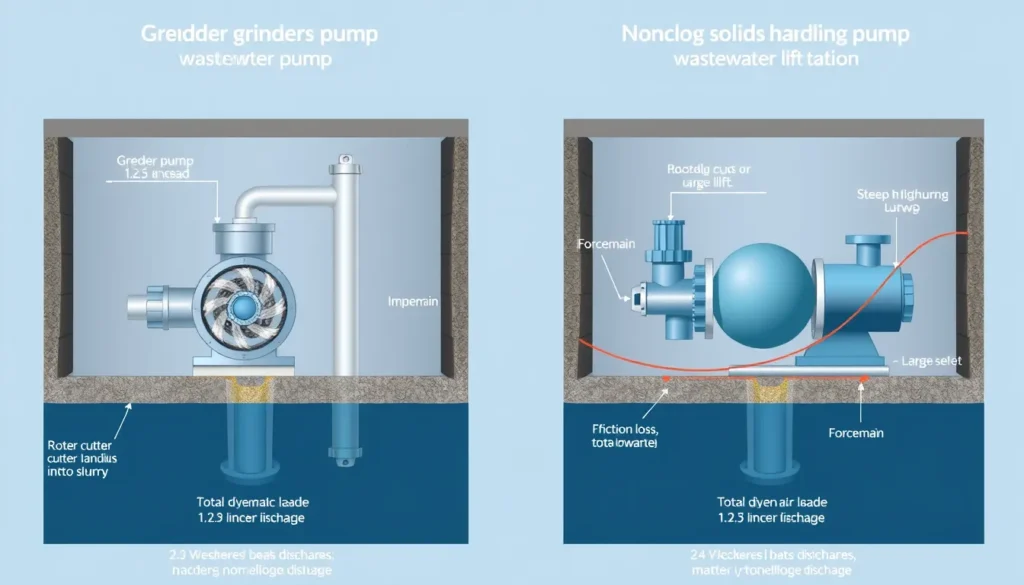
| Primary strategy | Grind or cut solids into a slurry | Pass solids through a large clear passage or vortex |
| Typical small-station duty | Higher head, lower flow; common 1 to 5 HP range | Higher flow, lower head; common 0.4 to 2 HP ejector range |
| Common discharge | About 1.25 to 2 in | About 2 in and larger; pass up to 2 to 3 in sphere depending design |
| Efficiency signal | Low, often about 20 to 40% | Varies; vortex about 30 to 50%, conventional non-clog about 50 to 70% |
| Good fit | Long forcemain, pressurized sewer, wipes, small pipe | Short forcemain, gravity sewer, septic tank, low-head high-flow service |
| Main caution | Avoid conventional septic tank and low-head commercial grinder misapplication | Clog risk with wipes, rags, grease, and oversized debris |
Overview — What It Is and Why It Matters
Small lift stations collect wastewater from homes, restaurants, schools, small commercial buildings, or isolated municipal services and pump it to a gravity sewer, septic system, or pressurized main. In this article, solids-handling pump is used in the common lift-station sense: a non-grinder wastewater pump, such as a sewage ejector with a non-clog, vortex, or open impeller that passes solids. Grinder pumps are technically solids-handling too, but here they are the contrasting technology: pumps that deliberately reduce solids before pumping.
A grinder pump uses rotating cutter or grinder elements near the suction to macerate wipes, fibrous material, and sanitary solids into a slurry. That action permits smaller discharge piping and higher pressure capability, which is why grinders are associated with long forcemains, pressurized sewer mains, and small lift stations where the waste stream is unpredictable. The tradeoff is lower hydraulic efficiency, more mechanical complexity, and greater sensitivity to low-head operation in some commercial designs.

A non-grinder solids-handling pump relies on a large clear passage, a vortex action, or an open impeller to pass debris without intentionally macerating it. These pumps are often high-flow, lower-head machines with better hydraulic efficiency and fewer cutting components, but they are more vulnerable to clogging when wipes, rags, grease, and fibrous solids become excessive. The consequence of choosing poorly is not merely a clogged pump: repeated binding can damage motors, overload protection can trip, wet wells overflow, maintenance crews face confined-space entries, and grinder slurry can harm conventional septic systems.
The Method — Derivation and Variants
Pump selection begins with the system head curve. From the energy equation for an incompressible fluid, the required total dynamic head is the sum of static lift, friction loss, minor losses, and any equivalent pressure head at the discharge point. In US customary form, pressure is conveniently converted with 2.31 ft of water per psi at specific gravity 1.0. In SI form, pressure in kPa is divided by 9.81 times specific gravity to obtain metres of head.
| Item | US customary form | SI form |
|---|---|---|
| Total dynamic head | TDH(ft) = Hstatic + hf + hm + 2.31 p(psi)/SG | TDH(m) = Hstatic + hf + hm + p(kPa)/(9.81 SG) |
| Flow conversion | 1 gpm = 0.0631 L/s | 1 L/s = 15.85 gpm |
| Head-pressure conversion | 1 psi ≈ 2.31 ft of water | 1 bar ≈ 10.2 m of water; 1 kPa ≈ 0.102 m of water |
| Shaft power estimate | P(hp) ≈ Q(gpm) TDH(ft) SG / (3960 eta) | P(kW) ≈ rho g Q(m³/s) H(m) / (1000 eta) |
The two variants are algebraically identical; the choice is a unit convention, not a different physical method. The constants matter: a 5 psi receiving pressure adds about 11.6 ft or 3.5 m of head, which can change pump selection in a small station. Friction depends strongly on flow, pipe diameter, fittings, and internal roughness. A grinder typically uses a smaller discharge, so friction rises faster with flow and the pump curve tends to be steep and high-head. A non-grinder solids-handling pump often uses a larger discharge and a flatter high-flow curve, but the selected impeller must still provide the required ball pass and clog resistance.
For either variant, the duty point is the intersection of the system curve and the pump curve. The selected pump must also satisfy solids capability, minimum submergence or cooling requirements, starting torque, electrical limitations, and maintenance access. Grinder efficiency commonly falls in the 20 to 40% range; chopper impellers are often about 40 to 60%; conventional non-clog impellers about 50 to 70%; and vortex impellers about 30 to 50%. Those values are selection signals, not guarantees for a specific model.
Worked Example
US customary example. A small mixed-use lift station must pump 60 gpm to a nearby pressurized sewer. Assumptions: static lift Hstatic = 22 ft; friction loss hf = 18 ft at 60 gpm; minor losses hm = 3 ft; discharge pressure p = 5 psi; specific gravity SG = 1.0. Step 1: convert pressure to head, Hp = 2.31 × 5 = 11.6 ft. Step 2: substitute, TDH = 22 + 18 + 3 + 11.6 = 54.6 ft. Step 3: express as pressure, 54.6 / 2.31 ≈ 23.6 psi. The station requires about 54.6 ft of head at 60 gpm. A grinder may be favored if wipes and long-term clog risk dominate, but the selected model must show 60 gpm at 54.6 ft on its curve and must not be a commercial grinder misapplied below its minimum-head requirement. A non-grinder solids-handling pump may be acceptable if the debris is manageable and the impeller has adequate ball pass.
SI example. A small facility pumps 2.5 L/s (about 40 gpm) through a 63 mm forcemain. Assumptions: static lift Hstatic = 6.5 m; friction loss hf = 3.8 m; minor losses hm = 0.5 m; discharge pressure p = 0.30 bar = 30 kPa; SG = 1.0. Step 1: Hp = 30 / 9.81 = 3.06 m. Step 2: TDH = 6.5 + 3.8 + 0.5 + 3.06 = 13.86 m. Step 3: pressure equivalent = 13.86 × 9.81 ≈ 136 kPa, or 1.36 bar. The duty is about 13.9 m at 2.5 L/s. Because this is a relatively low-head, modest-flow station, a non-grinder solids-handling pump may be the better lifecycle choice unless the waste stream contains wipes or the receiving main is pressurized. If a grinder is selected, confirm it is a low-head residential or light-commercial variant rather than a high-head commercial grinder that needs 20 to 30 ft of minimum head.
Calculator
Use an online total dynamic head calculator such as pumpcalcs.com total dynamic head calculator to combine static lift, friction, minor losses, and discharge pressure. Convert pressure to head before entering it, and use the same unit system throughout. The calculator gives the hydraulic duty; it does not replace a solids-handling review or a manufacturer pump-curve check.
Reference Values & Typical Ranges
| Property | Grinder pump | Non-grinder solids-handling pump |
|---|---|---|
| Typical small-station discharge | About 1.25 to 2 in | About 2 in and larger; conventional non-clog may be specified for a 3 in sphere |
| Solids strategy | Grinds or cuts solids into slurry; most controlled discharge particle size | Passes solids through clear passage or vortex; ball pass is a key specification |
| Typical flow and head | Higher head, lower flow; many 2 HP commercial units around 30 gpm or less, while 1 to 5 HP grinders may cover roughly 20 to 120 gpm depending on head | Higher flow, lower head; 2 in ejector examples up to about 220 gpm and nearly 75 ft of head |
| Common pressure capability | Common 2 HP grinder examples up to about 130 ft of head or nearly 60 psi | Often suited to shorter runs under about 750 ft in residential ejector service |
| Efficiency range | About 20 to 40% | Vortex about 30 to 50%; conventional non-clog about 50 to 70% |
| Best-fit applications | Long forcemain, pressurized city sewer, wipes, small discharge pipe, controlled slurry | Septic tank, gravity sewer, short forcemain, low-head and high-flow service |
Sources for these ranges include Pumps and Systems, Septic Solutions, Taylor Made Pump Stations, the Stanley Consultants white paper, and HPAC Magazine. Rules of thumb: a 2 in sewage ejector commonly ranges from 0.4 to 2 HP, while grinder pumps often start at 1 HP for residential or light commercial service and move to 2 HP and above for commercial duty. Some 2 HP commercial grinders require roughly 20 to 30 ft of minimum head; residential grinder exceptions may be designed for low-head replacement of ejector pumps. Grinders should not be used ahead of a conventional septic tank unless the system is specifically designed to handle fine slurry.
Application Guidance
In a small lift station, the pump choice should follow the waste stream first and the head calculation second, because a hydraulically correct pump can still be a maintenance failure. Grinders are strongest where the operator cannot control what is flushed: rental suites, restaurants, schools, corrections facilities, marinas, and small stations feeding long or pressurized forcemains. They reduce clogging from wipes and fibrous material and allow smaller discharge piping, but they consume more power per volume, require sharp cutting components, and can produce a slurry that harms conventional septic separation.
Non-grinder solids-handling pumps are strongest where flow is high, head is low, piping is short, and the receiving system is a gravity sewer or septic tank. A vortex impeller can pass large solids with less clogging but at lower efficiency; a conventional non-clog impeller is more efficient but more susceptible to fibrous clogging; a chopper or cutter pump may be appropriate for severe rag and grease service. The selected pump must match the actual ball pass to the debris, maintain adequate velocity in the forcemain, avoid low-flow overheating, and provide reliable starting torque. Field judgment should include wet-well cycling, minimum submergence, motor cooling, alarm and redundancy strategy, and lifecycle cost rather than first-cost alone.
Common Mistakes, Limits & Safety Notes
- Assuming a grinder pump is always the better choice. Grinders are not automatically superior in low-head, high-flow, short-run service, and some commercial grinders fail prematurely when applied below their minimum-head requirement.
- Using a grinder ahead of a conventional septic tank. Fine slurry can pass through the tank and damage the drainfield; use a grinder only where the downstream system is designed for it.
- Comparing horsepower instead of pump curves. Two pumps with the same HP can have very different flow, head, efficiency, and solids capability.
- Ignoring discharge pipe size and friction. Grinders often use smaller pipe, which raises friction; a larger solids-handling pump may reduce friction but still clog on wipes.
- Treating non-clog as meaning never clogs. Ball pass, impeller style, grease, and rag loading all affect clog risk.
- Forgetting minimum head, minimum flow, or motor cooling requirements. Low-head operation can overheat or overload some grinder motors.
- Neglecting starting torque and binding risk, especially with low-horsepower grinders in debris-heavy service.
- Overlooking safety and maintenance limits: confined-space entry, electrical lockout, gas detection, wet-well fall protection, and safe lifting of submersible pumps must be planned before the first service call.
The TDH equation is a hydraulic tool, not a solids-handling model. Manufacturer curves are usually based on clear water, and real wastewater may contain debris, grease, and fibers that alter reliability even when the calculated duty point looks correct. Use the calculation to narrow the selection, then confirm with the pump curve, solids specification, application experience, and safety review.
FAQ
Should I use a grinder pump or a regular sewage ejector pump for a small lift station?
Use a grinder when the waste stream is unpredictable, wipes and fibrous debris are likely, the forcemain is long, or the receiving main is pressurized. Use a non-grinder solids-handling ejector for shorter runs, low-head high-flow service, gravity sewers, and septic tanks. Always check the pump curve, ball pass, and minimum operating requirements.
Can a grinder pump be used to pump into a septic tank?
Generally no. A grinder reduces sewage into a fine slurry that may not separate properly in a conventional septic tank, allowing solids to carry into the drainfield. Use a sewage ejector for septic tank service unless the downstream system is specifically designed for grinder slurry.
Do grinder pumps need a minimum head pressure?
Some commercial 2 HP and larger grinder pumps require roughly 20 to 30 feet of minimum head to avoid running too far out on the curve, overheating, or drawing excessive current. Residential grinder exceptions are available for low-head replacement of ejector pumps, so verify the specific model.
What size discharge pipe does a grinder pump use?
Many small grinder pumps use about 1.25-inch to 2-inch discharge piping. Smaller pipe allows a compact forcemain but increases friction, so the pump curve must be checked against the actual pipe length, fittings, static lift, and receiving pressure.
Are solids-handling pumps the same as grinder pumps?
No. Grinder pumps are a specialized type of solids-handling pump. In lift-station practice, solids-handling often refers to non-grinder pumps such as sewage ejectors, vortex pumps, or non-clog impeller pumps that pass solids rather than intentionally grinding them into slurry.
How long can a small lift station forcemain be?
Residential ejector pumps are commonly applied to shorter runs under about 750 feet, while grinder pumps can push slurry over much longer distances because they are higher-pressure, lower-flow machines. The final limit is the pump curve, pipe diameter, friction, static lift, and receiving pressure.
Why do grinder pumps have lower efficiency?
Grinder pumps expend energy in cutting and macerating solids and often use small discharge passages and high-head impellers. Their hydraulic efficiency is commonly about 20 to 40 percent, compared with higher values for conventional non-clog impellers, but they may reduce clogging and maintenance in difficult service.
What causes a grinder pump to bind or clog?
Binding can result from low starting torque, excessive debris, low-head operation, worn cutters, or improper impeller clearance. Clogs may occur from oversized solids, grease, rags, or foreign objects. Correct sizing, adequate torque, maintenance, and a waste-stream review reduce these risks.
Leave a Reply