Short Answer
Key Formula / Key Facts Box
Governing relationship: life-cycle cost of a long discharge pipeline.
CLCC = Cpipe(D)L · CRF + [ρgQ(Hs + Hf(D)) / (ηpηm)] · t · ce
Hf = f(L/D)(v2/2g), and v = 4Q/(πD2)
Symbol Meaning US unit SI unit CLCC Life-cycle cost, annualized or present value $ $ Cpipe(D) Installed pipe cost per unit length $/ft $/m L Discharge pipeline length ft m D Internal pipe diameter ft or in m or mm Q Volumetric flow rate gpm or ft³/s m³/s or L/s Hs Static head, including elevation and pressure head ft m Hf Friction head loss ft m f Darcy-Weisbach friction factor dimensionless dimensionless ηp, ηm Pump and motor efficiency dimensionless dimensionless t Annual operating hours h/yr h/yr ce Electricity price $/kWh $/kWh CRF Capital recovery factor dimensionless dimensionless Plain-English restatement: The best long-pipeline diameter is the one that minimizes the sum of annualized pipe and installation cost plus lifetime pumping-energy cost while respecting velocity, pressure, and reliability limits.
Overview — What It Is and Why It Matters
In this article, a long discharge pipeline means the pressurized line downstream of a pump, from the pump discharge flange to the final delivery point, where line length is great enough that friction head and pipe capital cost materially affect the pump duty. Suction lines, short headers, and internal process piping are outside the main scope, although the same equations apply to them.
A long discharge line behaves as a hydraulic resistor whose resistance falls sharply as diameter increases. For a fixed flow rate, friction head loss is approximately proportional to 1/D5 in fully turbulent flow. Doubling pipe diameter therefore reduces friction head by roughly a factor of 32, but the pipe itself costs more per metre and may require larger fittings, valves, foundations, and installation effort. The engineering task is not to choose the largest or smallest pipe; it is to find the diameter that minimizes life-cycle cost while meeting velocity, pressure, erosion, surge, and reliability constraints.
This balance matters because pumping systems are major energy users. The U.S. Department of Energy notes that pumping systems can account for about 16% of a typical industrial facility’s electricity costs, and Hodgson reports that pumping systems account for about 20% of world energy usage. Oversizing pipe wastes capital; undersizing pipe can waste energy for decades, force a larger pump and motor, increase noise and vibration, accelerate erosion, and raise water-hammer risk. Sizing a discharge line to match the pump flange, a common field rule, is not an economic design method and can be costly in long lines.
The Method — Derivation and Variants
For steady incompressible flow, the total head required at the pump is the static head plus friction and minor losses plus any required delivery pressure head. In a long discharge line, friction usually dominates the variable portion. The Darcy-Weisbach equation gives friction head, and minor losses from fittings and valves are added as Kv2/(2g). The friction factor f depends on Reynolds number and relative roughness and is commonly obtained from the Colebrook equation or the explicit Swamee-Jain approximation.

| Quantity | US customary form | SI form |
|---|---|---|
| Velocity | v = 0.4085 Qgpm / Din2 | v = 4Q/(πD2) |
| Friction head | Hf = f(L/D)(v2/2g), g = 32.2 ft/s² | Hf = f(L/D)(v2/2g), g = 9.81 m/s² |
| Pump power | hp = QgpmHftSG / (3960ηpηm) | kW = ρgQH/(1000ηpηm) |
| Annual energy cost | $ = hp × 0.746 × t × ce | $ = kW × t × ce |
| Capital recovery factor | CRF = i(1+i)n/[(1+i)n−1] | CRF = i(1+i)n/[(1+i)n−1] |
The 3960 constant in US units combines unit conversions for gallons per minute, feet of head, specific gravity, and horsepower. In SI, for water at standard density, the hydraulic power is approximately 9.81Qm³/sHm kilowatts before dividing by pump and motor efficiency. For other fluids, replace water density with the actual density or use specific gravity consistently.
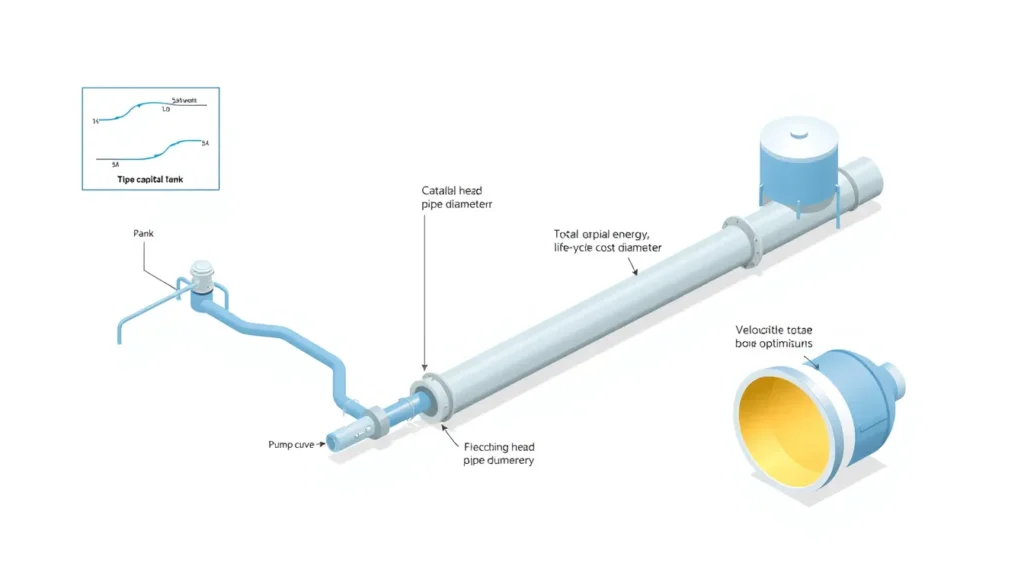
Economic pipe sizing compares at least two diameters. For each candidate, calculate velocity, friction head, total head, pump power, annual energy cost, pipe and installation cost, and present value or annualized cost. The capital recovery factor converts a present capital cost into an equivalent annual cost over the project life at a chosen discount rate. The variant for friction-dominated lines is most sensitive to diameter; static-dominated lines, such as high-lift mine dewatering or long rising mains with large elevation change, show less energy sensitivity but still require velocity and pressure checks. Variable-speed pump systems require the analysis to be checked across the expected flow range, not only at one duty point.
Worked Example
SI example — 5 km water discharge line. A pump delivers Q = 0.100 m³/s (100 L/s, 360 m³/h) through L = 5,000 m of steel pipe. Static head is Hs = 80 m. Assume f = 0.020, pump efficiency ηp = 0.72, motor efficiency ηm = 0.94, 6,000 operating hours per year, and electricity at $0.15/kWh. Compare DN200 and DN250 internal diameters.
For D = 0.20 m: area = 0.03142 m², v = 0.100/0.03142 = 3.18 m/s, velocity head = 3.18²/(2×9.81) = 0.516 m. Hf = 0.020×(5,000/0.20)×0.516 = 258 m. Total head = 80 + 258 = 338 m. Hydraulic power = 1,000×9.81×0.100×338 = 331.6 kW. Input power = 331.6/(0.72×0.94) = 490.0 kW. Annual energy cost = 490.0×6,000×0.15 = $441,000/yr.
For D = 0.25 m: area = 0.04909 m², v = 2.04 m/s, velocity head = 0.211 m. Hf = 0.020×(5,000/0.25)×0.211 = 84.6 m. Total head = 164.6 m. Hydraulic power = 161.5 kW. Input power = 238.6 kW. Annual energy cost = 238.6×6,000×0.15 = $214,740/yr. The larger pipe saves about $226,260/yr in energy, but it also exceeds the very low velocity target if the line is treated as a long transmission main only for DN250? In fact DN200 at 3.18 m/s is already above the common long-pipeline guidance of ≤1.5 m/s. If the incremental installed cost for DN250 is $300/m, or $1.5 million, the simple payback is about 1.5 million/226,260 = 6.6 years before discounting. A 20-year present-value analysis would normally favor the larger pipe if hydraulic and surge checks are satisfactory.
US example — 10,000 ft, 600 gpm line. A DOE pumping-system tip sheet evaluates 10,000 ft of pipe carrying 600 gpm. Using its Figure 1, annual friction-only pumping cost is about $16,900 for 6-in pipe, $4,250 for 8-in pipe, and $1,400 for 10-in pipe under the stated assumptions. The 6-in to 8-in step therefore saves about $12,650/yr in friction energy. A simplified check with f = 0.020 shows why: at 600 gpm in 6-in pipe, v = 6.8 ft/s and Hf ≈ 288 ft; in 8-in pipe, v = 3.8 ft/s and Hf ≈ 68 ft. The friction-head reduction is about 220 ft, which is a large and recurring energy saving.
Calculator
For a quick check of friction and static head, use the pumpcalcs.com total dynamic head calculator. Enter flow, pipe internal diameter, length, roughness or friction factor, fittings, and static lift to estimate total dynamic head. Use the result as an input to an economic pipe-sizing or life-cycle cost spreadsheet that compares at least two pipe diameters.
Reference Values & Typical Ranges
| Parameter | Typical range or rule | Practical note and source |
|---|---|---|
| Clean-water discharge velocity | 1.5–3.0 m/s (5–10 ft/s) | Common pump discharge range; higher values raise friction and erosion risk [5]. |
| Long-pipeline velocity target | ≤1.5 m/s (≤5 ft/s) | Recommended to reduce friction losses in long lines [5]. |
| Wastewater and slurry velocity | ≤2.0 m/s; keep above about 1.2 m/s where settling matters | Limit abrasion while avoiding solids deposition [5]. |
| Friction factor, clean commercial pipe | About 0.01–0.03 | Verify with Reynolds number and relative roughness; do not treat as universal [5]. |
| Pump efficiency | About 50–85% for many rotodynamic pumps | Actual value depends on specific speed, size, and duty point. |
| Motor efficiency | About 90–96% for modern industrial motors | Use manufacturer data for life-cycle cost. |
| Pumping energy share | About 20% of world energy; about 16% of facility electricity | Pumping-system optimization has large economic and environmental leverage [2][3]. |
| Water-project economic life | Commonly 20–40 years | Use owner discount rate and residual value; Viadux examples use 40 years [4]. |
Application Guidance
Start by classifying the system as static-dominated or friction-dominated. In a static-dominated line, most pump head is elevation or delivery pressure, so increasing pipe diameter may reduce friction energy only modestly; the decision may be driven by capital cost, velocity limits, and surge. In a friction-dominated long line, pipe diameter is a primary energy decision and should be evaluated over the full project life. The DOE recommends computing annual and life-cycle costs before making an engineering design decision and, in friction-dominated systems, evaluating pumping costs for at least two pipe sizes.
Check both the normal duty point and the maximum expected flow. A line that looks acceptable at average flow may exceed velocity limits during peak demand or pump runout. For variable-speed pumps, confirm that the selected diameter remains suitable across the operating range, because lower flow reduces friction head but can create low-velocity settling in slurry service. Keep fittings, valves, and bends to a minimum; use long-radius bends where practical; provide air release at high points and vacuum relief where needed; and confirm that pipe pressure class exceeds pump shut-off head plus surge allowance. In long lines, surge analysis is not optional when valve closures, check valves, or sudden pump trips can generate water hammer.
Common Mistakes, Limits & Safety Notes
- Sizing discharge pipe to the pump flange. The flange is a connection size, not an economic optimum. Long lines often justify a larger diameter or, less commonly, a smaller one after full life-cycle analysis.
- Ignoring energy cost. Comparing only pipe purchase price can hide decades of pumping cost. Use annual energy cost and present value.
- Using nominal diameter instead of internal diameter. Wall thickness, lining, and material class change the bore and therefore velocity and friction.
- Mixing US and SI units. Do not combine gpm with metres, or kW with feet without conversion. Check the 3960 and 9.81 constants.
- Forgetting minor losses. Valves, strainers, check valves, elbows, and reducers can add significant head in compact stations and at the pump discharge.
- Applying one velocity rule to every fluid. Clean water, slurry, wastewater, and high-pressure systems have different erosion, settling, and noise limits.
- Using a single friction factor without checking Reynolds number. Laminar, transitional, and rough-pipe flow behave differently; verify with Colebrook or a recognized explicit approximation.
- Neglecting surge and pressure transients. Fast valve closure or pump trip can produce pressures far above normal operating head and damage pipe or fittings.
- Omitting air release and drainage provisions. Air pockets raise head, cause erratic flow, and can promote corrosion or cavitation at high points.
- Treating the calculated optimum as final without constructability review. Availability, trenching, crossings, permits, thrust restraint, and maintenance access can change the practical choice.
FAQ
Should I size a long discharge pipe to match the pump flange?
Usually no. The pump flange is a connection size, not an economic optimum. In long lines, a larger pipe often reduces friction enough to pay back its extra capital cost through lower energy use. Evaluate at least two diameters using life-cycle cost while checking velocity, pressure rating, and surge.
How does pipe diameter affect pumping energy?
For a fixed flow rate, friction head falls sharply as diameter increases, roughly in proportion to 1/D^5 in turbulent flow. A larger pipe therefore lowers pump head and energy, but it costs more to buy and install. The economic optimum balances those two costs over the project life.
What is a good velocity for a long discharge pipeline?
For clean water, discharge velocities of about 1.5–3.0 m/s are common, but long transmission mains are often kept at or below about 1.5 m/s to reduce friction. Slurry and wastewater lines have different limits, often below 2.0 m/s with a minimum scour velocity to prevent settling.
How do I calculate annual pumping cost?
Calculate pump input power in kW, multiply by annual operating hours and electricity price. In US units, convert brake horsepower to kW by multiplying by 0.746. Include pump and motor efficiency and use the actual operating duty profile rather than a single rated point.
Is a larger pipe always the better choice?
No. Larger pipe reduces friction, but it raises material, installation, and fitting costs and may create very low velocities. The best choice is the diameter with the lowest life-cycle cost that also satisfies velocity, pressure, surge, constructability, and maintenance requirements.
How are fittings included in discharge pipe sizing?
Fittings and valves add minor losses, usually calculated as K times velocity head, v²/2g. Sum the K values or convert them to equivalent length and add to straight-pipe friction. In compact pump stations, minor losses can be a significant part of total head.
Does variable-speed pumping change the economic pipe size?
Yes. Variable-speed operation changes flow and head across the operating range. The pipe must suit peak flow for velocity and pressure, and low-flow periods for settling or minimum velocity. Check energy and surge across the expected duty profile, not only at one design point.
What safety issues matter in long discharge pipelines?
Pressure transients, water hammer, overpressure, air pockets, and thrust loads are key safety issues. Confirm pipe and fittings exceed shut-off head plus surge allowance, provide air release and vacuum relief, restrain bends, and perform surge analysis where fast valve closure or pump trip is possible.
Leave a Reply